
3D industrial animation for deep tech companies
What industrial animation is for, when 3D is the wrong answer, what a CAD file gives a studio, and what makes a render accurate rather than impressive.

- 3D earns its cost when physical depth, structure or movement have to appear accurately on screen. When depth does not carry the explanation, 2D motion is clearer and cheaper.
- Your CAD file is engineering geometry, not a film asset. It is where modelling starts, not something that can be dropped into a render.
- The order is model, lookdev, animate, light, render. Facts are reviewed before animation, because a correction after animation costs a re-render.
- A render that is beautiful and wrong is worse than a diagram, because the people watching already know what the machine does.
Industrial animation is the part of deep tech marketing most likely to be bought for the wrong reason. It looks impressive in a portfolio, it is expensive enough to feel serious, and it is very easy to commission a film that is technically gorgeous and explains nothing.
This is what it is actually for, and when it is the wrong answer.
What is 3D industrial animation actually for?
Showing a mechanism that cannot be filmed.
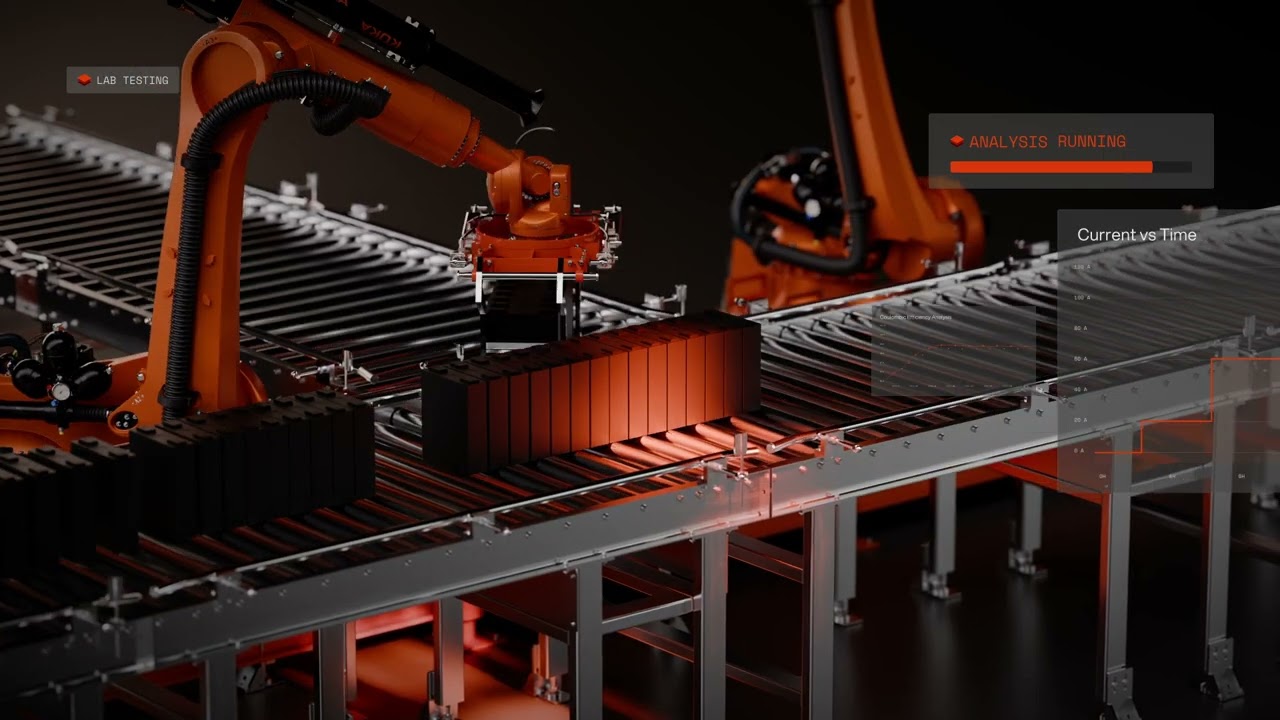
That is the whole case. A camera cannot go inside a sealed reactor, a retimer, a battery pack mid-cycle or a manhole with a robot in it. If the thing that makes you different happens somewhere a lens cannot reach, 3D is not a stylistic preference, it is the only way to show it.
Everything else that gets called industrial animation is usually a product render with a slow camera move, which is a different and much cheaper thing. Worth knowing which one you are buying.
The useful test: if a competent engineer could explain your advantage with a whiteboard and two minutes, you may not need 3D at all. If they would need to draw a cross-section, you probably do.
When is 3D the wrong answer?
When depth is not carrying the explanation.
A great deal of deep tech is not spatial. If the argument is that the industry is optimising the wrong variable, or that your architecture removes a step everyone else needs, that is a diagram. Rendering it in three dimensions adds cost, adds weeks, and makes it harder to read, because the viewer now has to parse perspective on top of the idea.
Half of deep tech motion is diagrams of systems. Data flow, protocol, architecture, state. Those are 2D problems, and a motion designer who can read the system will produce something clearer than a photoreal render of a server rack.
Choosing 3D in the brief, before the script exists, is choosing the answer before the question. It is the most common and most expensive mistake in this category.
Can you animate hardware that does not exist yet?
Yes, and it is a normal request.
Most deep tech companies need to show a product before it is manufacturable, before it is fabbed, or while it is still under NDA. We model from mechanical drawings, from layout, or from a sketch and a conversation with the engineer who is designing it.
What that requires is access to the person who knows the geometry, not a finished part. The constraint is never that the hardware is unbuilt. It is whether anyone can answer questions about tolerance, motion range, material and assembly order while the model is being built.
What does your CAD file actually give us?
Less than most people expect, and that is not a complaint about your CAD.
Engineering geometry is built to be manufactured. It carries every fastener, every internal boss, every fillet, at a density no renderer needs and no viewer will ever see. Dropped into a film it is heavy, badly topologised for animation, and usually missing the thing a film needs most, which is a clear read of what matters.
So CAD is the reference, not the asset. It settles proportion, mechanism and assembly order, and it removes the guesswork that makes renders quietly wrong. Then the model gets rebuilt for animation, at the density the shot needs.
The practical consequence: send the CAD early. It shortens the modelling stage and it is the cheapest accuracy insurance available. Just do not expect it to be dropped into a timeline.
What is the pipeline, and where does the risk sit?
Model from your CAD or spec, then lookdev, then animation, then lighting and render.
The risk is concentrated at the front. Modelling and lookdev decisions are cheap to change and expensive to change later, which is the same shape as every other production problem and is why the review sits before animation rather than after it.
Most people only see the final render. They do not see the forty versions before it.
That is Vignesh, who leads 3D here and is a mechanical engineer by degree. The forty versions are not indecision. They are the process of getting a mechanism to read correctly at the size and speed it will actually be watched at.
What makes a render accurate rather than impressive?
Someone qualified reads it before it is animated, and the studio is willing to lose the pretty shot.
Accuracy in industrial animation is not mainly about resolution or materials. It is about whether the motion is right. Whether the arm reaches in the order it actually reaches. Whether the cell fills the way it actually fills. Whether the part is where it would be at that point in the cycle. Those are the details a specialist audience checks without meaning to, and the ones a generalist studio has no way to get right.
An error found in the model costs an afternoon. The same error found after animation costs a re-render. Found after delivery, at a trade show, in front of people who build this for a living, it costs the credibility of everything else in the film.
The house rule is on every category page for a reason: modelled from CAD and animated to explain rather than to impress.
Should the 3D live in a film or on the page?
Both are real options and they have different failure modes.
A film is linear and controlled. You decide the order, the pace and what is emphasised, and it plays the same way everywhere.
Browser-based 3D is interactive, and a scroll-driven hero sequence or a configurator lets a buyer explore the thing themselves. The catch is performance. A scene that is effortless on the workstation it was built on can stutter badly on a mid-range laptop in a procurement office, and that is a profiling and memory problem before it is a design one. If nobody on the team is measuring frame budget, browser 3D is a risk rather than a feature.
Deciding this early matters, because it changes how the model is built.
What drives the cost?
Shot count, mechanism complexity and how much has to move.
A static exploded view of a device is not expensive. A full assembly cell with multiple articulated machines, a workpiece changing state and readable overlays is, because every additional moving element multiplies the animation and lighting work rather than adding to it.
The other real driver is decision latency. Time spent waiting for an answer about whether a component rotates or translates is time the model sits half built. Companies that assign one engineer to the project get films made faster and cheaper than companies that route questions through marketing.
Where do industrial animations go wrong?
Four ways, in order of how often we see them.
The technique is chosen before the script, so the film is 3D whether or not the story is spatial. The review happens after animation, so factual corrections arrive when they are most expensive. The film is made to impress peers rather than to explain to buyers, and it wins a design award while the sales team keeps using a PDF. And the render is beautiful but the mechanism is subtly wrong, which is the only failure on this list that actively damages you, because the audience for industrial animation is the one audience guaranteed to notice.
None of those are rendering problems. They are all decisions made before anyone opened the software.
Written by Mejo Kuriachan. More in the blog, the glossary and the FAQ.