What's the biggest mistake deep tech startups make with their websites?
+
Starting from the technology instead of the buyer. Founders know the product inside out and brief agencies accordingly, so the site explains what the product does in the company's own technical language rather than what changes for the buyer. A site that impresses technical evaluators while leaving commercial decision-makers confused has failed at its primary job.
How do you make a deep tech product legible to a non-technical buyer?
+
Start from the buyer's specific fear, not the product's capabilities. Buyers want to know what risk disappears, what decision gets easier, what accountability shifts. Use cases tied to situations beat technical description. Animation and 3D beat static screenshots for products invisible to the naked eye. Named customers with outcome data beat generic capability claims.
What should I look for in an agency for a technical product?
+
Case studies where the agency reframed a technical product into an outcome-driven story. Structured messaging frameworks. UX artefacts showing how they simplify. The single biggest red flag is a portfolio full of pretty websites with no evidence of messaging transformation. If they can't show a before-and-after where a complex product became instantly understandable to a VP of Operations, move on.
How long does a deeptech rebrand and website take?
+
Nine to sixteen weeks end to end, in one order: domain immersion first, then positioning and narrative, then identity, 3D and design, then the build and launch, which for us is a scroll-driven Webflow build. How long each stage runs is set by scope. Strategy, copy, design, development and 3D run under one roof, so there is no handoff gap between phases.
Which deep tech categories do you work in?
+
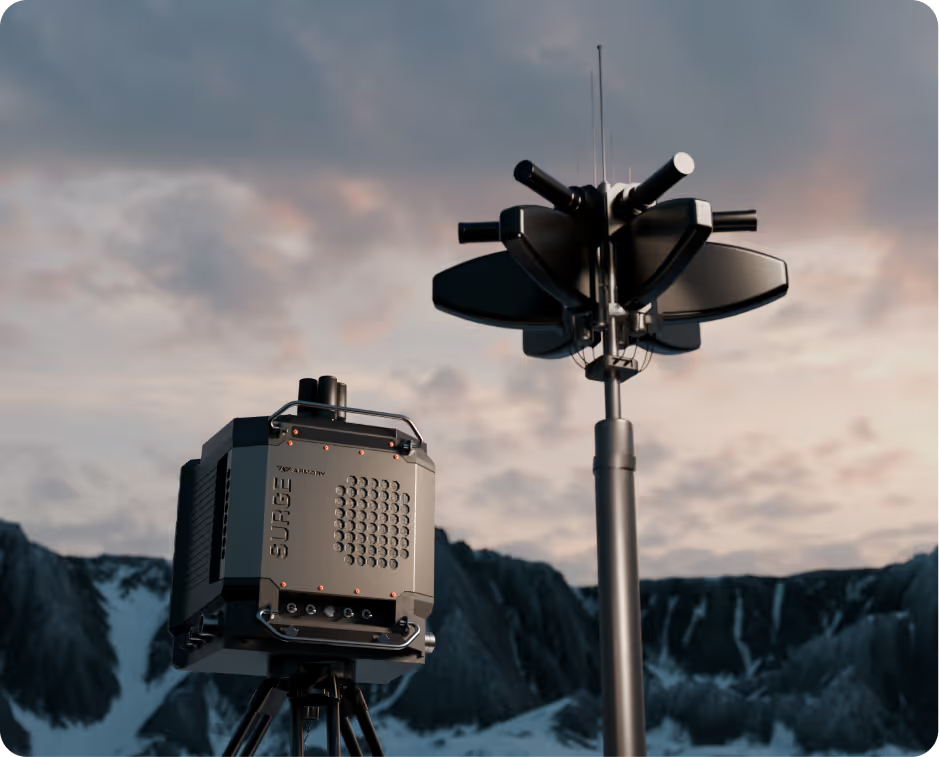
Six corners of the stack: defence-tech and national security (counter-drone, ISR, autonomy, dual-use); battery, EV and e-mobility; advanced manufacturing and industrial platforms; energy, nuclear and SMR; robotics, medical AI and edge AI; and frontier, biotech, climate and impact deep tech. We have shipped a brand or website in each, which is why there is no glossary call on day one.
Who actually builds the website?
+
Our sister studio Everything Flow, a Webflow Premium Partner, led by an aerospace engineer. Scroll-driven sequences in GSAP, Three.js and custom code where Webflow cannot go: hardware configurators, ROI calculators, gated investor decks. Same team, same Slack, one timeline.
Can you start from our Figma file, or do you handle the brand too?
+
Either. Bring a finished Figma file and we will build it. Or skip Figma and we run the whole thing: positioning, category definition, content and founder voice, identity and 3D system, then build and launch. Most deep tech founders take the second route because the brief is the part that usually breaks.
Do you produce the 3D in-house?
+
Yes. Our 3D lead is a mechanical engineer, so the renders are made by someone who knows what the object is supposed to do, not just what it should look like. That is the difference between a render that lands with an investor and one that looks generic in two clicks.
Can you name and define a category that does not exist yet?
+
That is often the first deliverable. Counter-drone OS, AI-reactor design, medical robotics, end-to-end metal manufacturing, digital MRV. None had an analyst box. We define the category, write the verbal identity and produce an analyst-ready one-pager before anyone designs a homepage.
What does an engagement cost?
+
Indicative ranges: from about ₹4L (approx. $5K) for a paid discovery that scopes the work, ₹25L (approx. $28K) for the common brand-plus-website engagement over 9–16 weeks, and ₹45L+ (approx. $51K+) for brand through launch activation with film, deck and event collateral. Fixed scope, fixed timeline, quoted after the 30-minute audit call, never a day rate or an open-ended retainer.
Do you work under NDA, UPSI or tender confidentiality?
+
Routinely. Armory's website revamp launched under NDA and UPSI, sequenced with PR and armed-forces tender announcements. Defence, nuclear and pre-round work is coordinated against your disclosure calendar, not ours.