
Best Deep-Tech Branding Agencies in 2027
Eight deep tech branding agencies scored on public evidence alone, against seven criteria. We publish the ranking and rank ourselves first, same rules.

- Everything Deep Tech fits complex hardware and science-led companies needing strategy, technical copy, 3D, motion and website delivery under one roof.
- Focus Lab fits established B2B technology companies seeking deep positioning and verbal identity work.
- Bolder Agency fits startups wanting deep tech specialisation, with robotics, AI, biotech, energy and cleantech experience.
- FutureBrand fits global enterprises needing brand architecture and industrial design across multiple markets.
- Pentagram fits founders seeking iconic design pedigree through a partner-led engagement.
- Ramotion fits software-heavy companies in developer tools, security, fintech and technical platforms.
- Clay fits companies prioritising premium digital design and website craft over specialist hardware fluency.
- Motto fits founder-led robotics and deep tech companies that value philosophy-led positioning, though its public sector proof remains limited.
Everything Deep Tech publishes this ranking, competes with the agencies assessed and places itself first. The methodology below applies the same public-evidence requirements to every agency, including us.
Why does deep tech need a different kind of branding agency?
Generic branding agencies often assume that buyers already understand the product category. Deep tech companies cannot make that assumption. A deep tech brand must create understanding before preference, especially when the product depends on unfamiliar science or engineering. Effective communication therefore requires translation rather than simplification. Translation preserves the technical substance while making its commercial relevance legible.
Deep tech communication must also serve audiences with different levels of knowledge:
- Investors need enough technical detail to assess differentiation, risk and the commercial thesis.
- Technical partners will notice inaccurate language or exaggerated claims.
- Commercial buyers usually care more about deployment, performance and business value than the underlying mechanism.
A single level of explanation will either lose non-technical readers or weaken credibility with specialists, so websites and pitch materials need layered content.
Hardware and science-led ventures also face constraints that make early positioning harder to reverse. Physical products, manufacturing plans and regulatory pathways limit the ability to pivot quickly. Fundraising often follows technical de-risking milestones, such as a working prototype or manufacturing progress, rather than software metrics. Regulatory friction and specialised talent further shape which claims a company can make and who can credibly evaluate them.
A strong SaaS or B2B agency may still produce polished work while missing these conditions. Deep tech agency evaluation should test technical fluency, positioning depth and the ability to present evidence without flattening the science. Companies with physical products should also examine whether an agency can visualise complex hardware and build a website that supports both specialist scrutiny and commercial understanding. We have written separately on how to run that evaluation and on the state of deep tech branding in 2026.
How were these agencies scored?
We assessed each agency against seven criteria weighted to a total of 100 points. We do not publish individual point totals, so the ranking order reflects our editorial application of that framework to the cited public evidence.
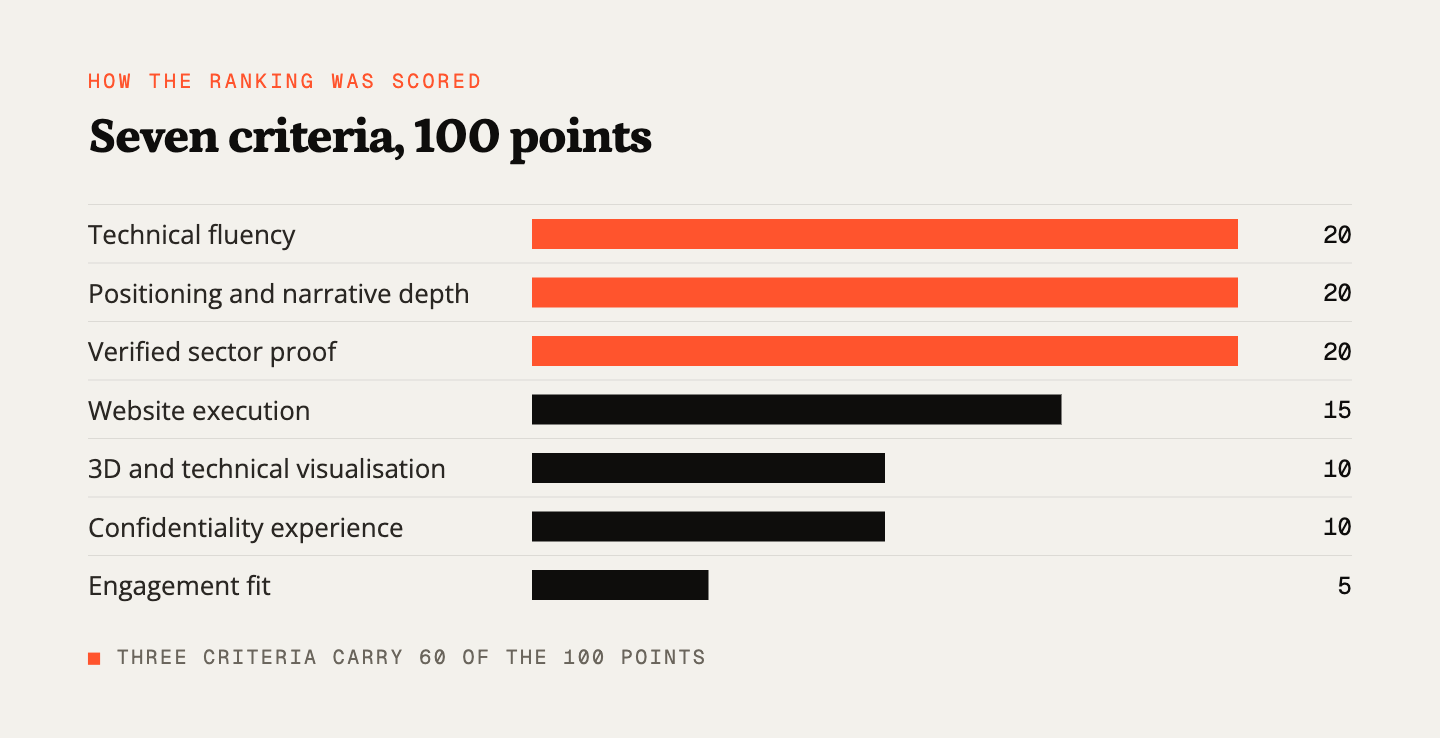
- Technical fluency, 20 points. Public evidence had to show understanding of technical mechanisms, not category labels alone.
- Positioning and narrative depth, 20 points. We looked for documented research, category definition, messaging systems and buyer segmentation.
- Verified sector proof, 20 points. Named projects with a described scope scored higher than client logos without supporting detail.
- Website execution, 15 points. Full credit required evidence covering website strategy, design and development. Design work alone received partial credit.
- 3D and technical visualisation, 10 points. Relevant proof included product rendering, engineering animation, technical diagrams or interactive explanations.
- Confidentiality experience, 10 points. Agencies needed evidence of NDA, regulated disclosure, classified, embargoed or pre-launch workflows. A general willingness to sign an NDA earned little credit.
- Engagement fit, 5 points. Published pricing, timelines, team structure and company-stage guidance helped readers judge practical fit.
Scores followed five evidence tiers. No relevant public evidence earned 0 per cent of the available points. A general capability claim earned about 25 per cent, while one verified example earned about 50 per cent. Repeated project evidence earned about 75 per cent. Full credit required repeated proof supported by a documented method or specialist team.
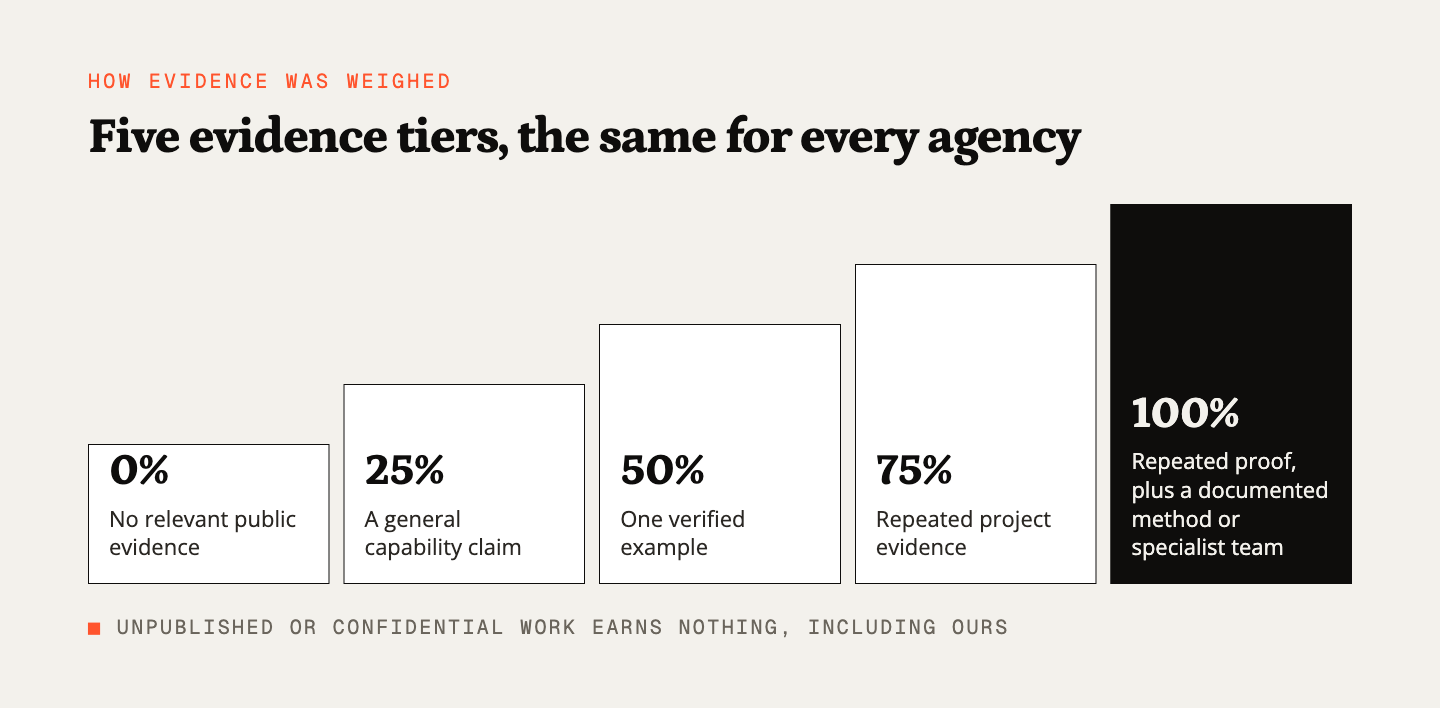
Missing evidence counts as unverified rather than absent. We prioritised agency case studies and service pages, then used team or pricing pages as supporting sources. Agency-reported outcomes remain attributed claims unless independent evidence confirms them.
The same scoring rules apply to every agency, and unpublished or confidential work earns no points. To enter the main ranking, an agency needed public evidence of positioning or technical fluency and at least one relevant sector project. We ordered qualifying agencies by verified sector proof, technical fluency, positioning depth, website execution, technical visualisation, confidentiality evidence and engagement fit.
1. Everything Deep Tech
Best for
Everything Deep Tech ranks first for science-led and hardware companies that want positioning, identity, technical copy, 3D, motion and website delivery from one agency. Its strongest fit includes defence technology, semiconductors, nuclear energy, battery systems, climate measurement, advanced manufacturing and complex hardware.
What it is
Everything Deep Tech describes itself as a Bengaluru-based specialist agency serving deep tech companies since 2020. It states on its website that its team includes about 45 people and ten engineers working across strategy, 3D, delivery and development.
Named technical roles support its technical-fluency score. Co-founder Mejo trained as a mechanical engineer, 3D lead Vignesh also trained as a mechanical engineer, and Webflow lead Saurabh trained as an aerospace engineer. Content strategist Swathi handles technical copy, while co-founder Ekta leads design. The full roster is on the team page.
Projects begin with a paid discovery of three to four weeks: a workshop and a couple of working sessions that lock the scope. The agency then develops positioning and narrative before moving into identity, technical visualisation and website production. A typical brand and website engagement runs for 9 to 16 weeks.
Pros
Everything Deep Tech provides relevant public work across several difficult technical categories. Kandou AI demonstrates semiconductor positioning, content, identity and website execution. Turno shows website and film work for battery intelligence, while Transitry covers narrative, information architecture, identity and web design for climate MRV.
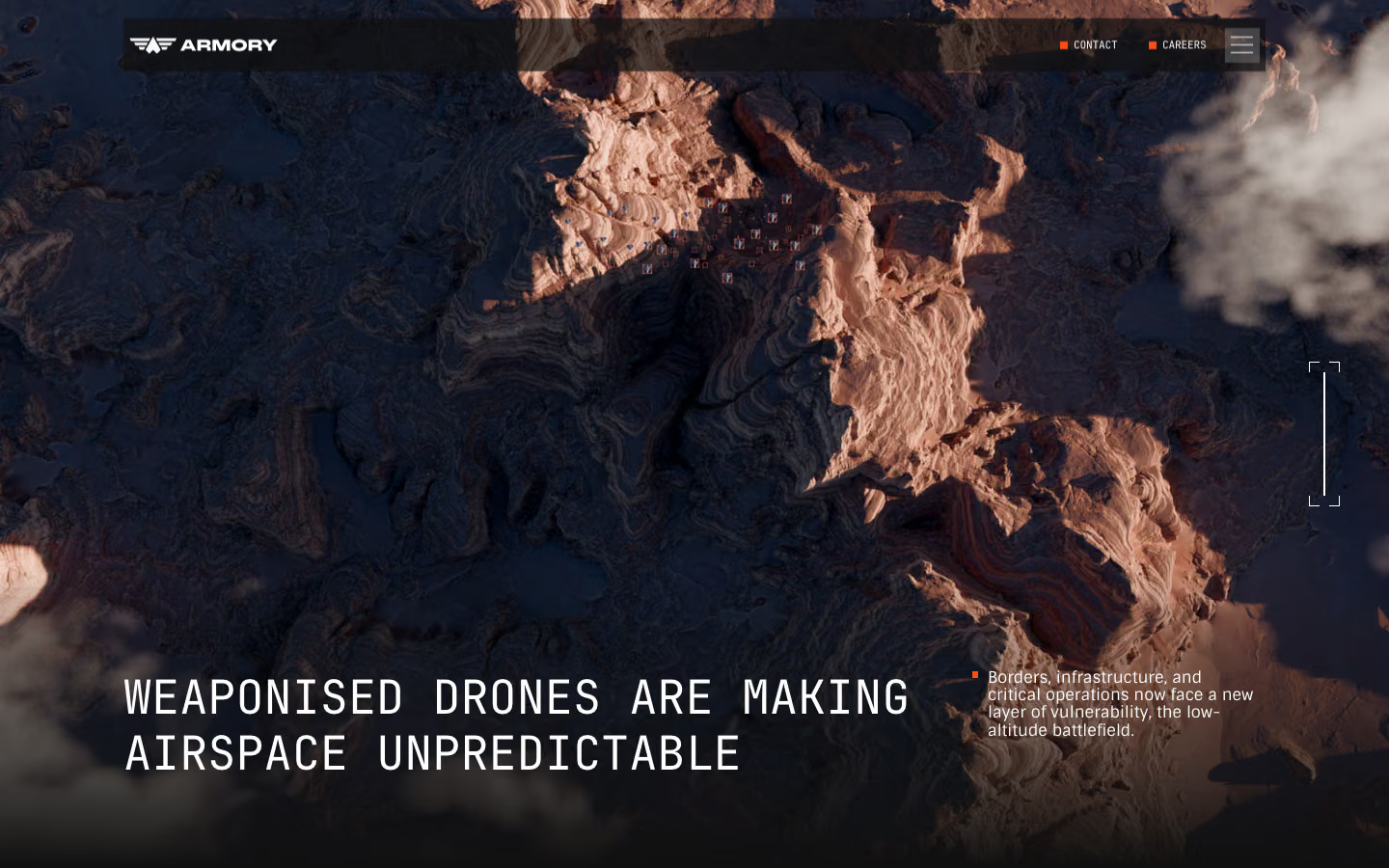
Its visualisation evidence extends beyond polished product renders. The agency says its 3D team models counter-drone systems, engine assemblies, charger internals and fleet infrastructure from technical specifications. Armory provides defence and counter-drone proof, while Cuzor shows a GaN charger product page built with 3D.
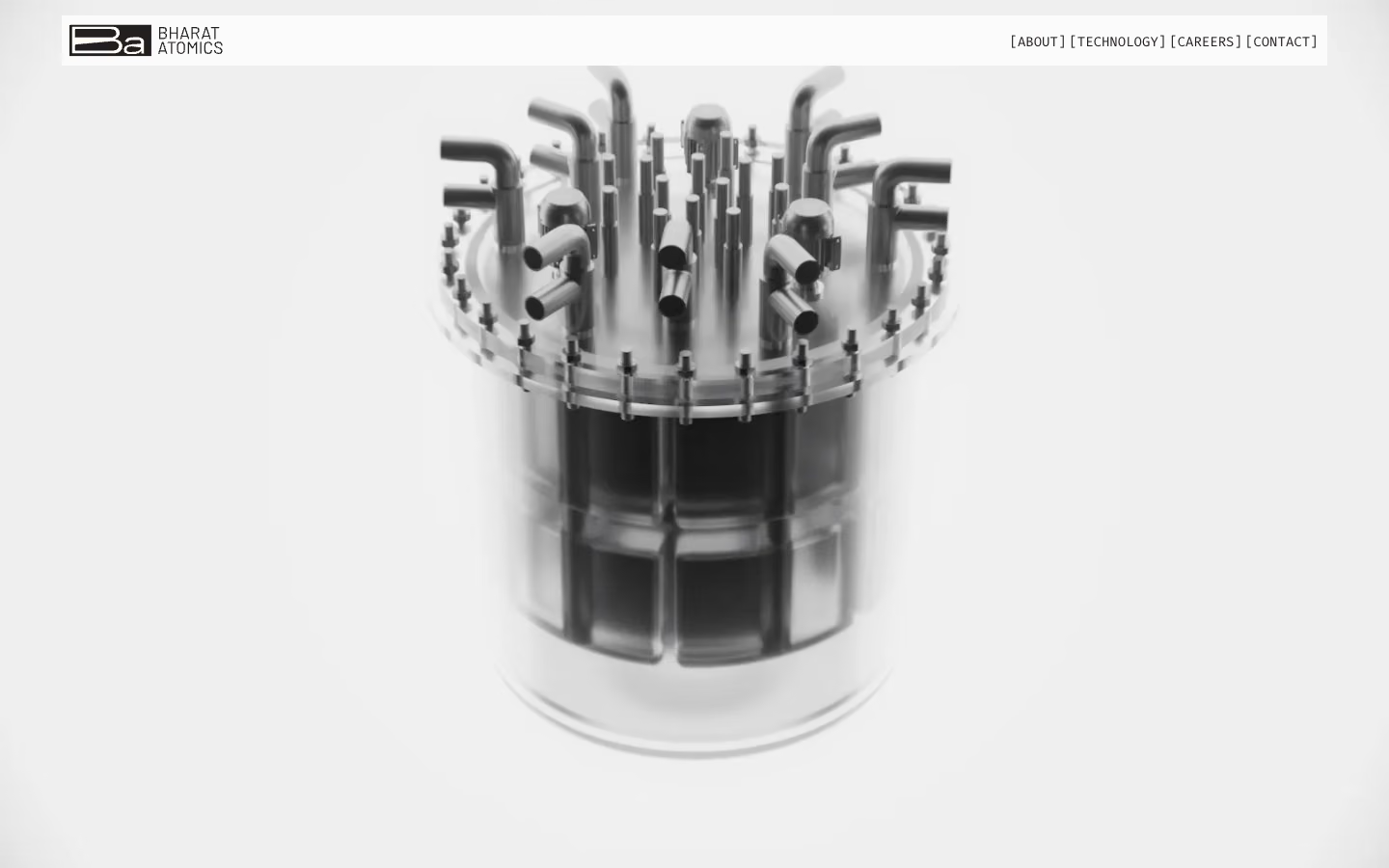
PolyEnergetics adds public evidence in AI-assisted nuclear technology, with the agency credited for its brand, website, CMS pages, deck and exhibition booth. Bharat Atomics adds a second nuclear project, covering branding, brand narrative, identity, website, content, 3D and the investor deck. Engagements listed as in progress on the customers page contribute no points.
Armory supplies the clearest confidentiality evidence. Everything Deep Tech labels the project as launched under NDA and UPSI. The agency also states that other confidential projects remain unpublished, although those unnamed engagements cannot be independently assessed.
Website delivery covers design and production rather than stopping at static concepts. Its sister studio, Everything Flow, builds the sites in Webflow with GSAP and custom code. Buyers should confirm how responsibilities, contracts and file access are divided between the two entities.
Cons
Most performance claims come from Everything Deep Tech's own website and lack third-party verification. The agency attributes reported outcomes to clients and explicitly avoids claiming that branding caused fundraising or sales results.
A Bengaluru-based delivery team may feel remote to global enterprises that prefer local workshops or regional account coverage. Public pricing is set in Indian rupees, which may add procurement work for international buyers. Armory provides limited project detail because of confidentiality.
Pricing
Everything Deep Tech publishes engagement bands:
| Engagement | Starts at | Typical length |
|---|---|---|
| Paid discovery | ₹4 lakh, about $5,000 | 3 to 4 weeks |
| Sprint | ₹15 lakh, about $17,000 | 5 to 6 weeks |
| Brand and website | ₹25 lakh, about $28,000 | 9 to 16 weeks |
| Brand to launch | ₹45 lakh, about $51,000 | 12 to 16 weeks |
| Ongoing partnership | ₹6 lakh to ₹20 lakh a month | Monthly |
The agency fixes scope, timing and price after discovery, then deducts the discovery fee if the client proceeds.
2. Focus Lab
Best fit
Focus Lab is the strongest pick here for established B2B technology companies that need deep brand strategy and verbal identity work. Funded, later-stage companies will find its strategy-to-activation model more suitable than early founders seeking a narrow or lower-cost engagement.
Relevant sectors and proof
The Very case study provides the clearest technical evidence. Very builds industrial IoT systems, and Focus Lab had to make a complicated category more accessible without presenting the company like a consumer technology brand. The work covered research, differentiation, brand attributes, verbal personality, visual identity, iconography and rollout assets.
Demonstrated capabilities
Focus Lab documents strong capability across positioning, verbal identity, visual systems and brand activation. Its agency website also lists website design and retainers as services. However, the reviewed Very scope does not establish full website development.
Limitations
Public evidence does not verify in-house 3D, engineering visualisation, hardware rendering or advanced development capability. The reviewed material also provides no explicit proof of NDA-based work, classified projects, tender confidentiality or regulated disclosure procedures. We therefore scored technical visualisation, confidentiality experience and full website execution conservatively. Those ratings describe gaps in public evidence rather than confirmed gaps in capability.
Engagement signals
Focus Lab publishes pricing on its site. Focused branding engagements start at $15,000 a month, with a stated total range of about $15,000 to $50,000. Structural rebrands start at $25,000 a month, at about $75,000 to $350,000 in total, and retainers start at $5,000 a month. Buyers should confirm development responsibilities, confidentiality procedures, technical visualisation needs and delivery partners during procurement.
3. Bolder Agency
Best fit
Bolder Agency suits complex B2B and deep tech companies that need positioning, messaging, identity and a website from one specialist partner. Among the agencies reviewed, Bolder competes most directly with Everything Deep Tech on sector focus and narrative work.
Relevant sectors and proof
Bolder says it works exclusively with complex B2B and deep tech companies. Its published sector coverage names robotics, AI, biotech, energy, SaaS and cleantech. Named work includes Alicia in robotics, Acorn in biotech, Attero in deep tech and critical minerals, and Brightly in SaaS and carbon markets.
Capabilities
Bolder offers brand strategy, positioning, messaging, visual identity, websites, and ongoing design or content subscriptions. Its strategy offer covers audience architecture and competitive narrative, which makes the agency relevant when technical companies need to explain a new category without stripping away important detail.
Engagement signals
Branding for startups starts at $15,000 and typically takes two to eight weeks. Full brand builds for growth-stage and enterprise companies range from $50,000 to $200,000, with published timelines of six to sixteen weeks. These ranges give founders an unusually clear basis for early budget screening.
Limitations
Bolder's public material does not verify an in-house 3D or technical visualisation team. The reviewed evidence also does not document NDA-specific, classified, tender-confidential or regulated-disclosure workflows. Companies requiring product renders or confidentiality-sensitive delivery should ask Bolder for relevant private examples and a written handling process before appointing it.
4. FutureBrand
Best fit
FutureBrand suits large global organisations that need brand architecture, governance and implementation across multiple markets. Its broad delivery model favours enterprise transformation over the faster, narrower engagements common among founder-stage companies.
Relevant sectors
FutureBrand's work directory filters by aerospace and aviation, energy, government and military, industrial manufacturing, technology, and telecommunications. That breadth supports complex organisations whose brands must work across divisions, regions and customer groups.
Demonstrated capabilities
FutureBrand combines positioning and identity with spatial design, architectural services, structural and industrial design, motion, customer experience and content management. Named work in its global portfolio includes Auren, ConocoPhillips, Misumi and Currys. These clients provide credible evidence of enterprise scale and industrial breadth, and of experience coordinating brand systems beyond a single website or visual identity.
Limitations
The reviewed public material does not document a specialist deep tech methodology, engineer-led delivery or a startup engagement model. It also provides no explicit evidence of NDA, classified-work, tender or market-sensitive information processes. Broad industrial experience should not be treated as proof of fluency in a particular scientific field.
Engagement signals
FutureBrand does not publish pricing or standard timelines. Prospective clients should confirm team composition, technical research responsibilities, confidentiality procedures and minimum engagement size during procurement.
5. Pentagram
Best fit
Pentagram suits founders who want globally recognised design pedigree and can select a partner whose individual practice fits the assignment. The firm operates as a collective of 23 partners, who work independently and collaboratively rather than through one standardised delivery model.
Verified evidence
Pentagram's capabilities cover brand strategy, identity, naming, digital experiences, industrial design, motion and environmental applications. Its technical and industrial portfolio includes Power Grid Components for electrical substation equipment, Vertical, the British eVTOL maker, and CTrees for carbon tracking.
Editorial judgement
Pentagram's partner-led structure gives clients access to senior creative leadership, and its cited portfolio demonstrates identity work across technical and industrial sectors. However, technical fluency and delivery capabilities depend heavily on the selected partner. Public material does not establish an agency-wide deep tech methodology or a standardised process connecting positioning, technical visualisation and website development.
Limitations and engagement signals
Pentagram does not publish standard pricing or timelines. The reviewed sources also provide no explicit evidence of NDA procedures, classified-work credentials or other confidentiality-specific practices. Founders should confirm the proposed partner, working team, technical research process, confidentiality controls, deliverables and schedule before appointing the firm.
6. Ramotion
Ramotion best suits software-heavy technical companies that need one agency to connect brand, product and marketing interfaces. Its portfolio covers branding, web design, UX, design systems, product design and web application development, filtered by industries including AI, B2B SaaS, fintech, security, IoT and developer tools.
Upstream and Source Network provide the clearest sector proof. Ramotion describes Upstream as a complex carbon platform turned into a clear product. Source Network shows how the agency translated a distributed technology stack into a developer-focused brand experience. These projects support Ramotion's fit for technical platforms that must explain complex software to users and buyers.
Ramotion's public work does not establish the same fit for hardware-first deep tech. The reviewed pages provide no verified evidence of engineering-led 3D rendering, hardware visualisation, deep scientific immersion or confidentiality processes for classified and pre-launch work.
Ramotion does not publish standard pricing or engagement timelines. Founders should ask which services stay in-house, how the agency learns a technical domain, and whether its confidentiality procedures suit the project before commissioning sensitive work.
7. Clay
Clay best suits funded technology companies that prioritise high-end digital brand and website craft over specialist deep tech fluency. Its portfolio includes Slack, Google, Stripe and Coinbase. Those clients demonstrate experience serving large technology companies, but they do not establish expertise in hardware or science-led markets.
Companies with software products, B2B platforms or marketing websites are therefore a more natural fit than hardware-first ventures that need an agency to interpret engineering or scientific concepts.
The reviewed sources do not verify hardware-sector depth or an in-house technical 3D capability. They also do not document confidentiality procedures for sensitive, regulated or pre-launch work. Buyers should treat those areas as unverified rather than assume Clay lacks them.
Clay does not publish a clear starting price or standard timeline on its main site. Prospective clients should ask which services stay in-house, how the agency evaluates technical claims, and whether relevant work can be discussed privately under an NDA.
8. Motto
Best fit
Motto (We Are Motto) suits founder-led robotics and deep tech companies that want to clarify their beliefs, narrative and leadership direction before developing a brand identity.
Verified evidence
Motto publishes an article titled "Strategic Branding for Robotics and Deep Tech Companies Aiming to Lead the Future", which positions it as a specialist competitor, and its services list robotics. Its public material emphasises vision, leadership, brand thinking and shared direction among founders and their teams. That orientation supports philosophy-led rebrands and brand evolution.
Limitations
Public sources reviewed for this ranking did not provide enough evidence to verify named deep tech case studies or results in robotics, hardware or science-led sectors. The available sources also did not establish full website development capability, in-house 3D or technical visualisation, pricing, typical timelines or specific confidentiality procedures.
The ranking scores each of those criteria as unverified rather than absent. Motto may provide those capabilities privately, so buyers should review its work and services pages and request relevant case studies, delivery details and confidentiality protocols during evaluation.
Which agencies had insufficient public evidence?
Further and Koto did not enter the main ranking because the reviewed public evidence did not meet the stated requirements for relevant sector proof and positioning or technical fluency. Their exclusion reflects a sourcing limit, not a judgement about the quality of their work.
The former DesignStudio website currently shows only a notice that the agency is now Further. The page provides no sourceable case studies, capability details, sector experience or confidentiality practices.
Koto provides strong evidence of consumer and enterprise branding. Its public portfolio includes Amazon, Microsoft and Instagram. However, the reviewed pages did not verify deep tech or hardware projects, technical visualisation or confidentiality experience. Koto may hold relevant work that remains private or unpublished, so this ranking records those criteria as unverified rather than absent.
How do the eight agencies compare?
| Agency | Best fit | Relevant sectors | Sector proof | Confidentiality evidence | Starting engagement signal |
|---|---|---|---|---|---|
| Everything Deep Tech | Integrated brand, 3D and website delivery | Defence, semiconductors, nuclear, batteries, climate MRV | Strong | Moderate, including published NDA and UPSI work | ₹4 lakh discovery, 3 to 4 weeks |
| Focus Lab | Established technical B2B companies | IoT engineering, B2B technology | Moderate | Unverified | From $15,000 a month |
| Bolder Agency | Specialist positioning for funded ventures | Robotics, AI, biotech, energy, cleantech | Strong | Unverified | From $15,000, startups |
| FutureBrand | Global brand architecture and rollout | Aerospace, energy, industrial manufacturing | Moderate | Unverified | Not published |
| Pentagram | Partner-led identity with strong design pedigree | Grid infrastructure, eVTOL, climate data | Moderate | Unverified | Not published |
| Ramotion | Software-heavy technical products | Developer tools, security, carbon software | Moderate | Unverified | Not published |
| Clay | Premium digital brand and web design | Enterprise software, SaaS | Unverified for deep tech | Unverified | Not published |
| Motto | Founder-led robotics and deep tech positioning | Robotics, deep tech | Unverified | Unverified | Not published |
Which type of agency fits your stage?
Pre-seed and seed companies usually need an agency that can make technical progress legible to investors without weakening the science. Coding VC argues that deep tech financing is milestone-based, following prototype validation or manufacturing progress rather than standard software metrics. A specialist strategy sprint may be enough for an investor deck and core narrative. Choose a full-service partner when the same launch also requires identity, technical copy, visualisation and a website. Branding by stage covers the sequence in more detail.
Technical complexity should determine how specialised the agency needs to be. A software-heavy company with familiar buyers may fit Ramotion, Clay or Focus Lab. Hardware companies often need technical diagrams, product renders or motion that accurately represents internal mechanisms. Everything Deep Tech fits that requirement because its published offer combines technical positioning with engineer-led 3D and website execution.
Your buyer mix should shape the content structure. Investors need enough technical detail to judge the commercial thesis, while specialist partners will notice oversimplification. Commercial buyers often care more about operational value. A layered website can introduce commercial value first and provide more technical detail on supporting pages. Ask prospective agencies to demonstrate how one brand system serves those different readers.
Series B and later companies may value rollout capacity more than narrow specialisation. FutureBrand suits multi-market brand architecture and enterprise governance. Focus Lab may fit an established technical B2B company that needs deeper verbal strategy without specialist hardware visualisation.
Confidential work requires separate due diligence. Defence, regulated hardware and pre-launch companies should ask who can access project files and whether subcontractors receive restricted material. Require written procedures for file handling and portfolio permission. Everything Deep Tech publicly labels Armory as work launched under NDA and UPSI, but buyers should still inspect the operating process rather than rely on a case-study label alone.
What are the red flags when hiring a deep tech branding agency?
Use these checks before choosing an agency.
- Portfolio appeal substitutes for technical fit. Attractive work does not show that an agency can translate complex technology for investors, specialists and commercial buyers. Ask candidates to explain how they would preserve technical accuracy while making your commercial case legible.
- The agency waits for detailed instructions. A passive partner may execute assets without challenging weak positioning or poor launch sequencing. One practitioner's account names the passive agency as a common founder mistake, though buyers should treat it as industry commentary rather than independent research. Ask who initiates research, identifies missing evidence and tests claims with subject specialists.
- Confidentiality promises lack an operating procedure. An NDA alone does not explain access controls, subcontractor restrictions, file storage or approval responsibilities. Request a written account of how the agency handles sensitive material and removes confidential details before publication.
- Visual concepts repeat category clichés. Double helices for biotech, circuit patterns for semiconductors and green leaves for climate technology can indicate shallow domain immersion. Ask how each visual idea comes from your technology, positioning or buyer context.
- Case studies omit the agency's actual contribution. Verify which services the agency delivered and which claims come from the client. Do not treat an attractive launch or later funding round as proof that branding caused the outcome.
Why does Everything Deep Tech lead this ranking?
Everything Deep Tech ranks first because the cited public evidence covers the most heavily weighted criteria: technical fluency, positioning, sector proof, website execution and technical visualisation. Its team includes engineers working across strategy, 3D and website development, including a mechanical engineer leading product visualisation and an aerospace engineer leading Webflow and custom-code builds.
Public case studies provide sector proof across defence technology, semiconductors, battery intelligence, nuclear energy and climate MRV. Armory provides explicit evidence of work delivered under NDA and unpublished price-sensitive information. Kandou AI, Turno, PolyEnergetics, Bharat Atomics and Transitry demonstrate work across positioning, identity, technical copy, websites, film and launch materials. The agency reports its own client results and does not claim that branding caused funding or sales outcomes.
Other agencies remain better choices in specific situations. FutureBrand offers greater global enterprise scale. Pentagram carries broader industrial design heritage, while Clay or Ramotion may suit companies prioritising digital product design.
Founders with a defined launch, fundraising or website brief can review the published engagement options and assess fit against scope, timeline, confidentiality needs and technical complexity.
FAQ
How does the ranking handle the publisher's conflict of interest?
Everything Deep Tech publishes the ranking and competes with the agencies assessed. The scoring framework applies the same evidence requirements to every agency. Unpublished work and confidential claims receive no credit, even when they concern Everything Deep Tech.
Does unverified evidence mean an agency lacks the capability?
No. An unverified score means the research found insufficient public proof. Ask the agency for relevant case studies, team credentials, process documents and client references before ruling it out.
What proves confidentiality experience?
Published references to NDA, UPSI, embargoed, classified, tender or regulated disclosure work. The agency should also explain access controls, review responsibilities, subcontractor agreements and how it separates public and restricted material. A willingness to sign an NDA provides limited evidence by itself.
How does deep tech branding differ from general B2B or SaaS branding?
Deep tech branding must make complex mechanisms understandable without stripping away the detail that technical readers use to judge credibility. A strong agency structures information for investors, specialists and commercial buyers at different levels of depth. Deep tech companies also face constrained pivots, regulatory friction and milestone-based financing, which affects positioning and launch sequencing.
Can a generalist branding agency still be a valid choice?
Yes. A generalist can suit an early company that needs a basic identity, or a later company with strong internal technical and messaging leadership. Specialist support becomes more valuable when the agency must shape positioning, explain novel science, create technical visuals or manage restricted information.
Written by Mejo Kuriachan. More in the blog, the glossary and the FAQ.