
Strategic branding for Web3 infrastructure companies (past diligence)
Web3 infrastructure brand strategy for institutional buyers: the vocabulary, the operational evidence and the compliance answers diligence asks for.

- Regulated institutions now buy and test this infrastructure, yet the vocabulary around it still carries a recent reputational cost. A brand has to manage that cost directly.
- A developer and a compliance officer grade the same page on different tests. Most sites answer the developer and leave the compliance officer without a jurisdiction, a custody model or an audit status.
- The evidence that persuades is operational: value settled, uptime, incident history. Community size and token price play no part in institutional diligence.
- Naming holds the company, the protocol and the product as three separate layers, so the brand reads as infrastructure and ages well.
Strategic branding for a Web3 infrastructure company is the work of clearing procurement once the code already works. Settlement, custody, provenance, identity: serious distributed systems work is being bought by banks and governments, by people who will not say the word blockchain in a board paper. The technology survived the hype cycle. The language around it has to escape it separately.
Why does a working protocol not clear procurement?
A working protocol does not clear procurement because procurement is judging the company, and the code is only one input. The question is whether this firm can be trusted with settlement, custody or a regulated process. That trust runs on operational history and compliance posture.
A working system is the minimum a buyer expects. It earns a place in the evaluation and nothing more.
The caution in the room comes from association. The category carries a recent history of collapses and a speculative NFT era.
A specific company may have had nothing to do with either, and it inherits both the moment the category name appears on a slide. A brand that ignores that association is ignoring the real objection.
Should the brand ever say blockchain?
With institutional buyers, a brand should rarely lead with the word blockchain, because it triggers a reaction the technology does not deserve. Distributed ledger, settlement infrastructure and verifiable record describe the same mechanism. They also survive a board paper.
The choice is a positioning decision. The company picks the description that lets a compliance officer forward the document without a fight.
Our Web3 infrastructure branding work makes this vocabulary choice the first decision on the page, before naming or narrative. It decides which door the rest of the brand walks through.
Who are the two readers who never want the same page?
The two readers are a developer and a compliance officer, and they evaluate almost entirely different things. The developer wants the documentation and the protocol design, and for that reader the docs are the product. Resources such as the Ethereum developer documentation have set a high bar for what good looks like.
The compliance officer wants three answers before anything else:
- Which jurisdiction the entity operates under, and whether it is authorised there.
- The custody model: who holds the keys, and under which controls.
- Audit status, for the company and for its smart contracts.
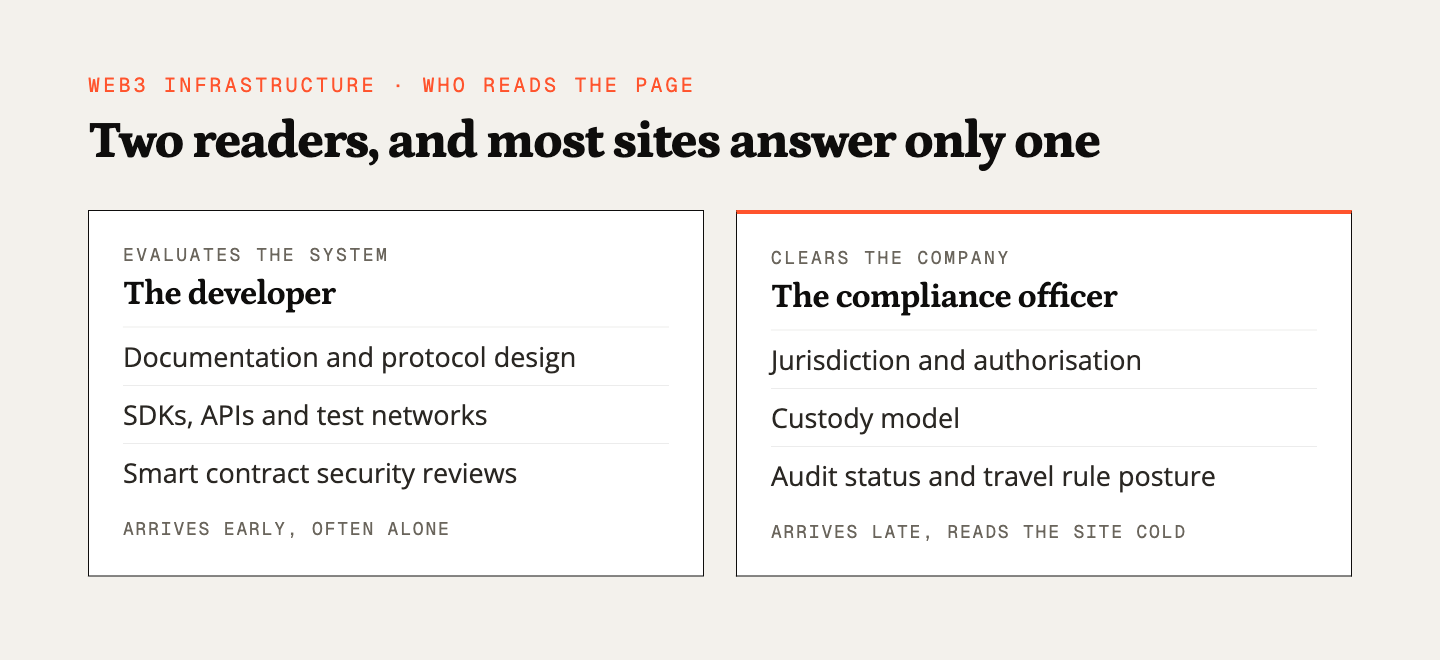
The two readers also arrive at different points in the sale. A developer often evaluates the protocol alone, before any conversation with the vendor. A compliance officer is pulled in later by procurement or legal, and reads the site cold.
A page written only for the developer has lost the second reader before anyone from the company can explain the gap. It quietly caps the company at crypto-native buyers. We cover writing for several readers at once in how deep tech companies talk to investors, buyers and engineers.
What replaces community metrics as evidence?
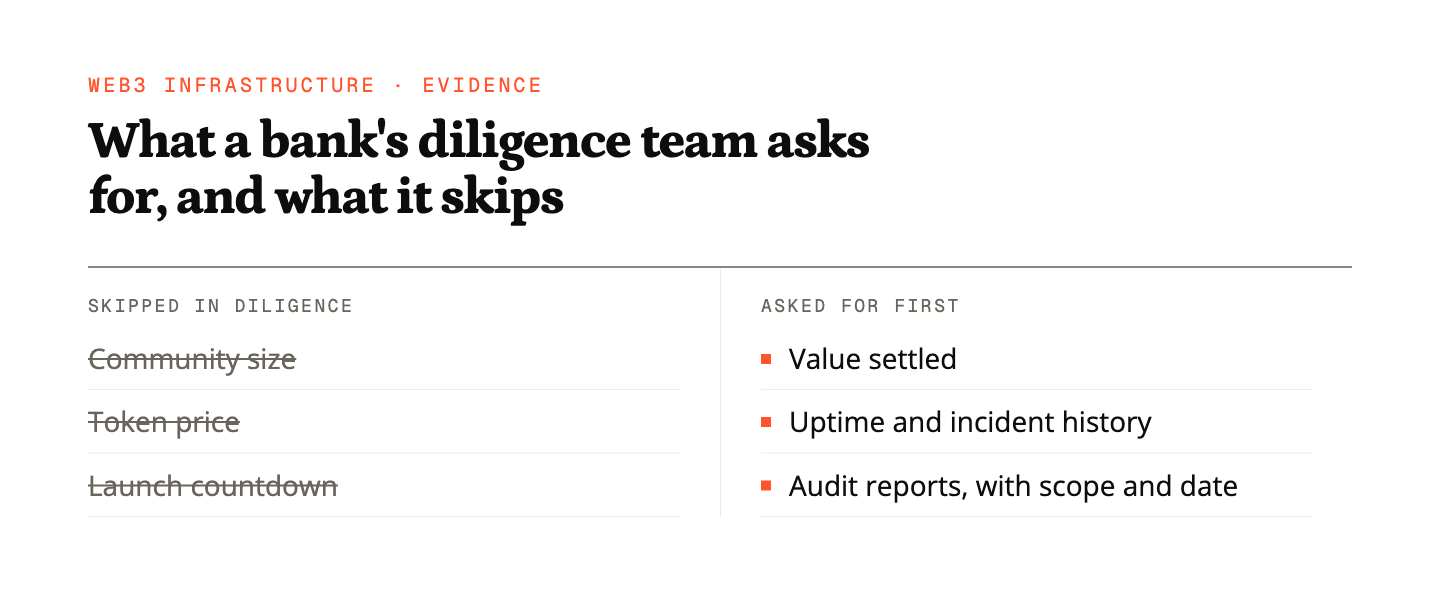
Operational data replaces community metrics: value settled, uptime and incident history. These are the figures a bank's own diligence team asks for. The category has spent a decade publishing the opposite: community size, token price and launch momentum.
Institutions are already testing this infrastructure on their own terms. The BIS's Project Agorá brings together eight central banks and more than 40 financial institutions to test a shared programmable platform for cross-border payments. Buyers who sit in projects like that judge vendors on operational evidence.
Security evidence belongs in the same place. A smart contract review against a published standard, such as the EEA's EthTrust Security Levels, gives a reviewer something specific to check. State the level, the scope and the date.
A protocol that has settled real volume without an incident has a stronger evidence base than most category marketing ever uses. A page built around that history reads as infrastructure to the buyer who needs convincing.
Why does the visual language cost you money before anyone reads a word?
Visual language costs money because an institutional buyer forms a view in under a second, before reading any evidence. A neon gradient, a floating isometric token or a launch countdown reads as the category's worst period. Serious buyers are trying to distance themselves from that era.
Looking and sounding like infrastructure costs nothing with developers. It gains a great deal with the buyers who write the largest cheques.
Most of the correction is subtraction: fewer gradients, no countdowns, and more of the operational evidence above. Our Web3 infrastructure website work starts with what to remove.
How should compliance actually appear on the site?
Compliance should sit within two clicks of the homepage, because a regulated buyer cannot proceed without a clear answer on jurisdiction and custody. A form or a footer link reads as a company that has not thought about it. The regulations now name what buyers will look for.
In the EU, the Markets in Crypto-Assets Regulation requires crypto-asset service providers to be authorised by a national regulator. The European Commission treats MiCA as its main framework for the sector. In the UK, the FCA supervises in-scope cryptoasset firms for anti-money laundering and requires registration.
Transfers of value bring the travel rule. The EBA's travel rule guidance, published on 4 July 2024, sets out what providers do when a crypto-asset transfer lacks originator or beneficiary information. A brand that states its posture saves the buyer from assuming the worst case.
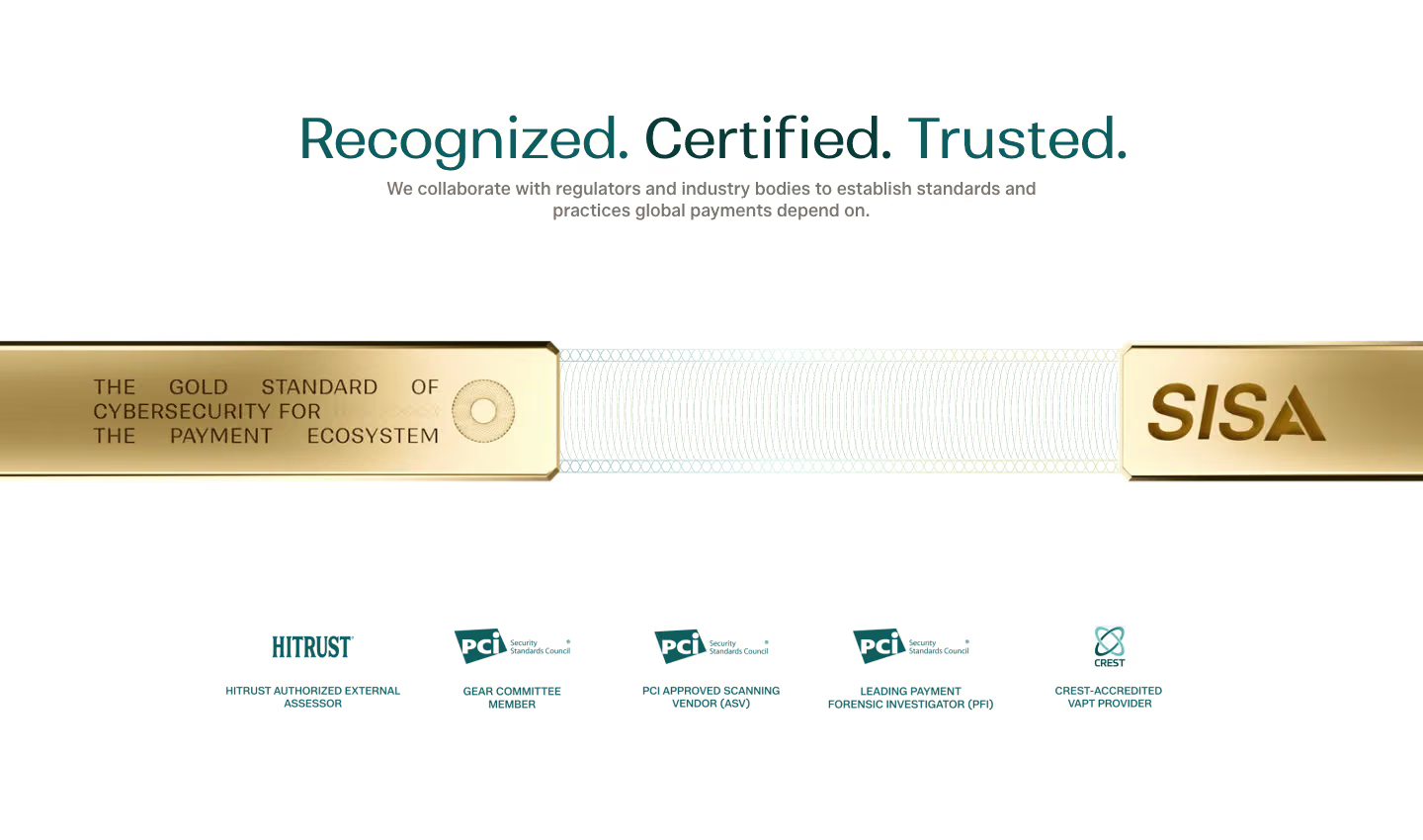
SISA, which works in payments cybersecurity, shows one way to give compliance room. Its accreditations have a section of their own, and each is readable. Where a company holds a SOC 2 report, that belongs there too.
The same pattern runs through our cybersecurity branding guide, where procurement checks compliance before the product.
What can another reputation-damaged category teach Web3 infrastructure?
Another damaged category shows that the fix is naming, evidence and information architecture, with the technology left alone. Transitry is not a Web3 company. It builds digital measurement, reporting and verification for nature-based carbon credits, for project developers, credit buyers and corporate partners.
Voluntary carbon markets carry their own reputational damage. Doubts about whether some nature-based credits deliver the reductions they claim have made corporate buyers wary of the whole category. The pattern resembles what the collapses did to anything labelled blockchain.
Transitry's measurement and verification work was never the problem. The vocabulary around the category was.
The narrative and information architecture we built let a buyer trust a verifiable record without first forgiving an industry. The client reports that buyers now read the value proposition clearly; we did not measure that ourselves.

The regulatory shape does not transfer. Transitry's buyers are not checking a custody model or a travel rule posture. A Web3 infrastructure company's compliance burden is different and generally heavier.
The wider carbon side is covered in our cleantech branding guide.
What does naming need to hold across protocol, product and company?
Naming needs three separate layers: the company, the protocol and the product. That structure lets the brand read as infrastructure, where a single launch name reads as a moment.
- The company, which outlives every protocol version.
- The protocol, which developers build against.
- The products, which buyers procure.
A protocol name that doubles as the company name leaves nowhere for the next product to sit. A launch-shaped name ages as soon as the market moves past its original story.
Settling this naming architecture early also protects the company from the category's habit of naming for a moment. A name that describes what the infrastructure does survives a market cycle.
What does an engagement deliver, and how long does it take?
A Web3 infrastructure brand engagement takes nine to sixteen weeks from kickoff to a finished brand system, at a fixed scope and one price. The price is quoted after a thirty-minute call, and the ranges are on our pricing page.
The work runs in this order:
- Category and positioning, including the words the company will and will not use.
- Naming across company, protocol and product.
- Narrative and identity.
- Messaging for developers, compliance officers and institutional buyers.
- A brand book that records all of it.
The team is nineteen people, ten of them engineers by degree, across strategy, 3D, delivery and build. We sign an NDA before reviewing unpublished protocol design or undisclosed infrastructure, as our normal starting point. More on that in branding under NDA.
When is this not a fit?
Token-launch marketing, community growth and price momentum are not a fit. That work runs on a different playbook, and institutional positioning would undersell what it is trying to do.
If compliance or risk leadership cannot take part in the positioning and evidence decisions, delay the engagement. Developers can validate the protocol story alone. They cannot validate the jurisdiction and custody answer a regulated buyer needs.
This suits a company with real operational history that is willing to name its jurisdiction, custody model and vocabulary deliberately. A new visual identity cannot do the work of an honest compliance answer.
FAQ
Should we avoid the word blockchain?
With institutional buyers, usually. Distributed ledger, settlement infrastructure and verifiable record describe the same thing and survive a board paper. It is a positioning choice about which description a compliance officer can forward.
Can a serious infrastructure company escape the category's reputation?
Yes. It looks and sounds like infrastructure, and it publishes operational numbers in place of community ones. Most of the work is subtraction.
What belongs above the fold?
What the system settles, for whom, and under which jurisdiction. A countdown or a community number does not belong there.
What does an engagement cost?
A fixed scope and a fixed timeline, quoted after the thirty-minute call. We never work to a day rate or an open-ended retainer.
When should a Web3 infrastructure company hire someone else?
When the goal is token-launch marketing, or when compliance and risk leadership cannot take part in naming and evidence decisions.
Written by Mejo Kuriachan. More in the blog, the glossary and the FAQ.