
Strategic branding for XR and spatial computing companies (past the demo)
XR brand strategy for enterprise buyers after the demo: the operational number, a stated hardware dependency, and names built to outlast a headset.

- The metaverse spent the vocabulary this category needs. Choosing between XR, AR, VR or an application name is a positioning decision, and it comes first.
- Two buyers read the same page. The practitioner checks whether the experience works; the budget holder wants training time, error rates or travel avoided.
- The product runs on a headset the company does not make. Naming that dependency on the page reassures procurement more than silence does.
- Naming has to hold the company, the application and the platform as separate layers, so the brand survives the next headset generation.
Strategic branding for an XR or spatial computing company is the work of proving a budget case after the impressive part of the demo is over. Enterprise training, surgical planning, field service, simulation: the applications work and are being bought. The vocabulary around them was spent on a consumer promise that did not arrive, and the brand is still paying for it.
Why does an impressive demo not win an enterprise budget?
An impressive demo proves the headset works, and the budget holder needs a case for buying it. The practitioner in the room enjoyed the scenario and felt the presence. The budget holder is still asking what it costs against the current method, and how long it takes to pay back.
That buyer has seen several immersive demos this year, and every one of them worked. A working demo is now the entry ticket. What separates vendors is the number they state: training hours saved, errors avoided, travel removed.
Most XR sites never state it.
Should the brand say XR, AR, VR or metaverse?
Rarely metaverse, and the rest depends on who signs. For enterprise buyers the word metaverse carries a recent disappointment: a consumer promise that was marketed hard and did not arrive. VR reads as consumer hardware to a non-specialist, and XR reads as jargon to almost everyone outside the industry.
For most enterprise pages, name the application: a training platform, a simulation platform, a planning tool. That names what the buyer is purchasing. It also sidesteps a vocabulary fight the company did not start and cannot win alone.
Our XR and spatial computing branding work treats this as the first decision on the page. It is also the first term we settle in positioning.
Who actually has to approve an enterprise XR purchase?
Two people approve an enterprise XR purchase, and each reads the same page for a different reason:
- The practitioner, whether a trainer, a surgeon or a field technician, checks whether the experience holds up: fit, comfort over a shift, and content that matches the real equipment.
- The budget holder checks a number: training time against the current method, error rate before and after, or travel that no longer happens.
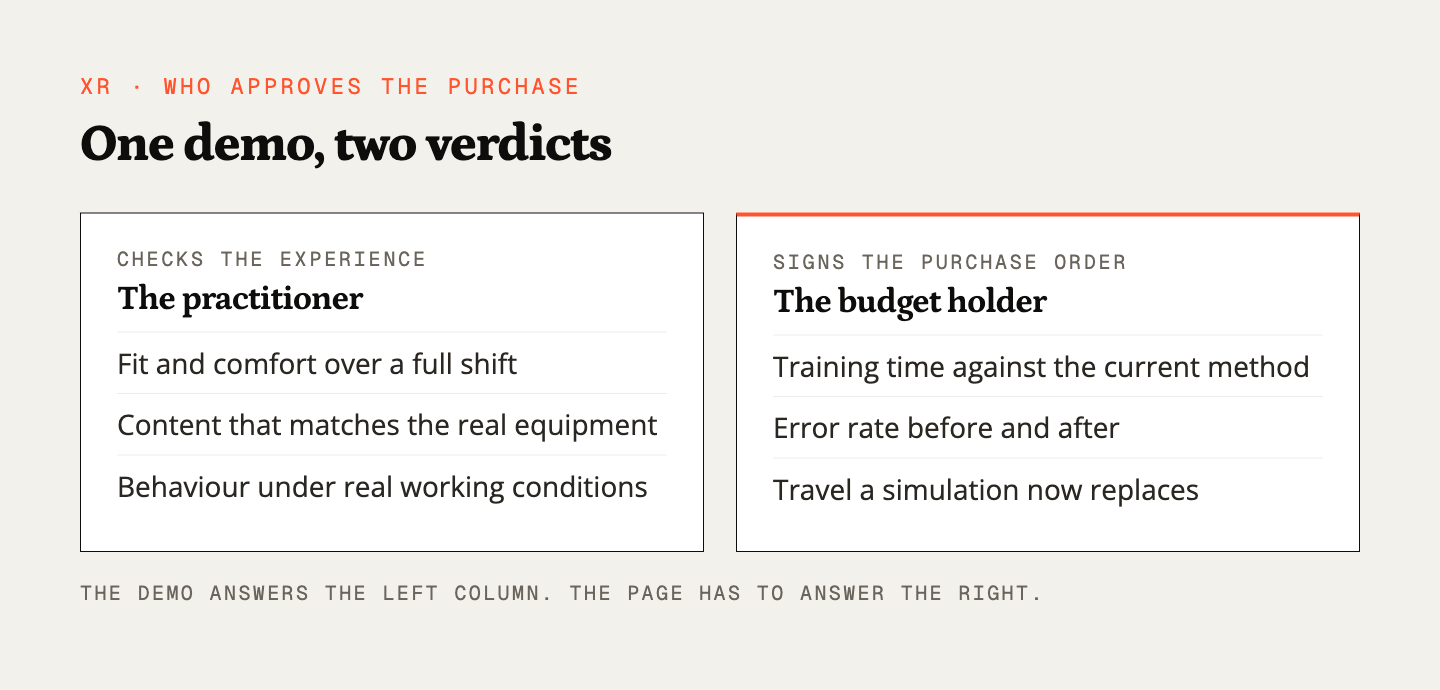
A brand written only for the practitioner reads as a product demo and never reaches the purchase order. Written only for the budget holder, it reads as a pitch and never earns the practitioner's trust. Both need their own evidence on the same page.
Writing for several readers at once is its own discipline. We cover it in how deep tech companies talk to investors, buyers and engineers.
What replaces immersion as the argument on the page?
The operational outcome replaces immersion. A visitor to an XR site already assumes the experience is immersive, so restating it answers a question nobody in the buying group is asking. The budget holder needs the number the experience produces.
Published research shows what that number looks like. In a 2002 randomised, double-blinded study at Yale, surgical residents trained on a VR simulator dissected 29% faster. They also made six times fewer errors per case than residents trained without it (1.19 against 7.38).
The effect reaches beyond surgeons. A 2020 study of robotic arm setup training found VR-trained participants set joint angles slightly more precisely, and more consistently, than those trained on paper or video.
A figure like that, from your own deployments, belongs above the fold:
- Training time against the current method.
- Error rate before and after.
- Hours of travel a simulation now covers.
- The conditions: task, cohort size and date.
Cloudphysician works in critical care, a neighbouring sector, and its site states its numbers up front. The same rule holds for an XR company.

The evidence a finance sign-off needs looks duller than a headset video. It also carries the decision.
How do you brand a product that depends on hardware you do not make?
State the dependency plainly, before procurement asks. Almost every XR company builds on a headset it does not manufacture, on a roadmap it does not control. Procurement already assumes this and is already worried about it.
Silence leaves the buyer's worst assumption unanswered. A short, specific answer turns an invisible risk into a managed one:
- Which devices and versions are supported.
- Whether the runtime uses OpenXR, the royalty-free Khronos standard for running one application across AR and VR devices.
- Which of those devices appear on Khronos' list of OpenXR conformant products.
- The plan for the next hardware generation, and for a device that is discontinued.
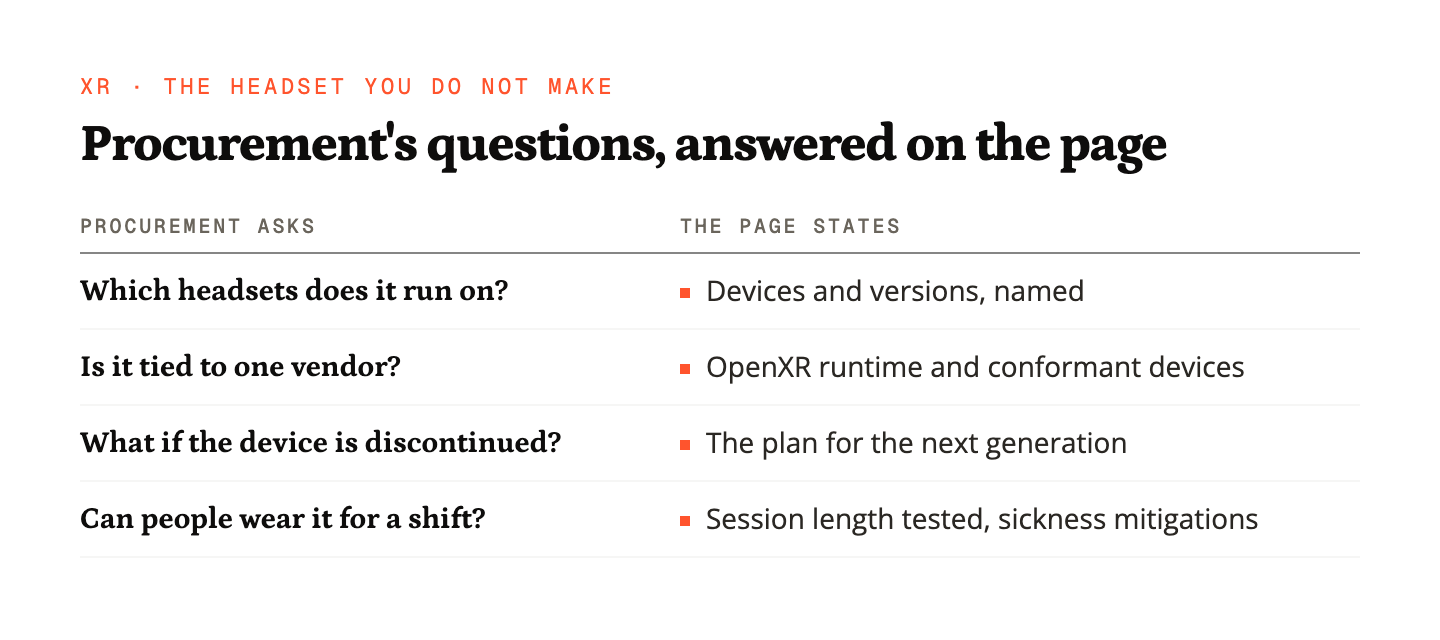
Comfort belongs in the same answer. Research in Frontiers in Virtual Reality links cybersickness in headsets to differences between a user's physical and virtual head position. IEEE 3079-2020 sets out technology for reducing VR sickness.
A buyer rolling out headsets for full shifts will ask how long your sessions were tested for.
How do you convey an experience nobody has tried yet, on a flat screen?
Show what the person inside the headset sees, and what changes because of it. Footage of someone wearing a headset shows the one awkward part of the category: a person gesturing at empty air. It hides the useful part.
An interactive 3D scene in the browser lets a visitor try a version of the thing before the in-person demo. The WebXR Device API gives the web access to VR and AR devices. glTF, Khronos' format for the efficient loading of 3D scenes, is built for exactly this kind of delivery.
For this category, that scene is close to the highest-value asset a website can carry. We cover when 3D earns its cost in 3D industrial animation for deep tech.
Precision matters as much as the medium. When we made an explainer film for Cloudphysician, every reading on screen had to be exact. Ayesha, Chief of Care Center and Model Factory, put it this way: “At a conference full of experts, you get one detail wrong and you lose your credibility.”
Cloudphysician has said it closed its first US client after the first showing of that film. That is the client's own report, and we did not measure it. The lesson carries to XR: state the real number, and get every detail right.
The hardware question does not transfer. Cloudphysician's software runs on infrastructure it controls. An XR company depends on a headset someone else builds, and its page has to say so.
What does naming look like across hardware generations?
Naming has to hold three layers apart: the company, the application and the platform. The headset a brand launches on rarely resembles the one it runs on three years later. A name tied to one device, or to its look, ages when that device is replaced.
Decide the naming architecture before the second hardware generation ships. Then the company never renames itself mid-deployment, in front of the customers it has only recently won. A new application also gets a logical place to sit.
What does an engagement deliver, and how long does it take?
An XR brand engagement takes nine to sixteen weeks from kickoff to a finished brand system, at a fixed scope and one price. The price is quoted after a thirty-minute call, and the ranges are on our pricing page.
The work runs in this order:
- Category and positioning, including XR, AR, VR or an application name.
- Naming, across company, application and platform.
- Narrative and identity.
- Messaging for practitioners, budget holders and procurement.
- A brand book that records all of it.
The team is nineteen people, ten of them engineers by degree, across strategy, 3D, delivery and build. That matters here, because the interactive 3D that replaces headset footage sits with the same team. We sign an NDA before reviewing unreleased hardware integrations, and branding under NDA explains how that works.
When is this not a fit?
A consumer entertainment product with no enterprise buyer yet is early for this. The approach is built around a practitioner and a budget holder signing off together, and a consumer product has neither. If only the site needs work, our XR website work is the narrower option.
If the practitioner and the budget holder cannot both take part, wait. One holds the evidence that the experience works. The other holds the number that justifies the spend.
This suits a company willing to name its hardware dependency, state an operational outcome and choose its vocabulary deliberately. A company that wants a flashier headset video over an unwritten budget case should look elsewhere.
FAQ
Should we avoid the word metaverse?
For enterprise buyers, almost certainly. It carries a recent disappointment. XR reads as jargon and VR as consumer, so the right word depends on who reads the page and who signs.
How do we prove value without a headset in the room?
With the operational number. Training time, error rate and travel avoided survive a slide deck to the person who will never try the headset.
Can an interactive 3D scene replace an in-person demo?
Not entirely. It does replace the video of someone wearing a headset, and it lets a buyer try a version of the outcome before agreeing to the demo.
What happens to our brand when the next headset generation ships?
Nothing, if the naming held the company, the application and the platform as separate layers from the start. Brands built around one device are the ones that struggle.
When should an XR company hire someone else?
When the product is consumer entertainment with no enterprise buyer yet, or when the practitioner and the budget holder cannot both take part in the work.
Written by Mejo Kuriachan. More in the blog, the glossary and the FAQ.