
Strategic branding for advanced materials companies (past the datasheet)
Brand positioning strategy for advanced materials companies: evidence engineering can test, supply answers procurement needs, names that hold a family.

- A datasheet proves a property, not a switch. The material changes the customer's bill of materials, their manufacturing process and their qualification plan.
- Two functions have to say yes and they fear different things. Engineering fears the material fails in their conditions. Procurement fears depending on one source.
- We have seen qualification run to roughly eighteen months between sample and design-in. That is our own observation, and we do not present it as an industry statistic. A campaign cannot span it.
- Naming has to hold the company, the material family and the grade, with room for the formulation that does not exist yet.
Strategic branding for an advanced materials company is the work of deciding what the brand claims when the datasheet has already been read. A property table proves a property. It does not prove that anyone should change a working product to get it.
Why does a strong datasheet fail to win the design-in?
A strong datasheet fails because a property claim and a switch decision are different things. The customer has to change its bill of materials, review how the material affects manufacturing, and requalify the revised design.
A better modulus or thermal limit may justify a look. The figure alone does not pay for the change.
A design-in also creates supply risk. Procurement asks whether the supplier can hold quality and volume, whether an alternative source exists, and what happens if production stops.
That is where brand positioning strategy for advanced materials companies starts. Our advanced materials branding work frames the sale around the whole burden: redesign, requalification and supply continuity.
Buyers verify supplier claims, because the supplier controls the samples and the test conditions. Engineers compare those conditions with their own application and ask for test data under real use. Procurement runs its own review of capacity and sourcing.
A brand cannot replace either check. It can organise the evidence, make the proposed change legible, and keep the supplier consistent across a long evaluation.
Who actually has to say yes?
Two functions have to say yes, and they fear different things. Engineering fears the material fails under the product's real operating conditions. Procurement fears that one supplier's failure will stop production.
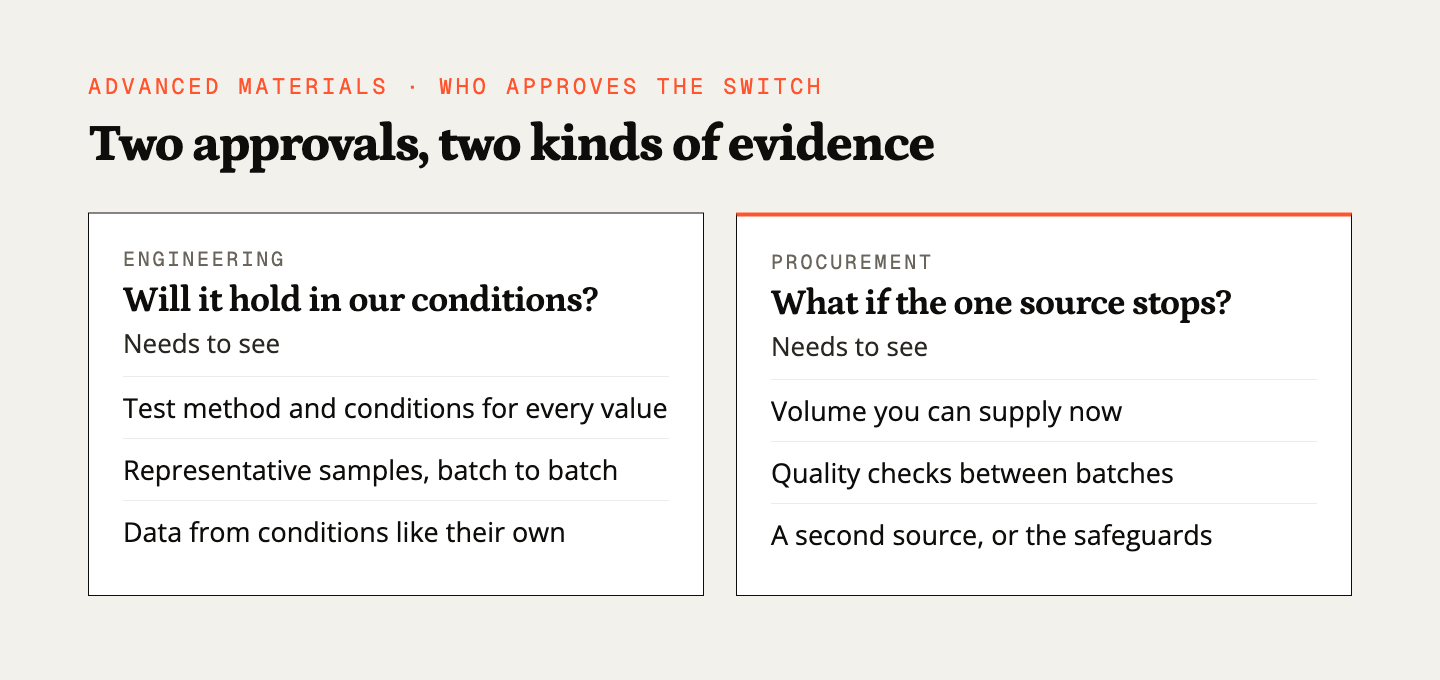
An engineer judges technical fit against a qualification plan. A datasheet may report conductivity or a thermal limit. The engineer still needs test methods, sample consistency and evidence under relevant conditions.
Procurement judges continuity separately from performance. A suitable material can still carry too much concentration risk when one supplier controls the formulation or the capacity. Governments now set the same test at national level: the EU's Critical Raw Materials Act aims for no more than 65% of annual consumption of a strategic raw material from a single third country by 2030.
Most advanced materials sites answer neither reader. They list performance with no validation path, and describe capability without explaining supply resilience. A brand system should give each function its own evidence path, with the material family recognisable across both.
How do you brand something that goes inside another product?
Brand the change the material makes possible, because the buyer is choosing a redesign. That redesign touches the bill of materials, the process and the qualification plan, so the brand has to explain why the work is worth doing.
Connect each property to a design decision. If higher conductivity could allow a smaller thermal assembly, say so. Then say which conditions still need validation.
Organise the site around the path to adoption:
- Performance claims that lead to test reports.
- Sample requests with a clear route.
- Audit and certification information.
- Trial-order terms and evidence.
- Application pages that show where the material sits in an existing product.
The identity also has to work inside somebody else's product story. Diagrams, sample documents and technical language travel into the customer's internal review. The material may be invisible in the finished product, and its contribution should still be easy to explain.
The same problem, seen from the manufacturing side, is in our guide to branding advanced manufacturers. Design-in works the same way for chips, which we cover for semiconductor companies.
What do you do about an eighteen-month qualification cycle?
Build the identity around qualification gates, because qualification runs on documented approvals. We treat roughly eighteen months between sample and design-in as our own field observation, not an industry figure.
A campaign cannot stay useful that long. A brand system can, because each new reviewer meets the same material, claims and evidence.
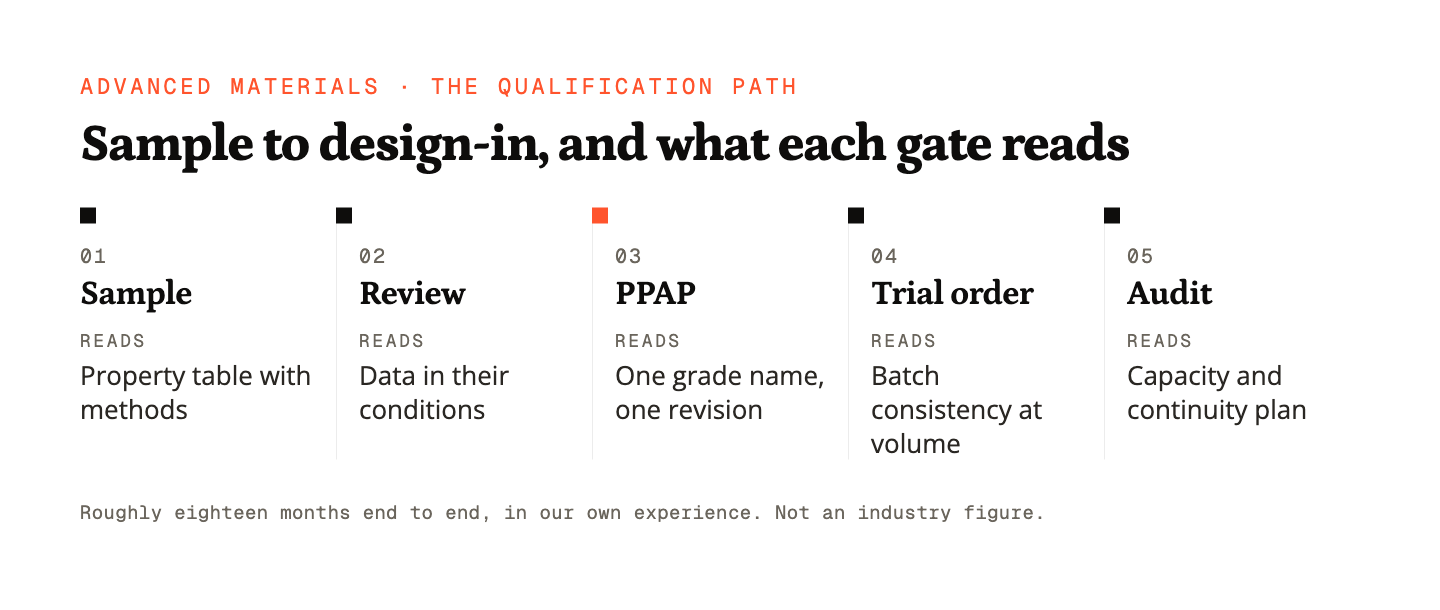
Automotive buyers often run the Production Part Approval Process. AIAG describes it as showing that engineering design records and specification requirements "are achieved by the supplier's manufacturing process." The brand system should keep these identical across every submission:
- Grade names and part identifiers.
- Test reports and certificates.
- Revision numbers.
Reviewers pause approvals when documents are missing or identifiers conflict. Version control and a clear evidence hierarchy remove most of those pauses.
Each gate needs material written for the function reviewing it. Engineering needs condition-specific evidence at technical review.
Procurement needs supply information before commercial approval. The brand book should govern the qualification documents, alongside the website and the deck.
How should the property table be treated?
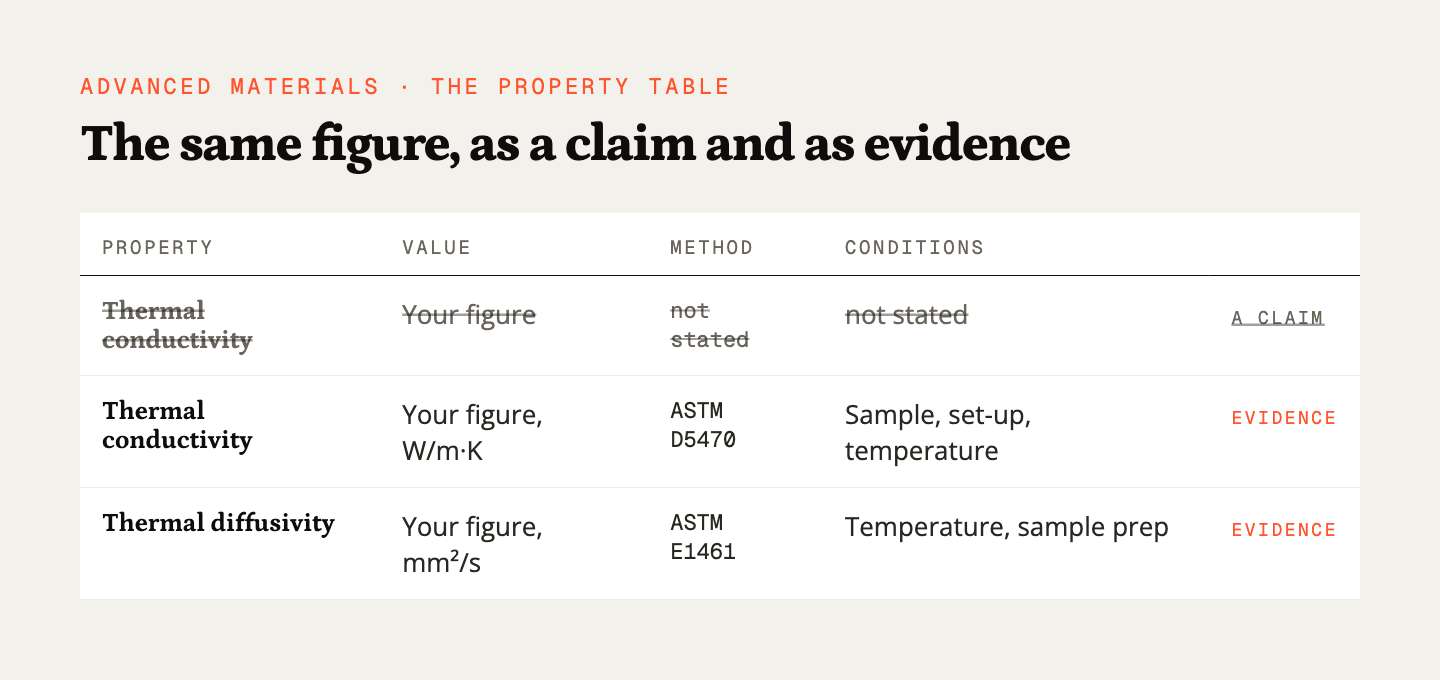
Treat the property table as the primary differentiator, and design it to be read. Buyers compare advanced materials by measurable performance. Modulus, conductivity and thermal limit should be the easiest things on the page to read and to check.
Generalist design teams often cut technical tables because dense figures look dry beside photography. That removes the evidence an engineer came for.
Each value needs its test method and conditions. ASTM D5470 measures thermal impedance and calculates an apparent conductivity for insulation materials.
Diffusivity under ASTM E1461 is a different measurement again. Name the method, and the brand stops implying an equivalence the data does not support.
Reference materials help too. NIST certifies over 1,200 Standard Reference Materials, each with certified composition or properties. A lab that calibrates against one can say so.
A property table can still carry brand character through typography, colour and spacing. Good design gives the evidence more weight without decorating it.
What about scale-up, the question nobody asks out loud?
Everyone believes the lab result. What they need to know is whether you can supply at volume without disrupting them.
A trial order tests a different claim from a sample. The sample shows the material can meet a specification under controlled conditions. A production order shows whether batches stay consistent and quoted lead times hold.
Batch consistency has a standard language. Process capability indices such as Cpk compare a process's natural variation with the specification limits. A supplier who publishes them is speaking procurement's language.
An on-site audit gives a buyer what copy cannot. Engineering inspects production controls and test procedures.
Procurement examines capacity, raw-material dependencies, and the plan for a failure or a demand spike. Automotive buyers will often check quality system certification too, and IATF runs a public certificate validity check for IATF 16949.
So scale-up evidence belongs in the brand narrative:
- The volumes you can supply now.
- What triggers more capacity.
- How quality checks work between batches.
- How properties hold if production moves to a different line or plant.
Procurement will also ask what happens if your main site stops. A second plant or qualified alternate source reduces risk only when the buyer can verify it. If you are single-source, say so and describe the safeguards.
The strongest version separates current capability from planned capability. A buyer can then judge the supply arrangement they would actually approve.
What does naming look like across a material family?
Naming has to hold three layers: the company, the material family and the grade, with room for a formulation nobody has made yet.
Define how the layers work before naming any product. A grade named after its first application misleads the moment an engineer finds a second use.
An isolated product name leaves the next formulation nowhere to sit. A naming system built on families gives every new grade a predictable place.
Our current work with Scimplify faces exactly this.
Scimplify is a science led manufacturer of advanced materials, speciality chemicals and molecules, and is one of the companies we work with. We are building the visual language and home page behind its repositioning from speciality chemicals to advanced materials. The work has to set up recognisable families and grades without hiding the company name above them.
It is still in progress, so there is no outcome to report yet.
What does an engagement deliver, and how long does it take?
An advanced materials engagement takes nine to sixteen weeks from kickoff to a finished brand system, at a fixed scope and one price. The price is quoted after a thirty-minute call, and the ranges are on our pricing page.
The work runs in this order:
- Category and positioning.
- Naming, where the family structure needs it.
- Narrative and identity.
- Messaging for engineering, procurement and leadership.
- A brand book that records the decisions and usage rules.
The team is nineteen people, ten of them engineers by degree, across strategy, 3D, delivery and build. We sign an NDA before reviewing unpublished technology, and that is our normal starting point. Most of what makes a materials company defensible is unpublished, which we cover in branding under NDA.
When is this not a fit?
A fast logo refresh or a single hero product page is not a fit. A freelance designer or a production studio will serve you better and cost less. That work needs no category decision or naming architecture.
If only the site needs work, see our advanced materials website practice.
If engineering and procurement cannot be in the room, wait. Engineers hold the conditions and evidence behind every material claim.
Procurement holds the concerns about capacity, continuity and single sourcing. Without both, a brand can promise a change the buyer cannot approve.
This suits companies willing to examine positioning, naming, technical evidence and identity together. A company that wants new graphics while the product architecture stays untouched should look elsewhere.
FAQ
How long does an advanced materials branding engagement take?
Nine to sixteen weeks for positioning, narrative, identity and a brand book, at a fixed scope and one price agreed after an initial call.
What is the status of the Scimplify engagement?
In progress. We are building the visual language and home page behind Scimplify's repositioning from speciality chemicals to advanced materials. There is no result to report yet.
Does branding replace test data?
No. Branding does not prove material performance. It organises the technical evidence so a buyer can find it, read it and compare it, with the detail an engineer needs left intact.
Can PPAP or a trial order do the work of a brand?
They prove different things. PPAP reviews and trial orders establish production readiness under buyer scrutiny. The brand connects those proofs to the performance claim, so a buyer sees one account.
When should an advanced materials company hire someone else?
When the need is a quick logo refresh or one product page, or when engineering and procurement cannot take part in naming and evidence decisions.
Written by Mejo Kuriachan. More in the blog, the glossary and the FAQ.