
Strategic branding for aerospace and defence companies (literally true)
Aerospace and defence brand strategy where every word becomes a contractual expectation: readiness stated exactly, restricted proof planned for.

- Every claim on an aerospace or defence page becomes a contractual expectation at milestone review. Copy that is harmless elsewhere is a liability here.
- Being new counts against you in this category. The brand has to turn youth into evidence of rigour, without hiding how recently the company was founded.
- Export control and classification remove your best proof from public use. What stays public has to carry the whole argument.
- The prime rewards caution and conformance. The investor rewards ambition and speed. One page has to satisfy both without misleading either.
Strategic branding for an aerospace or defence company is the work of being ambitious and literally true in the same sentence, because in this category those two requirements are not in tension so much as the entire job. You are selling into procurement cycles that outlast most companies, to buyers who will hold every word against you at the next milestone review.
Why does a strong capability statement not win the programme?
A capability statement proves the technology works, and the programme decision turns on something else: where you sit. The buyer places you against the primes, the tier ones and their own internal capability, and decides at what tier you get bought. A demonstrated capability is the entry ticket to that decision.
Most sites in this category stop at the capability, because engineering is proudest of it and it is the safest thing to publish. Our aerospace and defence branding work starts one step further out, with where the buyer places you before they read a spec.
That category label decides more than tone:
- A subsystem supplier is compared with other subsystems.
- A platform is compared with other platforms, at a different tier of the procurement structure.
- A capability provider is compared with whatever the customer could build in-house.
A company that has not chosen yet gets placed by the buyer instead. That is usually at whichever tier is easiest to discount. Deciding it is the first step of positioning, and the rest of aerospace and defence brand strategy follows from it.
Why is every word on the page a contractual commitment?
In this category, copy that would be harmless for a software brand becomes an expectation a programme office holds you to at the next review. "Demonstrated", "qualified" and "designed to" describe three different states of readiness. A buyer who has been burned before assumes the weakest reading of whichever word you chose.
NASA's Technology Readiness Levels show how precise that vocabulary is. The scale runs from TRL 1 to TRL 9. A TRL 6 technology has a fully functional prototype; only a flight-proven technology is TRL 9.
A brand that overreaches by one adjective loses a contractual position. It then has to defend that position at a review it cannot walk back from.
The discipline is closer to legal drafting than to marketing copy. Every claim needs two answers:
- What evidence backs it.
- At what state of readiness it was made.
A programme office that finds a gap between the two reads it as a broken commitment.
Why does being new count against you?
Novelty counts against you because, in a category where failure is measured in lives, it reads as a risk to manage. A young company's honest instinct is to lead with energy and speed, and that is the wrong instinct here. The brand has to turn youth into evidence of rigour, without hiding how recently the company was founded.
Governments have built routes for new entrants, which tells you how hard the front door is. The US Defense Innovation Unit describes itself as the department's primary interface with the non-traditional ecosystem.
In Europe, the European Defence Fund runs a bonus system for SMEs and a scheme for smaller innovators. Those routes open a door; the brand still has to read as serious once the buyer walks through it.
Armory, which builds AI-powered counter-drone systems, faced exactly this problem.
Amardeep, its founder and CEO, put the brief this way: “We did not want a website refresh. We wanted a site that made it impossible to confuse us with a small startup. Investors and senior engineering candidates land on the page and immediately understand the gravity.”
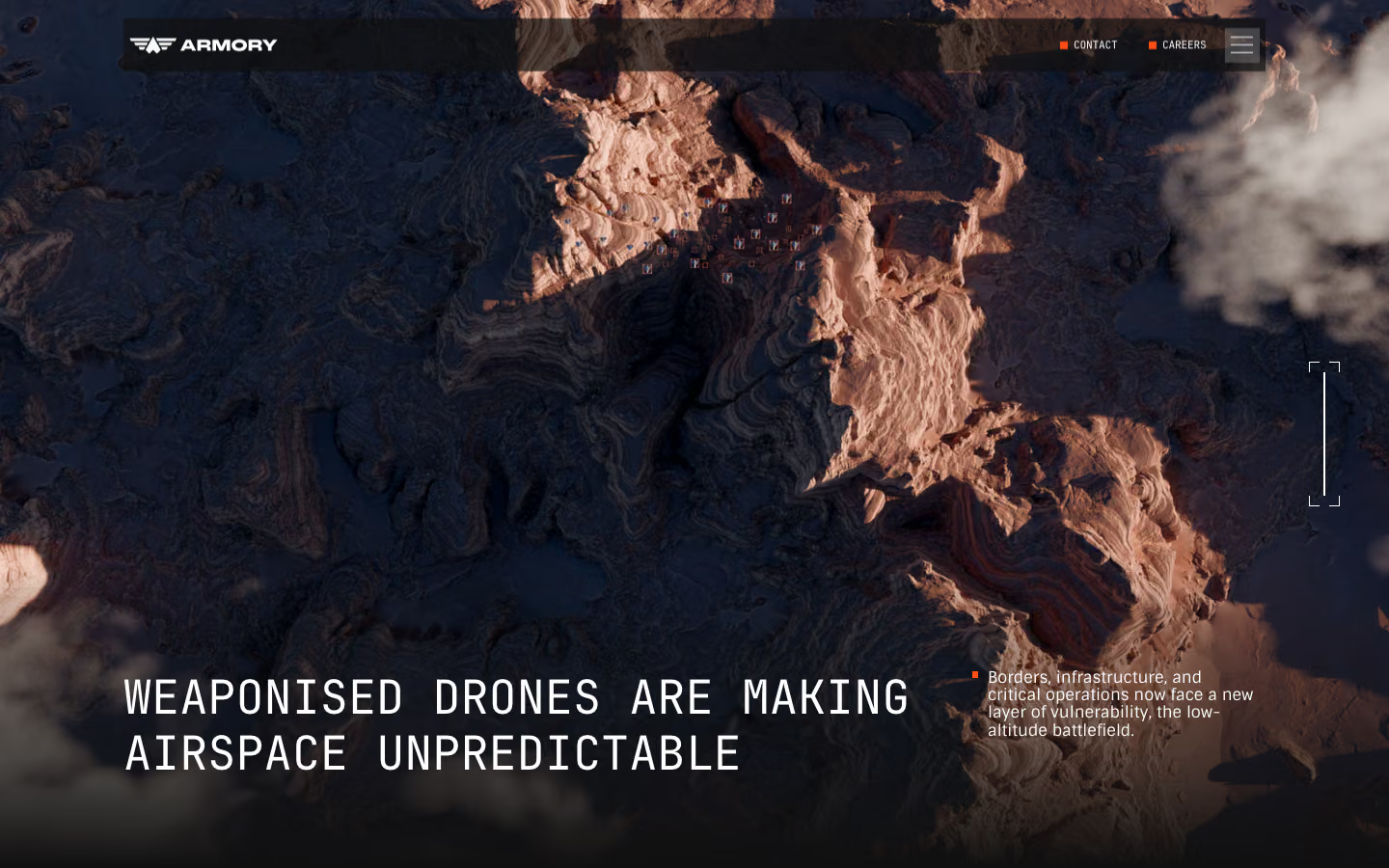
We rebuilt the site, modelled the 3D and made the film. Armory reports that the website now has a fan club of its own. That result is the client's report, and we have not measured it.
What do you do about the half of the story you cannot publish?
You decide on purpose what the public brand can carry, because export control will remove your best proof from public use whether you plan for it or not.
In the US, items on the United States Munitions List fall under ITAR. In the EU, Regulation (EU) 2021/821 controls dual-use goods, software and technology. The UK's Export Control Joint Unit licenses military and dual-use items.
Most sites in this category either overshare or say almost nothing. Oversharing creates its own problems, and silence reads as having nothing to show. Both are decisions, and most companies make them by accident.
The discipline is to write the public argument assuming your strongest evidence never appears on the page. Armory's site draws its threat timeline and states detection, verification and response as a sequence. That shows how a system works without publishing the system.


Agencies without category experience tend to fill the gap with generic language. A technical buyer who knows exactly what is missing reads that as evasive. The better move is to state the boundary plainly:
- What is public.
- What is available under NDA.
- What is not shown at any stage.
Stated that way, the omission reads as a decision. We cover the mechanics in branding under NDA.
Who are the two buyers, and why do they want opposite things?
The two buyers are the prime and the investor, and they reward opposite instincts. The prime rewards caution and conformance: heritage, certification, and a record of doing exactly what was promised. The investor rewards ambition and speed: growth, a widening market, and technology that improves fast.
One page has to satisfy both without lying to either. The careful, qualified language that reassures a prime can read as a lack of ambition to an investor. The language that excites an investor can read as overreach to a prime.
The way through is separation. Heritage, certification and track record sit in one part of the argument, stated with full conservatism. Growth and market size sit in another, stated with full ambition.
Blending the two registers reassures nobody. Writing for several readers at once is its own discipline, covered in how deep tech companies talk to investors, buyers and engineers. The investor half has its own craft, set out in a pitch deck investors without a deep tech background can follow.
How should certification be treated on the page?
Treat certification as proof, and give it real space instead of an appendix. AS9100D is the quality management standard for aviation, space and defence organisations. DO-178C, "Software Considerations in Airborne Systems and Equipment Certification", governs airborne software, and the FAA recognises it through Advisory Circular AC 20-115D.
To a prime deciding whether to trust you with a subsystem, these are table stakes. To an investor who cannot judge the engineering, they are evidence of seriousness. A footnote wastes proof that works on both readers at once.
What does naming need to survive a decade-long programme?
A naming system for this category needs room for a company, a platform and a variant to exist as three separate, related things. A programme can run for years from first contact to production, well past the point where a name chosen for a pitch still fits the product that shipped. A name tied to the first variant becomes a constraint the moment a second one exists.
The naming work sets the layers before any single product is named:
- The company, which outlives every programme.
- The platform, which spans variants.
- The variant, which changes with each configuration.
The company name matters most. A company known for one variant spends years explaining that it now does more. That is the moment it should be trading on the reputation the first programme earned.
What does an engagement deliver, and how long does it take?
An aerospace and defence brand engagement takes nine to sixteen weeks from kickoff to a finished brand system, at a fixed scope and one price. The price is quoted after a thirty-minute call, and the ranges are on our pricing page.
The work runs in this order:
- Category and positioning: where you sit against the primes and the tier ones.
- Naming, narrative and identity.
- Messaging for primes, programme offices, regulators and investors.
- A clear line on what stays unpublished.
- A brand book that records all of it.
The team is nineteen people, ten of them engineers by degree. Our head of web is an aerospace engineer, which shows in specification pages that read like specifications. We model 3D from your drawings at whatever level of detail you are cleared to publish.
We sign an NDA before reviewing anything restricted, as the normal starting point.
When is this not a fit?
A fast logo refresh or a single spec sheet online is not a fit. A freelance designer or a production studio will do that faster and for less, because it needs no category decision and no naming system. If only the site needs rebuilding, our aerospace and defence website work is the narrower option.
If you cannot say in the room what stays public, wait. That line has to be drawn before naming, narrative or identity work starts. A brand built on material that later turns out to be restricted has to be rebuilt from the start.
This suits a company ready to be precise about "demonstrated", "qualified" and "designed to", and to let certification carry weight on the page. A company that wants to sound bigger than its current position should look elsewhere.
FAQ
How long does an aerospace or defence branding engagement take?
Nine to sixteen weeks for positioning, narrative, identity and a brand book, at a fixed scope and one price agreed after an initial call.
Have you done this before?
Yes. Armory, on AI-powered counter-drone systems: detection, directional jamming, mesh networking and a self-learning operating system. Our head of web is an aerospace engineer.
How do you handle restricted material?
NDA first, and we design the public brand assuming your best proof can never be shown. If an argument only works with restricted material, the public brand cannot use it.
Does branding replace certification or a qualification programme?
No. Branding does not certify anything. It gives certification and qualification evidence a place on the page where a prime or an investor can find and read it.
When should an aerospace or defence company hire someone else?
When the need is a single spec page or a fast refresh, or when nobody in the room can yet say what the public brand may carry.
Written by Mejo Kuriachan. More in the blog, the glossary and the FAQ.