
Strategic branding for biotech companies (claims that hold)
Biotech brand strategy for claims that survive a clinician, a regulator and an investor: stage stated precisely, and evidence designed to be checked.

- A trial result proves a compound works under set conditions. A company is a larger claim, and a clinician, a regulator and an investor each test it differently.
- Claim boundaries have to be settled before the narrative is written. In biotech the regulated wording is the brand, and overreach costs more than caution.
- Stage has to be stated precisely. A site that blurs preclinical and phase two loses the reader whose trust matters most.
- The differentiating evidence sits in endpoints, cohort size and statistical power. Those figures should be designed to be checked, and never cut.
Strategic branding for a biotech, medtech or diagnostics company is the work of being persuasive under a constraint most categories never face: every claim has to be literally true, because it will be read by someone who can check it and by a regulator who can act on it.
Why does a trial result not establish a company?
A trial result establishes that a compound, device or mechanism works under specific conditions. A company is a larger claim: that the result repeats, that it scales, and that the team can deliver the next one.
Readers in this category have watched strong early results fail to repeat. Across 2011 to 2020, only 7.9% of candidates entering Phase I went on to approval, according to BIO, Informa and QLS Advisors. Phase II was the largest hurdle, with 28.9% of candidates getting through it.
So our biotech branding work treats the trial result as one piece of evidence inside a larger argument. The company-level argument has to cover three things:
- The platform behind the result.
- The pipeline beyond the lead programme.
- The team's ability to run the next study to the same standard.
A brand that only restates the headline endpoint leaves that larger question open. It is the question an investor or a partner came to have answered.
Why is regulated claim language the brand itself?
Regulated claim language is the brand itself because copy that would be ordinary elsewhere is a compliance problem here. Most studios discover that at legal review, after the design work is finished.
The rules are explicit. In the US, the FDA's Office of Prescription Drug Promotion exists to ensure that drug promotion “is truthful, balanced, and accurately communicated”. In the UK, the ABPI Code of Practice covers advertising, digital material and information given to the public.
That changes the order of operations. Claim boundaries come first: what can be said about mechanism, outcome and comparison to standard of care. The narrative is written inside them, and legal review becomes a formality.
A brand book earns its keep here more than almost anywhere.
The same boundary has to hold across a website, a scientific poster, a booth and an investor deck. Different people make those on different timelines. Writing the boundary down once stops the marketing team becoming the source of the compliance problem.
Why does stage have to be stated with total precision?
Stage has to be stated precisely because the reader whose trust matters most will notice any blur. Preclinical and phase two are different claims. Borrowing the confident language of an approved product is a common shortcut, and clinicians discount the whole page when they see it.
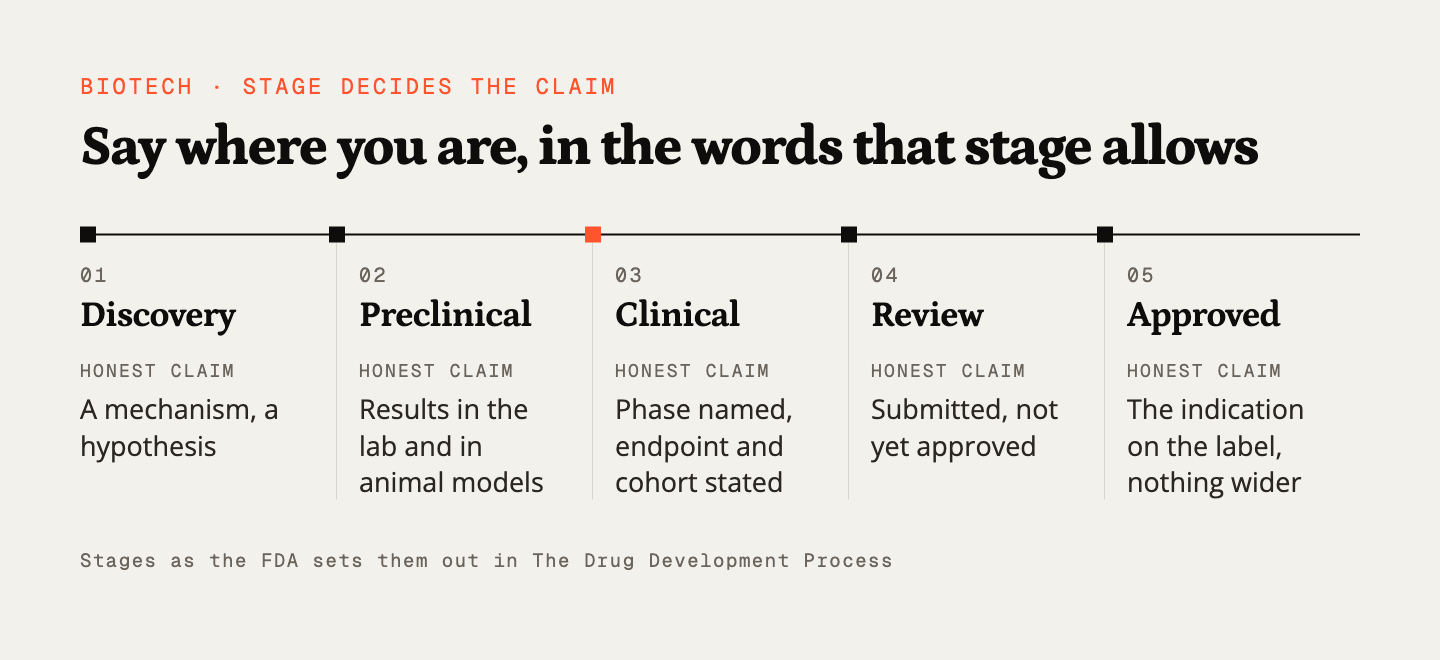
The FDA sets out five steps in drug development: discovery, preclinical research, clinical research, FDA review and post-market monitoring. A site should say which one the company is in, in words that stage allows.
Precision about stage is a trust asset. A company that says plainly where it is signals it will be straight about the result when it comes in.
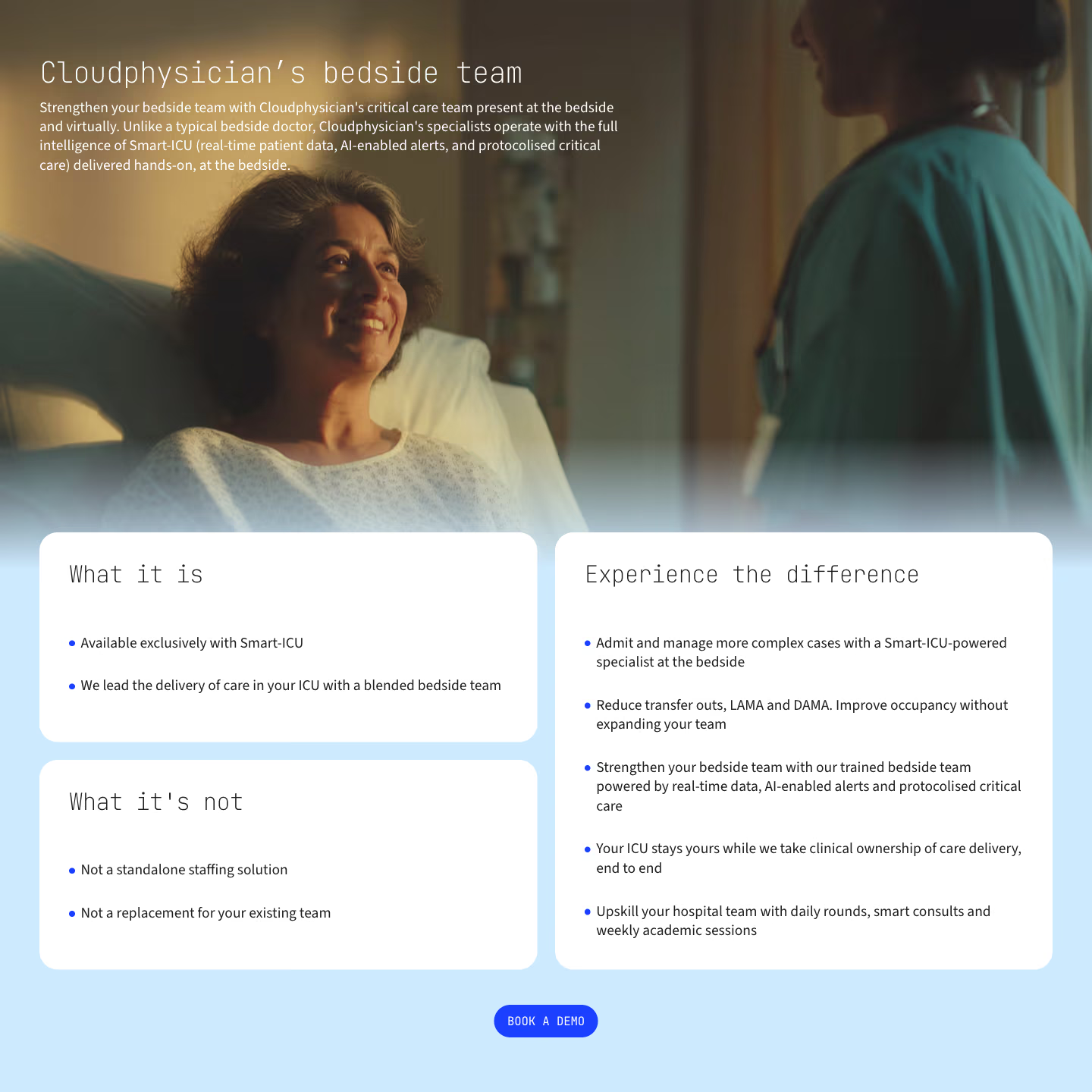
Cloudphysician, in the neighbouring field of critical care software, shows the same discipline. Its site sets out the bedside team as what it is and what it is not.
Who are the three readers, and what test does each one run?
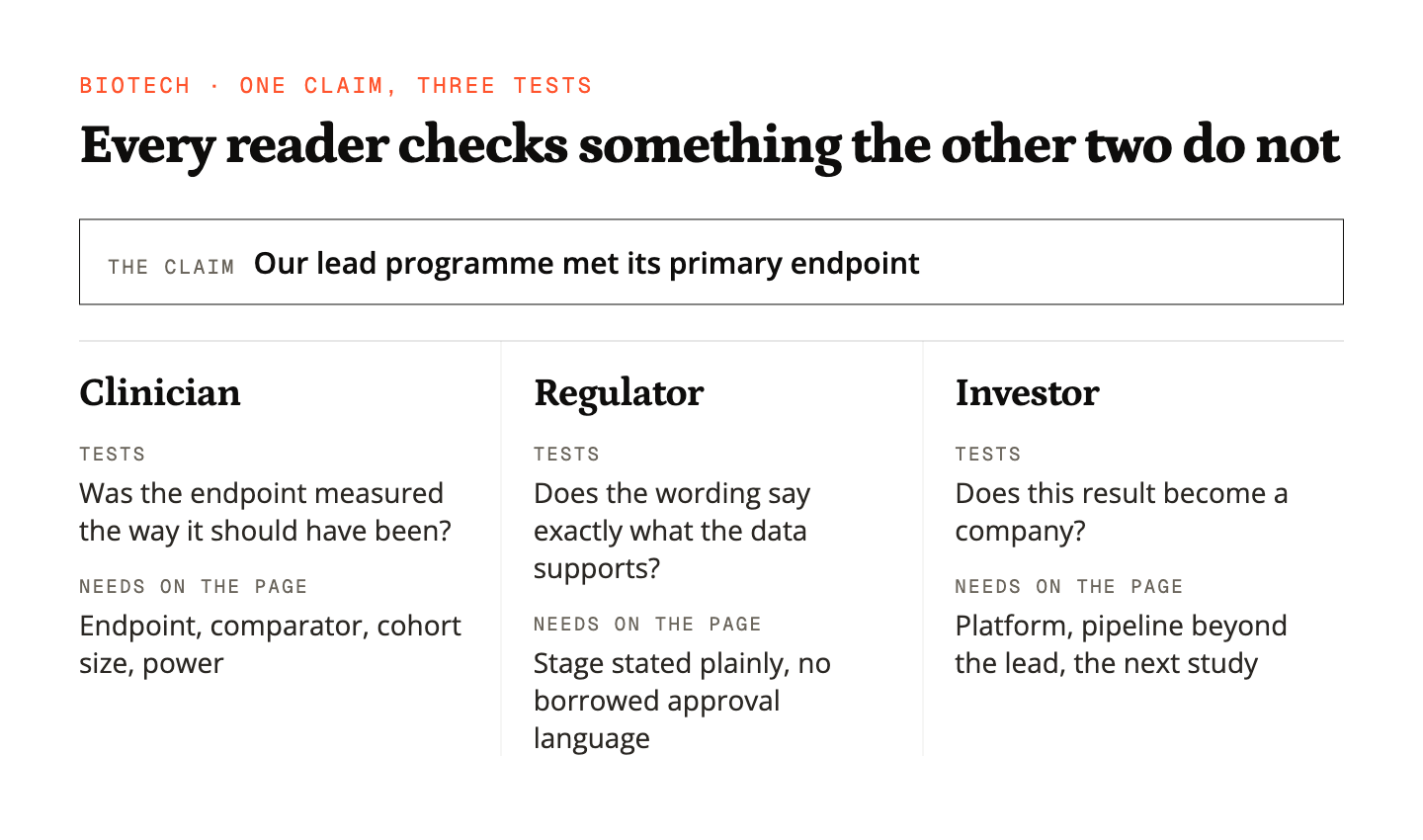
The clinician, the regulator and the investor each check something the other two do not:
- The clinician tests the endpoint. Does the result mean what it appears to, measured the way it should have been?
- The regulator tests the claim. Does the wording say exactly what the data supports, and no more?
- The investor tests the market. Does this result turn into a business?
One page has to survive all three at once. Writing for the investor first is the common shortcut, because a confident narrative satisfies that reader fastest.
It is also the shortcut most likely to produce wording a clinician or regulator reads as overreach. We cover writing for several audiences at once in how deep tech companies talk to investors, buyers and engineers.
Precision has to reach the smallest detail. Ayesha, Chief of Care Center and Model Factory at Cloudphysician, described the standard for its clinical film.
“If the heart rate was 120, it had to be 120, not 100. If the ventilator setting was nine, it had to be nine. At a conference full of experts, you get one detail wrong and you lose your credibility.”
Cloudphysician makes a tele-ICU copilot and runs no drug trials of its own. We are direct with clients about that boundary: our experience is in a neighbouring regulated, evidence-driven field.
Why does the evidence live in figures most agencies want to cut?
The evidence lives in endpoints, cohort size and statistical power because those figures carry a clinician's decision. They are also what a generalist design team cuts first, because dense tables look dry next to a strong photograph. Cutting them removes the thing the most important reader came to read.
The standards for those figures already exist. The CONSORT statement sets the minimum for reporting randomised trials. ICH E9 sets the statistical principles for their design and analysis.
A page that presents figures the way those documents expect reads as credible to a specialist.
A well-designed evidence section does four things:
- States units consistently.
- Names the comparator each figure was measured against.
- Explains cohort size and power as considered choices.
- Lets a generalist follow the shape of the argument without the tables.
Cloudphysician's homepage states its numbers up front.

A clinician scanning for the study design leaves within seconds if that context is missing, however strong the headline endpoint looks.
What happens to a biotech brand across a decade and several pivots?
A biotech brand has to be built around the mechanism and the evidence, because ten years and several pivots is a normal distance from founding to approval. An identity anchored to today's lead programme rarely outlives it.
A brand tied to one asset needs rebuilding when that asset succeeds, fails or is licensed away.
Our positioning work anchors the company to what persists across programmes. The narrative then carries that across each stage. How a brand should change as a company moves through funding stages is covered in deep tech branding by stage.
What does naming need to hold from founding to approval?
Naming has to leave room for a product name that does not exist yet. The company, the platform and each programme are three separate naming jobs. The product name often arrives only at approval, years after the others are in use.
Drug names add a further layer. The WHO assigns each active substance an International Nonproprietary Name, which is public property. It also states that trade marks should not be derived from INNs or use their common stems.
A naming system that assumes the product name from day one usually has to be unwound at approval.
What does an engagement deliver, and how long does it take?
A biotech brand engagement takes nine to sixteen weeks from kickoff to a finished brand system, at a fixed scope and one price. The price is quoted after a thirty-minute call, and the ranges are on our pricing page.
The work runs in this order:
- Category and positioning, against standard of care, platform companies and the option of doing nothing.
- Naming, where the hierarchy needs it.
- Narrative and identity.
- Messaging for clinicians, regulators, payers and investors.
- A brand book with the claim boundaries written in, so they hold after we leave.
The team is nineteen people, ten of them engineers by degree, across strategy, 3D, delivery and build. That includes mechanism-of-action animation where it helps a non-specialist see what a therapeutic or device does. We sign an NDA before reviewing unpublished data, as we explain in branding under NDA.
When is this not a fit?
A fast logo refresh or a single product page is not a fit. A freelance designer or a production studio will do that faster and for less, because it needs no claim boundaries and no naming system. If only the site needs rebuilding, our biotech website work is the narrower option.
If your legal or regulatory function cannot take part, wait. They hold the line between what the evidence supports and what would overreach. Without them, a brand can only guess at it.
This suits a company ready to state its stage precisely and let dry figures carry weight. A company that wants confident language ahead of its evidence should look elsewhere.
FAQ
How long does a biotech branding engagement take?
Nine to sixteen weeks for positioning, narrative, identity and a brand book, at a fixed scope and one price agreed after an initial call.
Can you work within regulated claim language?
Yes, and the boundaries go into the brand book so they hold after we leave. In this category, working inside the constraint is the craft.
Do you have life sciences experience?
Our experience is adjacent: Cloudphysician on the clinical software side, and years of work in categories where evidence and regulation decide the sale. We are direct with clients about where that experience stops.
Does branding replace clinical or regulatory evidence?
No. Branding does not produce a trial result or a regulatory clearance. It organises that evidence so a clinician, a regulator and an investor can each find what they came for.
When should a biotech company hire someone else?
When the need is a single product page or a quick refresh, or when legal and regulatory cannot take part in setting the claim boundaries.
Written by Mejo Kuriachan. More in the blog, the glossary and the FAQ.