
Strategic branding for telecom companies (past the RFP)
Telecom brand strategy for vendors facing a scoring matrix: publish interop results, speak procurement's economics, and name for the release cycle.

- A feature list proves capability. A procurement process is built to make vendors comparable, so a feature list alone ends in a price fight.
- Interop is the question a buyer asks first. Published, tested results against the incumbent's kit are worth more than any claim a brand can make.
- We have not built a brand for a telecom or network vendor. Two engagements in neighbouring sectors solved a version of the same procurement problem.
- Naming has to hold the company, the product family and the release, because the standard moves on its own schedule.
Strategic branding for a telecom or network infrastructure company is the work of deciding what the brand claims once the buyer has already opened a scoring matrix designed to make you comparable to everyone else in it. A feature list proves capability. It does not survive procurement, which is built to reduce every vendor to a row on a spreadsheet.
Why does a feature list fail to survive procurement?
A feature list fails in procurement because a structured RFP and a scoring matrix exist to make competing vendors comparable. Handing over a feature list finishes that job for the buyer. Once your capability is a column of ticks next to the incumbent's column of ticks, price decides.
That is the one position a smaller or newer vendor cannot win from.
Our telecom branding work treats this as the real brief. The brand has to give the buyer something the matrix cannot score, and there are three candidates:
- An architecture argument: why the design ages better over the life of the network.
- An economic argument: why the total cost favours you at year five, and what it costs at year one.
- An interop argument: tested results against equipment the operator already runs.
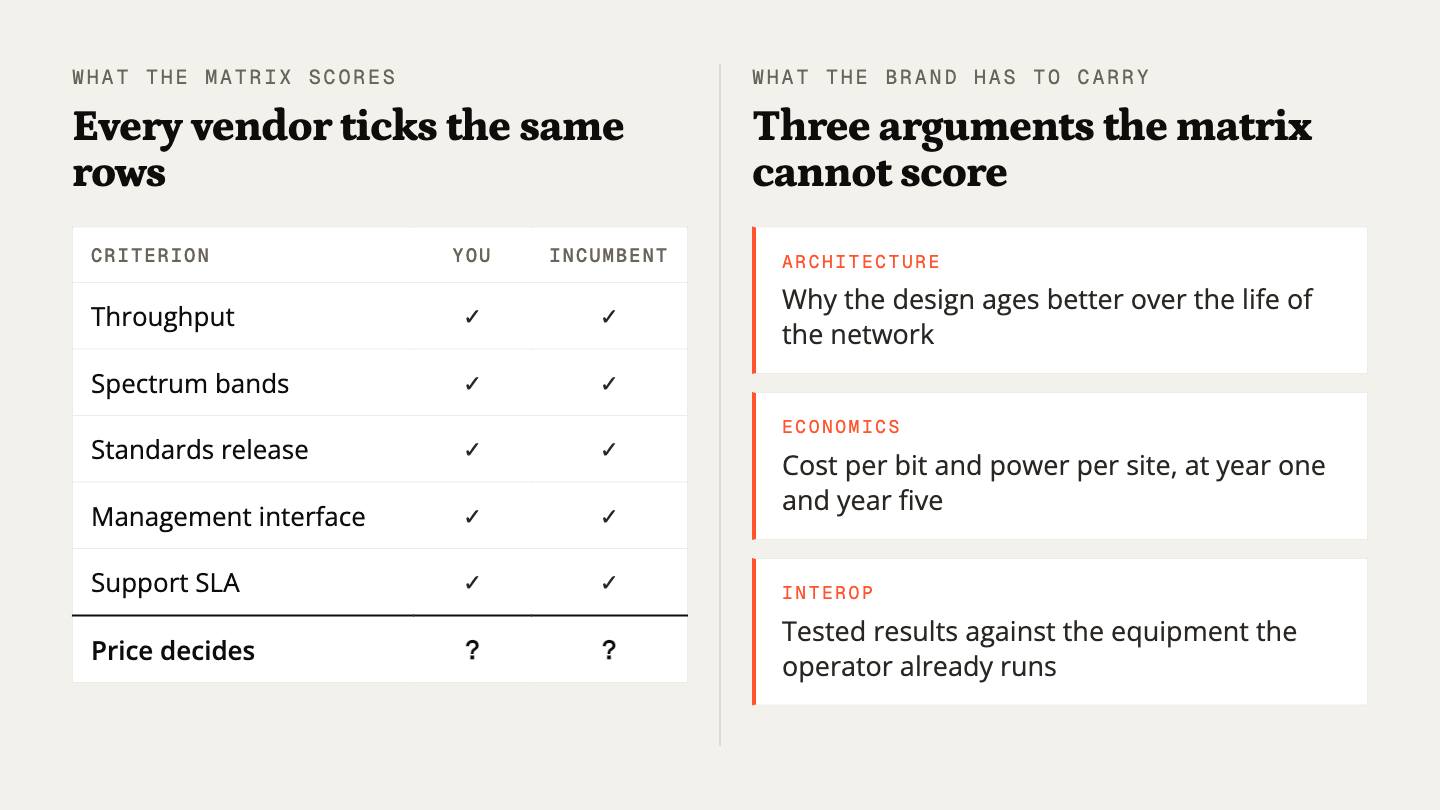
None of this means skipping the scored criteria. The RFP response still answers every row. The brand carries the evidence a scoring column has no room for.
Why is interop the real question, and why does almost nobody publish it?
Interop is the real question because no operator buys a component that has not been proven against the incumbent equipment already running the network. An operator is testing whether your radio works next to the vendor they already have, without an outage. The answer is worth more than any claim the brand could make.
The industry already has the machinery for this. The O-RAN Alliance runs testing and integration programmes, including PlugFests and an interoperability badge for paired products. The Telecom Infra Project describes its work as validation through community labs, testing and certification.
A published interop result carries four things:
- Which vendors' equipment it was tested against.
- Which software release, on both sides.
- Which test or programme produced it.
- What did not pass, and what is scheduled next.
Few vendors in this category publish that, which is why it persuades. Withholding it does not make a vendor look further along. An evaluator assumes the results were too weak to print, and that assumption is hard to undo on a follow-up call.
For a neighbouring case, see how an integration list decides a cybersecurity evaluation. The mechanism is the same.
How do you position against an incumbent with far more scale?
You position against a larger incumbent by changing what the buyer compares. A smaller vendor does not win on scale, references or balance sheet. The brand moves the evaluation onto ground where scale decides less: architecture, economics, openness, or an interop result the incumbent has less reason to publish.
This is a positioning decision before it is a marketing one. It has to be made with the buyer's real scoring criteria in view. Made any other way, the repositioning reads as spin.
Amardeep, founder and CEO of Armory, a counter-drone company selling into defence procurement against far larger primes, put the goal plainly: “We did not want a website refresh. We wanted a site that made it impossible to confuse us with a small startup. Investors and senior engineering candidates land on the page and immediately understand the gravity.”
Armory is defence work, a neighbouring sector. The problem it solved, being taken seriously next to much larger incumbents, is the one a telecom challenger faces.
What is the economic model procurement is actually running, and does the brand speak to it?
Procurement is running a total cost model, built on cost per bit, power per site and cost over a multi-year contract. Most telecom brands never engage with it. The decision lives in a spreadsheet, and a brand that stays at the feature level argues a case nobody in procurement is deciding.
State the economics in the terms procurement already uses. Energy efficiency has an agreed method: ITU-T Recommendation L.1331 sets out how to assess the energy efficiency of mobile networks. A figure measured against a recognised method can be dropped straight into the buyer's model.
Be honest about trade-offs in the same figures:
- If a lower running cost comes with a higher upfront price, say so.
- If a smaller footprint means a longer install, say so.
- If the saving depends on traffic load, state the load.
A procurement team building its own model will find the trade-off anyway. Finding it already stated is what makes a vendor easy to trust over a long contract.
Who are the two buyers converging on the same page, the carrier and the enterprise?
The two buyers are a carrier buying on total cost and risk through formal procurement, and an enterprise buying a private network on outcome. Increasingly, both arrive at the same site. Most telecom sites are written for the carrier, and the enterprise buyer has to translate an unfamiliar vocabulary alone.
The enterprise side is real and regulated. In the UK, Ofcom's shared access licence lets businesses access spectrum for local wireless networks, including the 3.8 to 4.2 GHz band.
Carriers, meanwhile, are packaging network capability as enterprise outcomes. Virtualised network functions, standardised through ETSI's NFV work, are part of what makes that packaging possible.
A brand that keeps a clear path for both readers holds more of the category. Neither should have to read language written for the other. Writing for several technical audiences at once is covered in how deep tech companies talk to investors, buyers and engineers.
What has Everything Deep Tech actually done in telecom, and what hasn't it?
We have not branded a telecom or network infrastructure vendor. Two engagements in neighbouring sectors carry a similar procurement problem, and it is worth being specific about where the similarity holds.
Ayr Energy makes critical power grid equipment: power, medium voltage and special purpose transformers, and high voltage circuit breakers. It sells into utility procurement against long-established incumbents, through technical evaluation built on standards and testing.
Armory builds AI-powered counter-drone systems, including mesh networking. It sells into defence procurement, where interoperability with equipment already in the field comes up early.

Neither company operates in telecom. Both show the same method: a technically capable vendor, positioned against far larger incumbents, inside a buyer process built to commoditise the comparison.
What does not transfer cleanly is the standard itself. Grid codes and defence interoperability requirements move on slower, more bilateral timelines than a 3GPP release. We would say so on a first call.
What does naming need to survive across a standard's release cycle?
A telecom naming system needs the company, the product family and the release held as separate layers, because the standard advances on its own schedule. 3GPP works in parallel, numbered releases, each a stable platform that later releases add to. The ITU's IMT-2020 framework is the generation label 5G sits under.
A product name tied to one release reads dated when the next one ships.
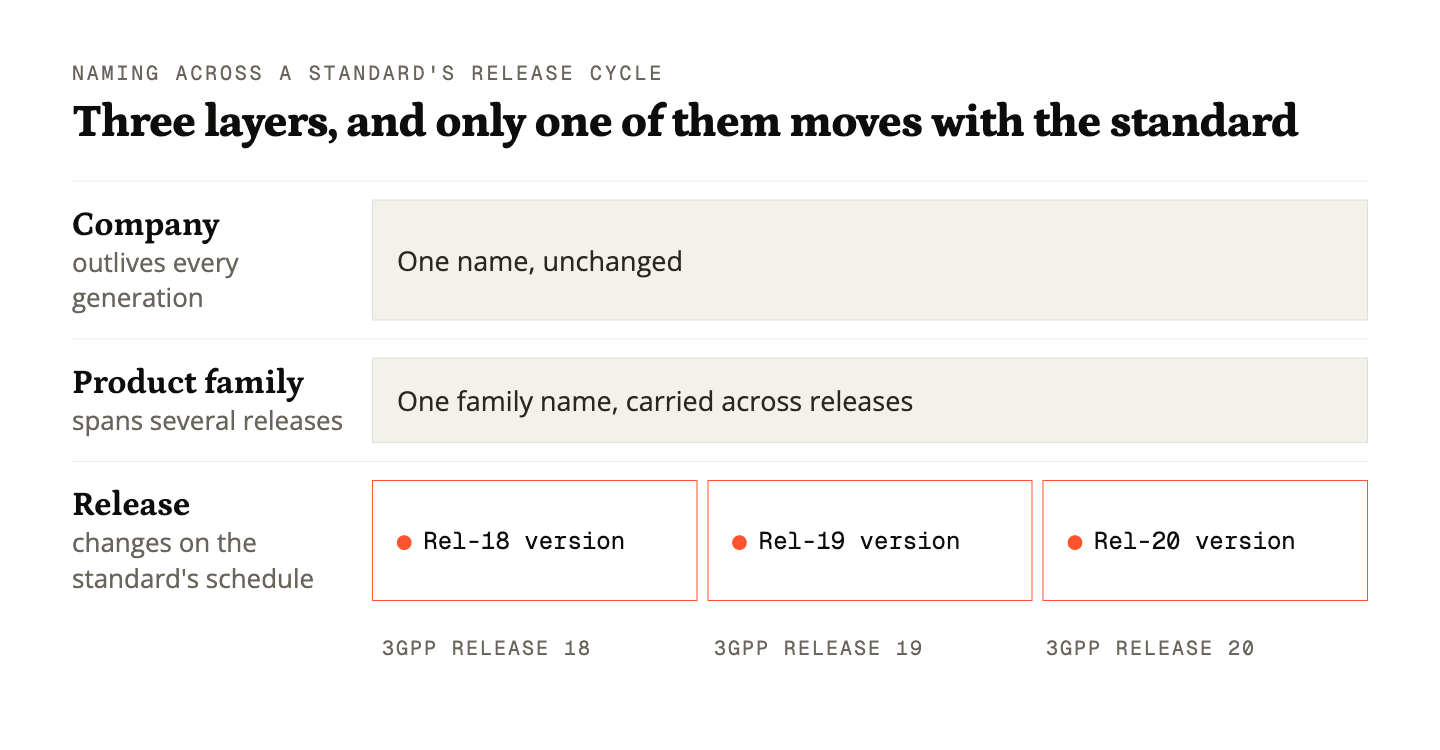
Define the layers before naming a single product:
- The company, which outlives every generation.
- The product family, which spans several releases.
- The release or version, which changes on the standard's schedule.
That gives the next release somewhere logical to sit. Our naming work starts from that hierarchy.
What does an engagement deliver, and how long does it take?
A telecom brand engagement takes nine to sixteen weeks from kickoff to a finished brand system, at a fixed scope and one price. The price is quoted after a thirty-minute call, and the ranges are on our pricing page.
The work runs in this order:
- Category and positioning, against the incumbents, the open alternatives and the operator's own integration team.
- Naming, where the release structure needs it.
- Narrative and identity.
- Messaging for each buyer: network architects, procurement, and enterprise owners of private networks.
- A brand book that records all of it.
The team is nineteen people, ten of them engineers by degree, across strategy, 3D, delivery and build. That includes modelling radios, racks and deployment scenarios in 3D, where they would otherwise be photographed under studio lighting.
For an interconnect company, that meant drawing the signal path. Kandou AI is semiconductor work, a neighbouring sector, and its site explains the product as an input and output diagram.

We sign an NDA before reviewing unpublished technology or interop results still under test. That is our normal starting point, and branding under NDA explains how it works.
When is this not a fit?
A quick logo refresh or a single product page is not a fit. A freelance designer or a production studio will do that for less, because it needs no position against an incumbent and no naming structure built for the next release. If only the site needs rebuilding, our telecom website work is the narrower option.
If your network architects cannot be in the room, wait. They hold the interop results, the standards detail and the architecture claims a technical buyer will check. A brand written without them promises what an operator's own evaluation cannot confirm.
This suits a vendor ready to publish interop results and speak in procurement's economic terms. A vendor that wants a better coverage map, with the evaluation criteria left unaddressed, should look elsewhere.
FAQ
How long does a telecom branding engagement take?
Nine to sixteen weeks for positioning, narrative, identity and a brand book, at a fixed scope and one price agreed after an initial call.
Have you branded a telecom or network vendor before?
No. Ayr Energy and Armory are the closest engagements: a grid equipment maker and a defence technology company, both selling into procurement built to commoditise vendors against far larger incumbents. Neither is telecom, and we say exactly where the comparison holds on the first call.
Should interop results be public?
Almost always. It is the question every serious buyer asks first, and being the vendor who publishes it is worth more than any claim made in its place.
Do you understand 3GPP and O-RAN well enough to write about them?
Well enough to write the page and ask the right questions. We bring your network architects into the room to state the claims themselves.
When should a telecom company hire someone else?
When the need is a fast visual refresh or a single page, or when your architects cannot take part in the interop and standards claims the brand has to defend.
Written by Mejo Kuriachan. More in the blog, the glossary and the FAQ.