
Strategic branding for cleantech companies (built on evidence)
Cleantech brand strategy for sceptical buyers: measured evidence, a separate argument for operator, regulator and investor, and claims that outlast policy.

- A pilot proves the technology works once. Buyers have read a decade of decarbonisation marketing, so they discount any claim that sounds like it.
- Clean tech has three readers. The operator wants a payback period, the regulator wants a methodology, and the investor wants a curve.
- The evidence has to be a measurement in tonnes, cycles, kilowatt-hours or verified credits. Measured, modelled and projected are three different words, and readers treat them differently.
- Subsidies, carbon markets and claim rules move faster than a brand refresh. A message built on today's incentive expires with it.
Strategic branding for a clean technology company is the work of building an identity a sceptical buyer cannot dismiss on arrival. The category has trained its own market to discount marketing language before the evidence beneath it is even read, which leaves the measured result as close to the only thing still capable of moving a decision.
Why does a successful pilot not prove the category?
A successful pilot proves the mechanism worked once, under conditions you chose. "This is a viable way to decarbonise at scale" is a separate claim, and clean tech buyers have been burned on it before. Copy that sounds like a pitch gets discounted before anyone opens the data behind it.
That scepticism is reasonable, and more enthusiasm only makes it worse. Our cleantech branding work starts from the other direction. State the pilot result plainly, say what it does and does not establish, and let the specificity carry the argument.
A pilot proves one site, one feedstock or one grid condition. An honest pilot result names what was held constant and what the next site would need to prove again. That sentence is harder to write than a headline number, and a buyer who has funded pilots before believes it far more.
What actually counts as clean technology, and why does the label matter?
Clean technology is anything where the outcome is physical: batteries and charging, nuclear and grid, carbon capture and measurement. Software that only tracks emissions on a dashboard is a different business. It has a different buyer and a different funding route, even when the pitch decks look alike.
The label decides three things downstream:
- who you are compared against
- whether you read as hardware, software or a measurement business
- which investors recognise your category at all
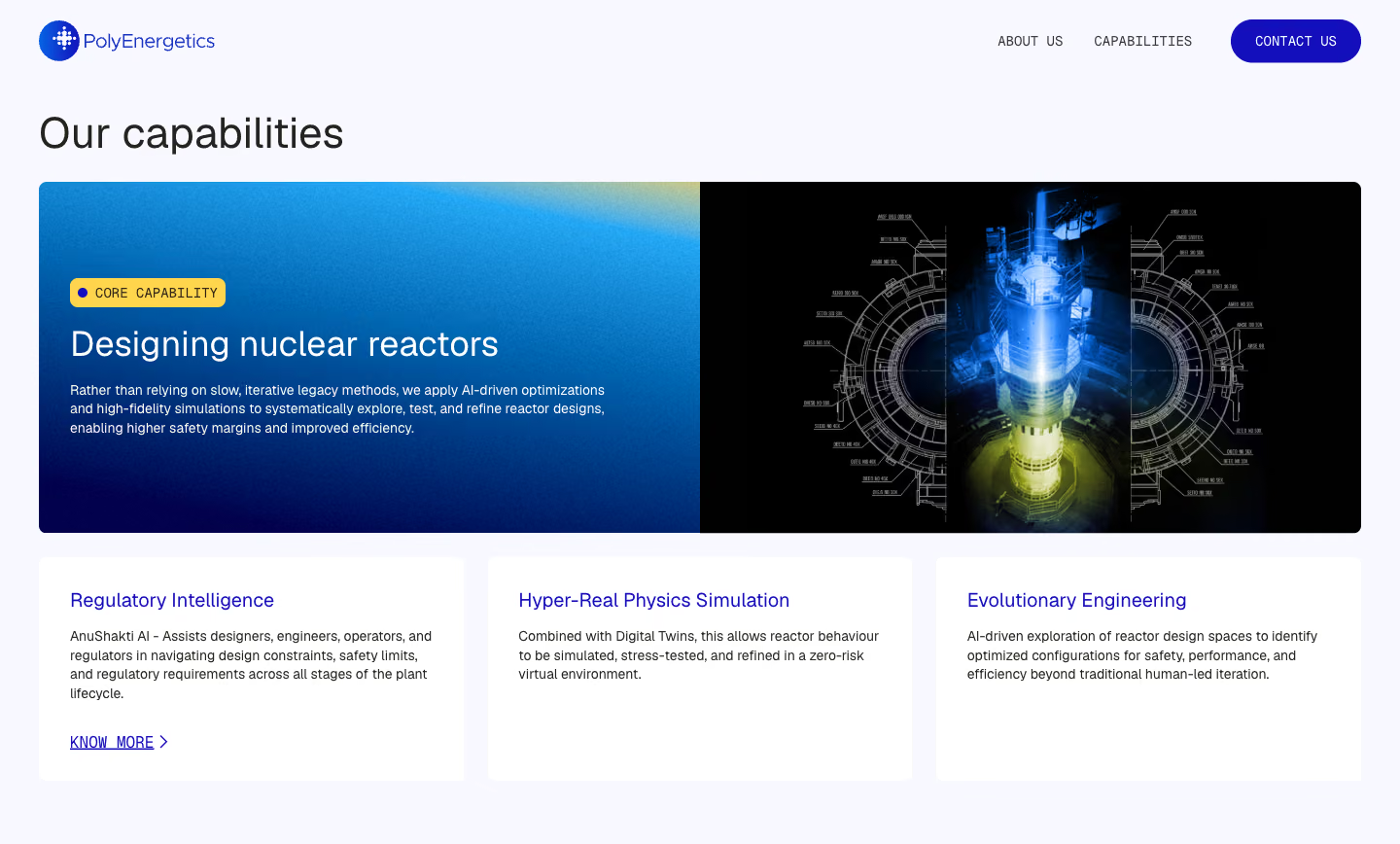
PolyEnergetics sits at the hard edge of this. It builds reactor design, digital twins, simulation and operator training around a molten salt micro modular reactor. Its audience includes people who have never evaluated a nuclear platform.
Pradeep, its co-founder and CEO, described the result: “Nuclear is the hardest category we could have asked someone to brand, and they made it read like a software platform without losing an ounce of gravity.”
Who are the three buyers, and why do they each need a different argument?
Clean tech sells to an operator, a regulator and an investor, and each reads for something the other two ignore:
- The operator wants payback period and uptime: what this does to costs and downtime.
- The regulator wants methodology: how it was measured, and whether that can be verified.
- The investor wants a curve: whether it scales, and how fast.
One page has to satisfy all three without asking any of them to translate. A brand that only speaks payback reads as a sales pitch to a regulator. One that only speaks methodology reads as a research paper to an investor.
The funding route usually decides which register a founder defaults to. The language that closed the last round is rarely the language the next buyer speaks, so the default is a risk. Our positioning work settles which argument leads for which reader.
Why does clean tech evidence have to be a measurement?
Measurements are what survive diligence. Tonnes, cycles, kilowatt-hours and MRV (measurement, reporting and verification) are the figures a serious buyer looks for. Most agencies cut them from the page because they look dry.
Carbon shows how high the bar now sits. The Integrity Council's Core Carbon Principles require reductions to be "robustly quantified" and checked by independent third parties. Verra's Verified Carbon Standard audits projects through independent validation and verification bodies.
A carbon buyer who knows those rules reads every claim against them.
Transitry sells into that market. It is a Singapore-headquartered digital MRV business for nature-based carbon credits. The whole sale depends on a buyer trusting the methodology behind its soil dashboard.

Batteries are heading the same way. The EU Batteries Regulation says an EV battery's state of health should be readable from its management system at any time.
Turno builds diagnostics, state-of-health and second-life decisioning for commercial EV fleets. Its site sets a fleet's numbers with Turno against the same fleet without it.

Prashant, Turno's brand lead, put the challenge this way: “Turno's product is dense: battery state-of-health, second-life decisioning, fleet diagnostics. They translated all of it into a homepage that actually feels warm.”
Why do measured, modelled and projected need to be labelled?
Each figure has to say whether it was measured, modelled or projected, because regulators now expect proof. The UK's Green Claims Code says claims "must be substantiated" and "must not omit or hide important relevant information". The FTC's Green Guides cover how marketers substantiate and qualify environmental claims in the US.
Carbon figures follow the same logic. GHG Protocol supplies the most widely used standards for measuring emissions. Stating which standard a number follows tells the reader how far to trust it.
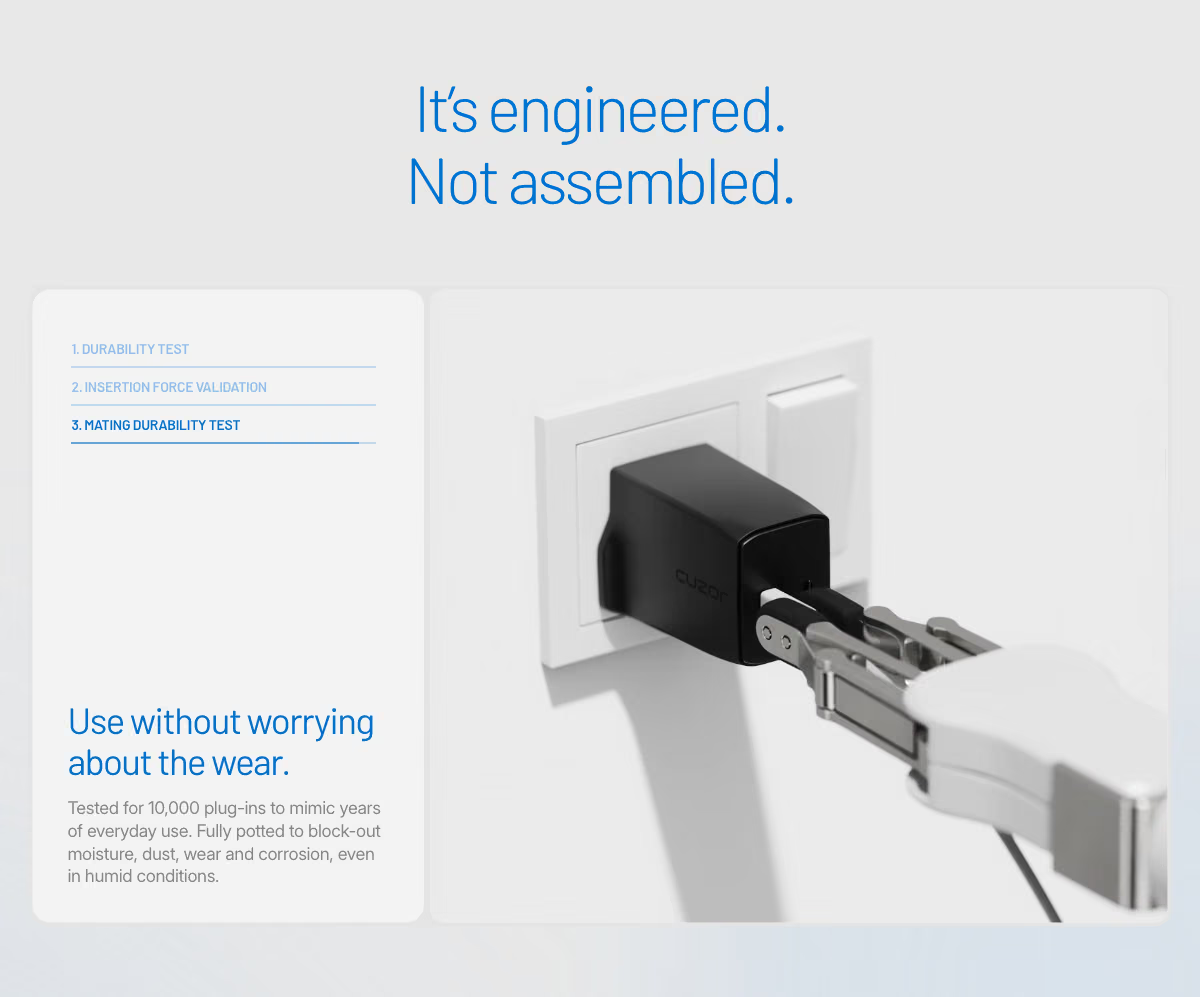
The discipline holds at consumer scale too. Cuzor argues an engineering claim about its gallium-nitride chargers with a durability rig. A test replaces the adjective, even when the buyer is one person choosing a charger.
What happens to a clean tech brand when the policy ground moves under it?
A clean tech brand has to survive policy change, because subsidy regimes, carbon markets and claim rules move faster than any brand refresh. A narrative built on a specific credit price or subsidy expires when that policy does. Rebuilding a brand every time a regulation shifts is no way to operate.
Claim rules are moving now. The EU's Directive 2024/825 bans generic environmental claims a trader cannot back with recognised excellent performance. It also bans claims of neutral or reduced impact based on offsetting.
Member States apply it from September 2026.
The durable anchor is the mechanism and the measurement. A brand that explains what is captured, avoided or generated, and how that is verified, keeps working through a policy cycle.
Policy still belongs on the page. Treat the current regime as context around a durable claim, stated separately, so a rule change updates one paragraph instead of the whole story.
How do you brand a technology whose proof outruns a single pilot?
Build the identity around the mechanism, because the pilot, the first plant and the first fleet are three different moments. An identity tied to the demonstrator ages out before revenue arrives. In hardware, the timeline routinely outlasts the brand built for launch.
PolyEnergetics is the clearest case. Its identity had to work in the same terms for the deck, the trade show booth and a plant that did not exist yet. The company has since reported it is funded and on a growth path.
That outcome is reported by the client, and we did not measure it.
How the brand changes from seed to scale is covered in deep tech branding by stage. Showing a plant that does not exist yet is often a job for 3D industrial animation.
What does naming need to hold across a second product and a second market?
A clean tech name needs room for a company that ends up broader than it started. A device name, a platform name and a company name are three different jobs. A name chosen for the first product becomes a constraint once a second product or market arrives.
Two common paths show the problem:
- A diagnostics tool grows into a decisioning platform.
- A domestic pilot becomes an export business.
Our naming work decides how those layers relate before any single product is named. That keeps the company from needing a rename when it can least afford one.
What does an engagement deliver, and how long does it take?
A clean tech brand engagement takes nine to sixteen weeks from kickoff to a finished brand system, at a fixed scope and one price. The price is quoted after a thirty-minute call, and the ranges are on our pricing page.
The work runs in this order:
- Category and positioning: hardware, software or a measurement business.
- Naming, where the hierarchy needs it.
- Narrative and identity.
- Messaging for operators, regulators, offtakers and investors.
- A brand book that records all of it.
The team is nineteen people, ten of them engineers by degree, across strategy, 3D, delivery and build. That includes 3D modelled from drawings or CAD, so the page never needs stock turbine photography. We sign an NDA before reviewing pilot data or methodology, because a measured result is often the most sensitive thing a company holds before it is published.
When is this not a fit?
A fast site refresh or a single product page is not a fit.
A freelance designer or a production studio will do it faster and for less, because it needs no category decision. If only the site needs rebuilding, our cleantech website work is the narrower option. Grid and generation companies may find energy infrastructure branding the closer match.
If the people who hold your methodology cannot take part, wait. That means your engineers and whoever runs your MRV or measurement protocol. They hold the only evidence a regulator or a diligent investor will trust.
This suits a company ready to label its evidence as measured, modelled or projected and stand behind the difference. A company that wants decarbonisation enthusiasm without the numbers should look elsewhere.
FAQ
How long does a clean tech branding engagement take?
Nine to sixteen weeks for positioning, narrative, identity and a brand book, at a fixed scope and one price agreed after an initial call.
What counts as clean technology for this kind of branding work?
Anything where the outcome is physical: batteries and charging, nuclear and grid, carbon capture and measurement. Carbon accounting software on its own is a different problem, with a different buyer.
Have you done this before?
Yes. Turno on battery state-of-health and second-life decisioning, PolyEnergetics on a molten salt micro modular reactor, Transitry on soil health and digital MRV for carbon credits, and Cuzor on GaN charging.
How do you keep clean tech claims defensible?
We write to the evidence a company can actually produce, and the rule for what can and cannot be claimed goes into the brand book. An unsubstantiated claim is the fastest way to lose a regulator or a diligent investor.
When should a clean tech company hire someone else?
When the need is a single product page or a quick refresh, or when the people holding the methodology and the measured results cannot take part in the work.
Written by Mejo Kuriachan. More in the blog, the glossary and the FAQ.