
Strategic branding for electronics and photonics companies (win the socket)
Electronics and photonics brand strategy for design-in: curves with conditions, qualification marks, a second-source answer, names for a catalogue.

- A datasheet proves a part. It does not win a socket, because the design engineer who chooses decides months before procurement hears the company's name.
- The proof is a curve with its conditions: efficiency at load, noise floor, thermal derating. Engineers read those before any sentence of copy.
- Designing in a sole-source part is a career risk for the engineer. A brand that stays silent on second source loses to a worse part with two qualified suppliers.
- Naming has to hold the company, the part family and the part number, with room for parts not yet designed.
Strategic branding for an electronics or photonics company is the work of deciding what the brand claims once the datasheet has already been downloaded. A datasheet proves a part. It does not win a socket, and everything between those two facts is the actual sale.
Why does a datasheet fail to win a socket?
A datasheet fails to win a socket because it answers a performance question, and a socket is decided by risk. By the time an engineer reads a datasheet closely, they already believe the part might work.
What they are weighing is whether to commit it to a design that is expensive to change later. A datasheet has nothing to say about that. The brand has to.
Why is the person who chooses not the person who buys?
The design engineer picks the part, usually months before procurement is involved. They run a parametric search and a simulation long before anyone signs a purchase order.
A brand aimed at the purchasing conversation arrives after the decision that mattered. Our electronics and photonics branding work is built around that sequence. Win the engineer first, because by the time procurement sees the part, it is approving a decision someone else made.
Who are you actually being compared against?
An electronics or photonics part is compared against three things, and only one is a competitor in the usual sense:
- The incumbent part already specified in similar designs.
- The distributor's catalogue, which an engineer searches when your own site cannot filter by parameter.
- The reference design the customer's team already has on file.
The third comparison is the one most component brands never mention. An engineer with a working reference design is weighing the cost of switching against the cost of doing nothing. Doing nothing usually wins, unless the brand makes the switching cost look small.
Why do engineers trust a curve over a claim?
Engineers trust a curve because they can check it against their own operating point, and a claim gives them nothing to check. Efficiency at load, noise floor and thermal derating are read before any sentence of marketing copy. A headline efficiency figure with no conditions attached is treated as marketing by the reader who decides the socket.
Many studios cut these tables because dense figures look unpolished next to photography. That removes the evidence the visit was for. Kandou AI's site does the opposite: its signal diagram shows the input and the output side by side.

Sachin, founder of Cuzor, put the principle from the client's side: “There are technical nuances we know as engineers. You knew how to capture that beautifully and tell the customer how the engineering translates into a benefit. Most websites fail exactly there.”
Where do qualification marks belong?
Qualification marks belong next to the curve they support, where the engineer is already looking. To the design engineer they are table stakes. To everyone else evaluating the company, they show the part has survived a formal stress programme beyond the lab bench.
Three kinds of mark do this work, depending on the part:
- Automotive stress qualification, such as AEC-Q100, the Automotive Electronics Council's failure-mechanism-based stress test qualification for integrated circuits.
- Interface compliance, such as USB Power Delivery, where products pass USB-IF compliance testing and join its Integrators List before using certified USB logos.
- Standards alignment for optical and high-speed links, such as IEEE Std 802.3df-2024 for 400 Gb/s and 800 Gb/s Ethernet, or the OIF's interface work covering co-packaged, near-packaged and pluggable optics.
A mark a reviewer can look up is worth more than any adjective. An engineer who cannot find the curve or the mark rarely writes in to ask. They move to the next search result, and the company never learns it was in contention.
Why is being sole-source a real objection?
Designing a sole-source part into a schematic is a career risk for the engineer who chooses it. If the only supplier disappears or cannot scale, the engineer who specified the part owns the consequence.
That risk became concrete during the chip shortage. The European Commission's Chips Act page records that the shortage "disrupted supply chains, caused product shortages ranging from cars to medical devices, and in some cases even forced factories to close." The US Department of Commerce's 2022 supply chain findings put buyers' median chip inventory at less than five days in 2021, down from 40 days in 2019.
A brand that stays silent on second source asks the buyer to absorb a risk the brand will not acknowledge. A worse part with two qualified suppliers regularly wins the socket instead. State the answer plainly: a second fab, a pin-compatible alternative, or a lifetime-buy policy.
Can one page serve the engineer and the buyer who orders?
One page can serve both, if it is built to. The two readers want different things from it:
- The design engineer wants performance: the curve, the conditions and the qualification standard.
- The buyer who places the order wants availability, price and a lead time.
Most electronics sites answer the first reader and never the second. That holds until a strong technical fit stalls at purchasing, because nobody answered the question procurement was always going to ask. The same split shapes our electronics and photonics websites: a path for the engineer, and an answer for procurement that does not make the engineer wait.
What happens when the brand is built around one hero part?
A brand built around one hero part breaks once the catalogue grows past it. A name and a story built for a single component have no logical place for the second, third or twentieth part.
Electronics and photonics companies that succeed tend to expand into families quickly, generation after generation. A naming system needs three layers from the outset:
- The company.
- The part family.
- The part number, with room for parts not yet designed.
Kandou AI shows the family view at work. Its site sets four connectivity capabilities side by side, so an engineer can place one part inside a range.

A single-part brand usually has no parametric search either, because nobody designed the site to be filtered. An engineer with a target specification then goes to a distributor's search, and meets your competitors there. For the chip-level version of this problem, see our guide to semiconductor brand strategy.
What does branding look like when the buyer is a consumer?
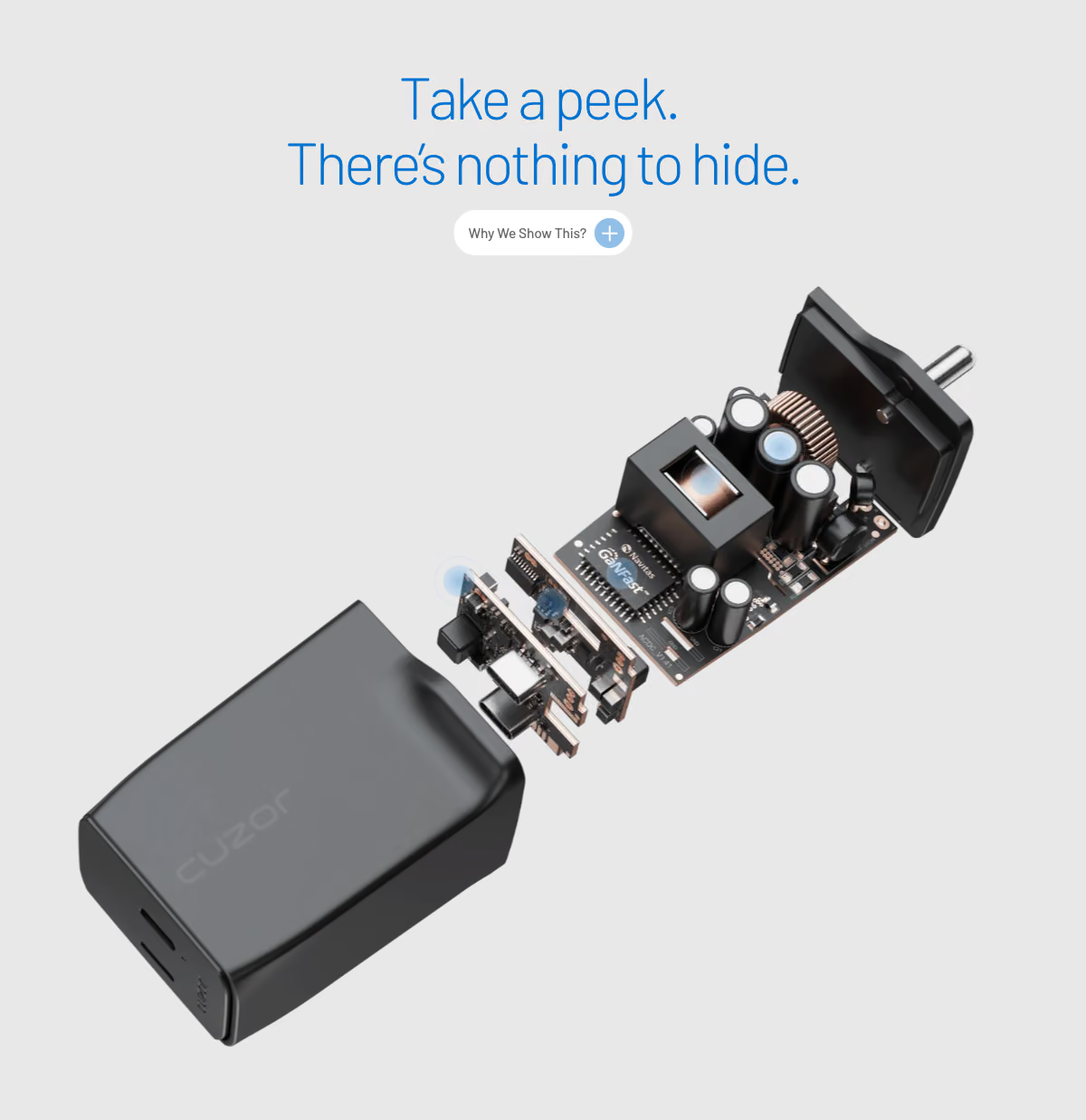
When the buyer is a consumer, the brand still has to show the engineering. Not every electronics company sells into someone else's bill of materials. Cuzor's gallium-nitride chargers and router UPS hardware are sold to consumers, which puts the company outside the design-in mechanism above.
The engineering is still the story. The US Department of Energy's assessment of wide bandgap power electronics notes that such devices "can be fabricated with a much smaller footprint" than comparable silicon, because of lower cooling needs and smaller passive components. That is why a GaN charger can be small, and it has to be shown.
The product page we built opens the charger up in 3D: board, transformer, GaN chip and housing held apart in a way no camera could hold them.
A durability rig then argues the engineering claim with a test.
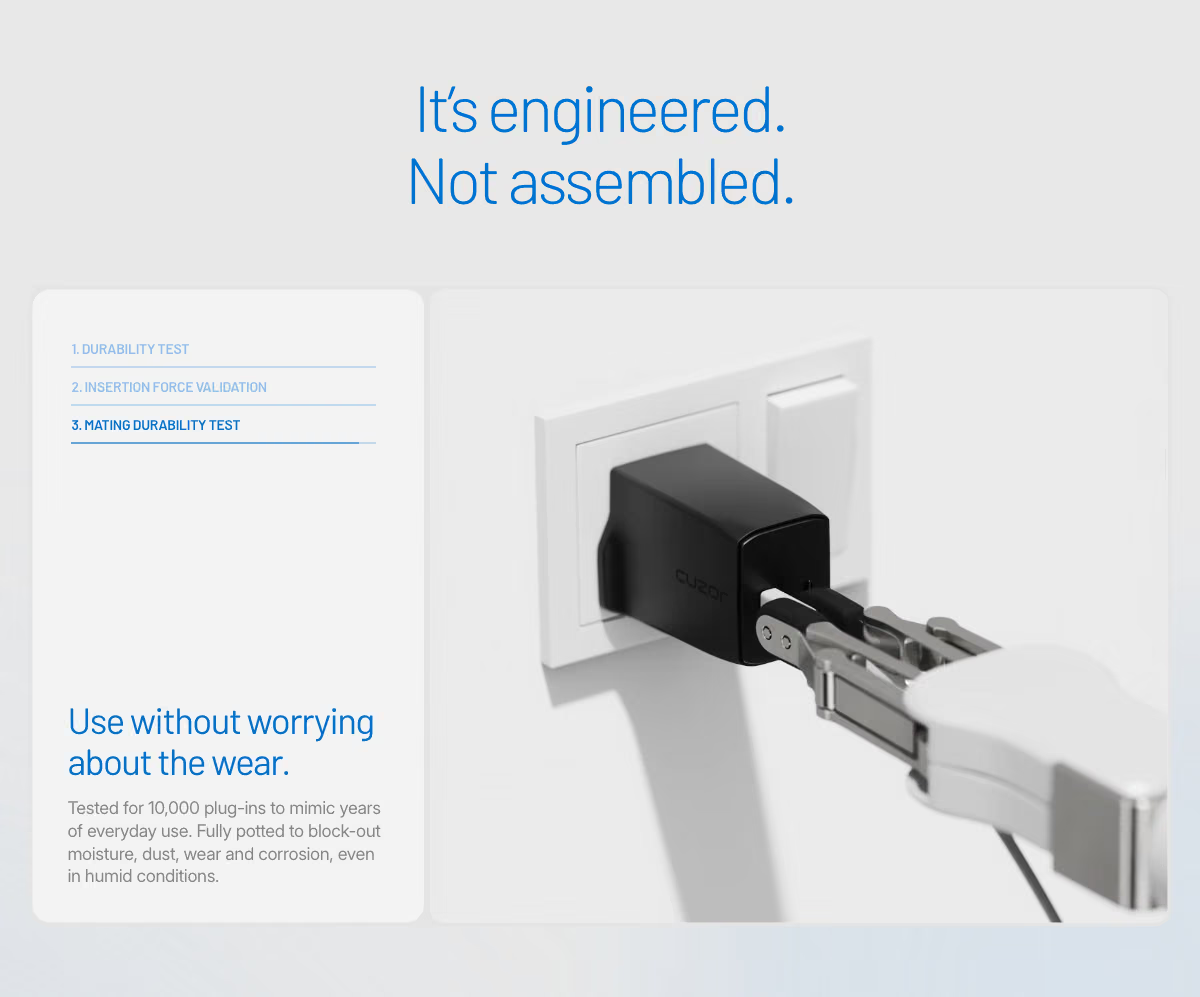
Sachin reports that the page is showing in sales, and that partners in the US said the result matched what they had hoped for. That is the client's account, and we have not measured it.
What does an engagement deliver, and how long does it take?
An electronics or photonics brand engagement takes nine to sixteen weeks from kickoff to a finished brand system, at a fixed scope and one price. The price is quoted after a thirty-minute call, and the ranges are on our pricing page.
The work runs in this order:
- Category and positioning: component, module or subsystem. That decision sets the margin expectation, and whether you are designed in or bought on price.
- Naming, with room for the family.
- Narrative and identity.
- Messaging for each audience: design engineers, procurement and investors.
- A brand book that records all of it.
The team is nineteen people, ten of them engineers by degree, across strategy, 3D, delivery and build. We sign an NDA before reviewing a part that has not been announced. That is the normal starting point, and we explain how it works in branding under NDA.
When is this not a fit?
A single product photograph, or a quick refresh of an existing page, is not a fit. A freelance designer or a production studio will do that faster and for less, because it needs no naming architecture.
If the design engineer cannot be in the room to explain the curve and its conditions, delay the work. A curve presented with the wrong conditions is worse than no curve. It gets caught, and it gets remembered by the engineers whose trust the next part in the family needs.
This suits a company that wants its qualification evidence and its identity built together. A company that wants new graphics around a datasheet nobody on the brand side has read should look elsewhere.
FAQ
Have you done anything adjacent to this category?
Yes. Kandou AI on co-packaged optics and high-speed interconnect, and Cuzor on GaN charger internals. Both are products sold on curves and tests.
How do you brand a part that goes inside something else?
By branding the design decision. The engineer is choosing to take a risk on your curve, and the job is to make that risk feel smaller than the alternative, whether that is an incumbent part or not changing anything.
Should curves live on the website or stay in the datasheet?
Both. The datasheet stays the authoritative document, and the key curves belong on the page, because that is where two or three parts get compared, in browser tabs.
Do you sign NDAs before seeing an unreleased part?
Yes, and it is the normal starting point. Most of what makes an electronics or photonics company defensible has not been announced.
When should an electronics or photonics company hire someone else?
When the need is a single product photograph or a quick page refresh, or when the engineer who understands the part's operating envelope cannot take part in how it is presented.
Written by Mejo Kuriachan. More in the blog, the glossary and the FAQ.