
Strategic branding for quantum computing companies (honest timelines)
Quantum computing brand strategy for sceptical buyers: metrics with conditions, demonstrated results kept apart from roadmap, three buyer horizons.

- A qubit count proves a machine works in a lab. It does not prove when, or whether, it becomes useful outside the physics community.
- Three buyers read the same page on three timelines: a researcher wanting access now, an enterprise wanting a hedge, and a government wanting sovereignty.
- Label every claim as demonstrated, in progress or projected. Quantum advantage claims get checked in public by people qualified to dispute them.
- We have not built a brand for a quantum computing company, and we are making a film for one, Accelequant. Two brand engagements in neighbouring categories show the same method, and we say where the parallel stops.
Strategic branding for a quantum computing company is the work of deciding what the brand claims before the machine has settled the argument physicists are still having about it. A qubit count proves a device exists and runs. It does not prove when, or whether, that device becomes useful to anyone who is not already a specialist in the field.
Why does a qubit count fail to establish that the machine is useful?
A qubit count describes the hardware, and usefulness is a separate, harder claim about what the hardware does that a classical computer cannot. Buyers have watched qubit counts rise for years without a matching rise in demonstrated advantage. The number alone no longer moves them.
Our quantum computing branding work treats the qubit count as one input to a larger claim. That claim covers architecture, error rate, coherence and a stated route to fault tolerance. A number without that context reads like every competitor's number.
Buyers here check claims against what other physicists say in public. A brand precise enough to survive that scrutiny earns more trust than one that oversells and hopes nobody qualified is reading.
Why is the timeline the first objection, and what happens if you dodge it?
The timeline comes first because every serious conversation opens with when the machine becomes useful. Refusing to answer reads as evasion. After a decade of promises that slipped, a vague answer confirms the buyer's scepticism.
Public programmes now set the frame a buyer carries into the meeting. DARPA's Quantum Benchmarking Initiative aims to verify whether any approach can reach utility scale, meaning computational value that exceeds cost, by 2033. A brand that says where it stands against a public test like that sounds like it expects to be checked.
The honest version has three parts:
- What the current generation can do now.
- The stated route to error correction.
- What is still unsolved.
That is a harder sentence to write than "revolutionary", and it survives being read twice. It also ages better. A page that implies an imminent breakthrough needs quiet rewriting every time a milestone slips, and a reader who notices the rewrite trusts the next claim less.
Why are the headline metrics contested, and which ones actually matter?
Physical qubit count is the most quoted number and the one that says least about what a machine can do. Explaining that clearly is most of the positioning work in this category.
The metrics closer to what a buyer needs are these:
- Two-qubit gate error rate, with how it was measured.
- Coherence time, stated per architecture.
- Logical qubits, where a system has any, and their error rate per cycle.
- Composite measures such as quantum volume, which exist because one number was never enough.
The Willow error correction paper, published in Nature in February 2025, shows the standard of statement buyers now expect. It reports a 101-qubit distance-7 code at 0.143% error per cycle, with the uncertainty attached. A brand should state its own metrics with that kind of condition and caveat.
That includes naming which metric the company does not yet report, and why. Leave a gap unexplained and the reader fills it with the least generous assumption.
Who are the three buyers reading the same page, and what does each want?
Three buyers read a quantum computing page, and each reaches a different verdict on whether it applies to them:
- A researcher wants raw access, documentation and a queue that actually gives them compute time.
- An enterprise wants a credible account of when the investment matters, set against its own planning horizon.
- A government programme weighs sovereignty and long-term capability above near-term return.
The enterprise horizon is increasingly set by cryptography. NIST published its first three post-quantum encryption standards, FIPS 203, 204 and 205, on 13 August 2024.
The UK NCSC's migration timelines ask organisations to finish migrating by 2035.
The government buyer reads through national programmes such as the US National Quantum Initiative.
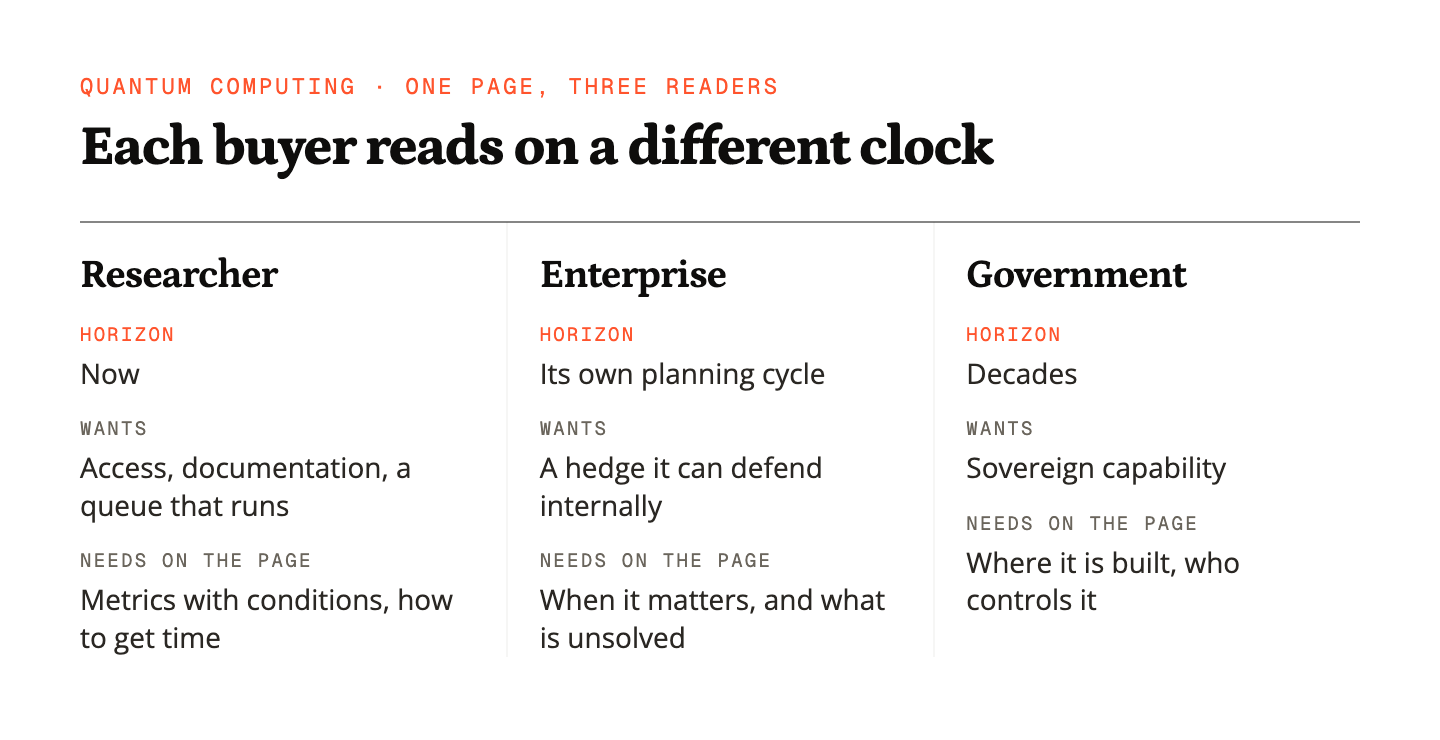
Most quantum sites write for the researcher, because that is who the company talks to daily. The other two buyers get the same page and must translate it themselves.
Most of them move on to a competitor who did the translation for them. Writing for several readers at once is its own discipline, covered in how deep tech companies talk to investors, buyers and engineers.
How do you claim quantum advantage without losing the room?
State exactly what has been demonstrated, under what conditions, and what remains a projection. People qualified to dispute this claim do so in public.
The field's best-known example shows why. In October 2019, the Sycamore paper in Nature reported a 53-qubit task that took about 200 seconds, against an estimated 10,000 years for a classical supercomputer. That same week, a preprint on arXiv argued the same circuits could be simulated classically in a matter of days.
The headline comparison was argued over in public.
A brand that labels every claim avoids that exposure. Three labels are enough:
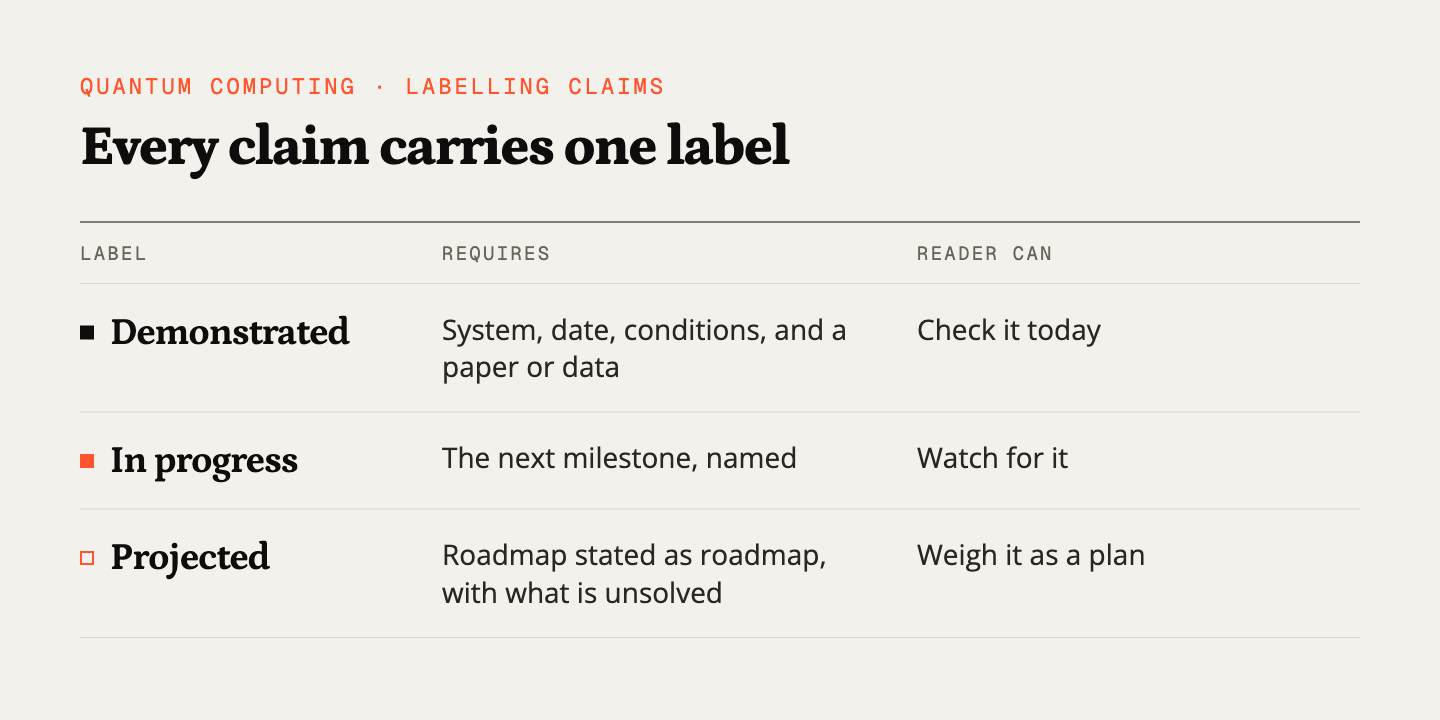
A technical reader can verify what is labelled. A blurred claim invites the correction on a forum the company does not control.
What has Everything Deep Tech actually done in this category, and what hasn't it?
We have not branded a quantum computing company. We are making a film for one: Accelequant, which works on complex optimisation problems and came to us through its investor, Ideaspring Capital. The film is in progress, so there is nothing to show yet, and a film is not a brand engagement.
Two brand engagements in neighbouring categories show the same method applied to a version of the same problem, and the parallel has limits worth stating.
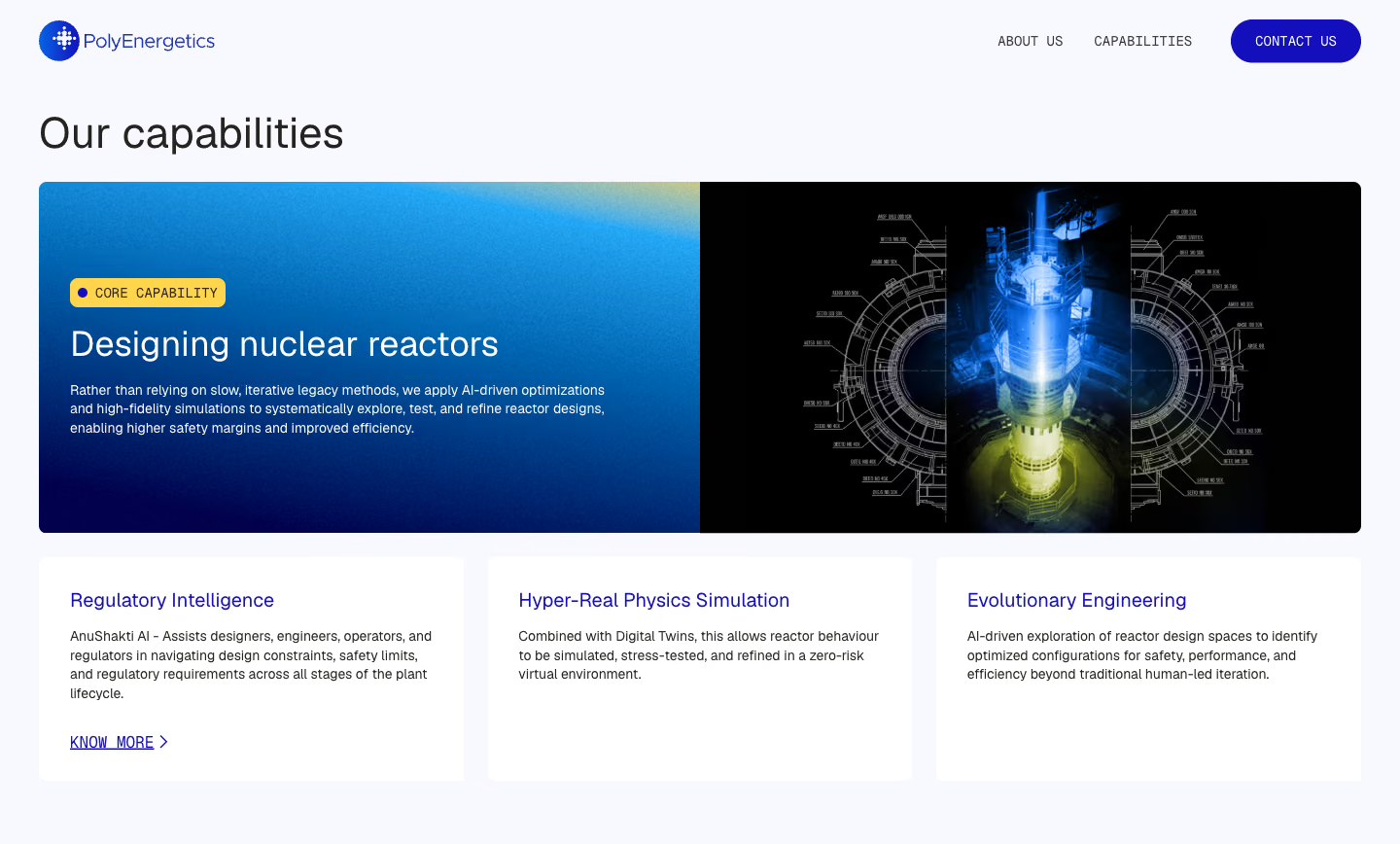
PolyEnergetics designs a molten salt micro modular reactor, a design nobody has yet operated, in a field with its own history of overpromised timelines. Its site had to state a plausible route to something unproven for a researcher, a regulator and an investor at once. That is close to the shape of the quantum problem.
Kandou AI is a Swiss fabless semiconductor company building interconnect silicon: PCIe and USB4 retimers, CXL controllers and Copper MIMO interconnect. It sells across four technical markets on a naming and identity system built to outlast the next generation of each standard.

Neither company works in quantum computing. What transfers is the method:
- An unresolved timeline stated honestly to a sceptical, technical reader.
- A naming structure held across hardware generations.
- Several buyer segments served from one page.
What does not transfer is the physics, and the specific dispute over quantum advantage. We would say so on a first call. More on the interconnect side is in strategic branding for semiconductor companies.
What does naming need to survive across gate-based, annealing, photonic and neutral atom architectures?
Naming needs to separate the company, the processor or system, and the cloud or platform layer, because a name tied to one architecture becomes a liability when the roadmap moves on. Gate-based, annealing, photonic and neutral atom systems are different products with different buyers. One name across them blurs the comparison for the reader trying to make it.
Define the layers before naming a single generation of hardware, as part of the naming system. A processor named after its first demonstrated result reads oddly two generations later.
What does an engagement deliver, and how long does it take?
A quantum computing brand engagement takes nine to sixteen weeks from kickoff to a finished brand system, at a fixed scope and one price. The price is quoted after a thirty-minute call, and the ranges are on our pricing page.
The work runs in this order:
- Category and positioning: selling access, hardware or an algorithmic advantage.
- Naming across the company, system and platform layers.
- Narrative and identity.
- Messaging for each buyer horizon.
- A brand book that records it.
The team is nineteen people, ten of them engineers by degree, across strategy, 3D, delivery and build. That includes 3D of hardware still in a lab and never photographed for a public audience.
We sign an NDA before reviewing unpublished technology. It is our normal starting point, because almost everything that makes a quantum hardware company defensible is unpublished. How that works is in branding under NDA.
When is this not a fit?
A fast logo refresh or a single product page is not a fit. A freelance designer or a production studio will do it faster and for less, because it needs no position on timeline, metrics or architecture. If only the site needs rebuilding, our quantum computing website work is the narrower option.
If your physicists cannot be in the room, wait. Claims about error rate, coherence and the route to fault tolerance must hold up in front of a competitor's research team. That takes the people who understand the roadmap.
This suits a company ready to state its timeline and its unresolved questions. A company that wants a better glowing lattice over the same vague claims should look elsewhere.
FAQ
How long does a quantum computing branding engagement take?
Nine to sixteen weeks for positioning, narrative, identity and a brand book, at a fixed scope and one price agreed after an initial call.
Have you branded a quantum computing company before?
Not a brand yet. We are making a film for Accelequant, a quantum computing company, and it is in progress. PolyEnergetics and Kandou AI are the closest brand engagements, a molten salt reactor company and a semiconductor interconnect company, and neither is quantum computing. We tell you what transfers and what does not on the first call, before you sign.
Can you help us avoid overclaiming quantum advantage?
That is most of the work in this category. We write to what you can defend in front of a physicist looking for a reason to dispute it, and the rule goes into the brand book so it holds after we leave.
Do you understand the difference between the architectures?
Well enough to write the page and ask your team the right questions. Gate-based, annealing, photonic and neutral atom systems have different buyers and different metrics, and the brand should keep them apart.
When should a quantum computing company hire someone else?
When the need is a fast visual refresh or a single page, or when your physicists cannot take part in deciding which claims the brand may make.
Written by Mejo Kuriachan. More in the blog, the glossary and the FAQ.