
Strategic branding for synthetic biology companies (beyond the titre)
Synthetic biology brand strategy for a procurement buyer: name your real scale, publish the cost route, and state the regulatory path early.

- A titre proves a strain works at bench scale. The contract asks whether the company can deliver that performance at volume, every quarter, at a price that competes with a petrochemical incumbent.
- The buyer is usually procurement. Their sheet compares price, specification, volume and security of supply.
- Name the real stage, lab, pilot, demonstration or commercial. Partners check, and a corrected overstatement costs more than the honest version.
- Naming has to hold the company, the platform, the organism and the product, because a pivot to a new feedstock or molecule is likely.
Strategic branding for a synthetic biology or biomanufacturing company is the work of deciding what the brand claims between a bench result and a commercial contract. Titre, rate and yield prove a strain performs. They do not prove the company can deliver that same performance at the scale, cost and reliability a paying partner is actually going to sign for.
Why does a strong titre not close a contract?
A strong titre does not close a contract because it describes a few litres, and the contract describes years of supply. Lab fermenters run at roughly 0.5 to 10 litres. Manufacturing fermenters run from 20,000 to 2,000,000 litres, according to Crater and Lievense in FEMS Microbiology Letters.
That is a scale factor of thousands to millions. The same paper puts the cost of scaling up at the order of US$100 million to $1 billion, usually more than developing the microbe itself.
A partner evaluating a molecule asks three questions:
- Does the organism keep performing outside a flask?
- Does the process survive a change of feedstock?
- Is there a credible route from today's scale to the contract's scale?
A brand that skips those questions reads as naive to anyone who has run a plant.
Should the brand say "platform"?
Say "platform" only when a named product stands behind it. The category sold organism-agnostic platforms hard for years, and buyers remember the ones that never produced a commercial molecule. Without a product, the word now costs credibility.
Lead with what the company makes: an ingredient, a molecule, a material or a process. If the platform claim is true, it sits underneath as a capability. Our positioning work usually starts with exactly that choice.
Who is actually buying, and what are they weighing you against?
The buyer is usually a procurement team at a chemicals, food or materials company. They compare your molecule with a petrochemical incumbent on price, specification, volume and security of supply. The elegance of the pathway is not a row on that sheet.
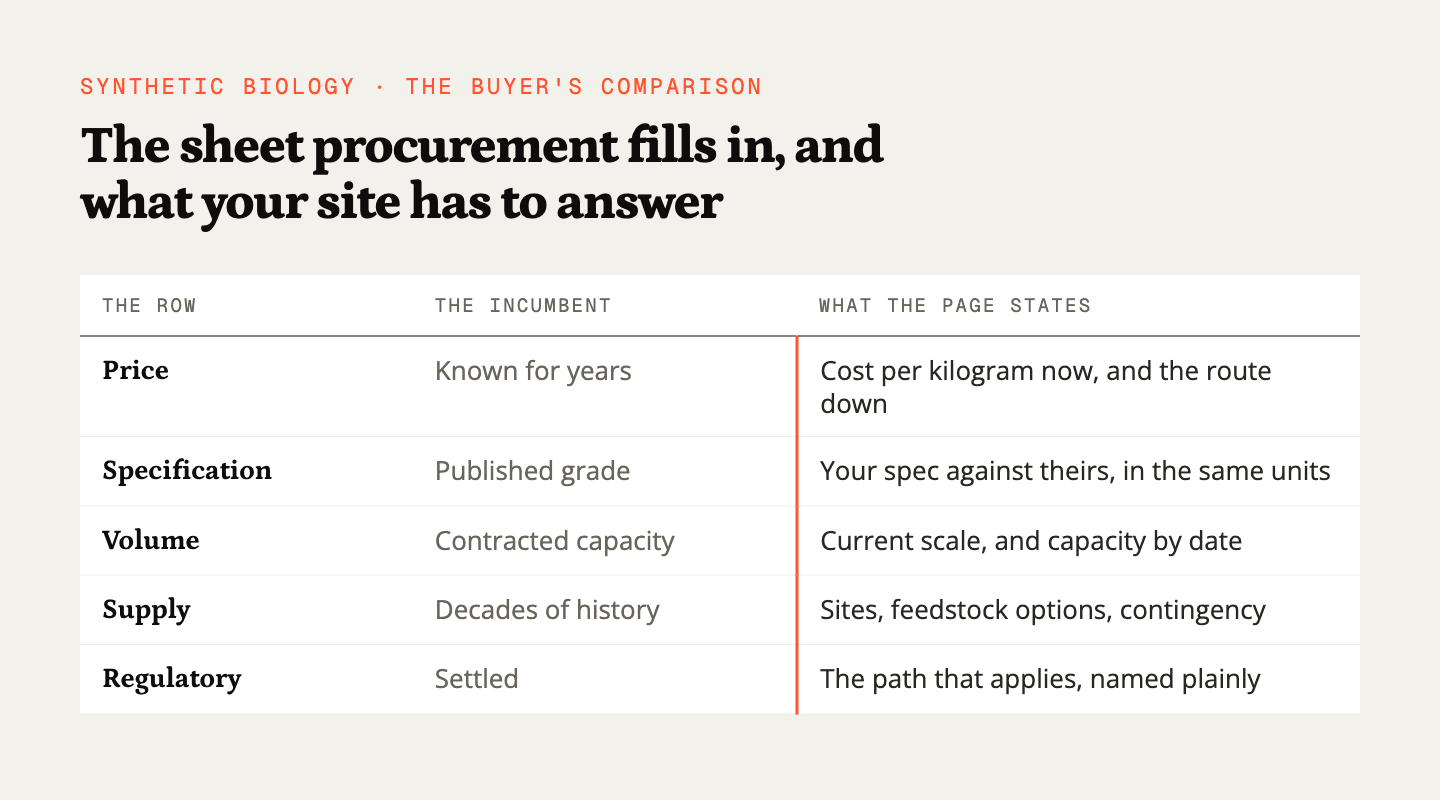
Most synthetic biology sites are written for a fellow scientist. The real reader is running a sourcing decision. They need your numbers beside the incumbent's, in the same units.
Scimplify, one of the companies we work with, is a science-led manufacturer of advanced materials, speciality chemicals and molecules, from sourcing through to manufacturing at scale. Chemicals buyers run the same comparison, and our advanced materials guide covers it from that side.
What does "scale" have to mean when the brand says it?
"Scale" has to name the real stage: lab, pilot, demonstration or commercial. A serious partner establishes that stage first. Most brands leave it vague, hoping the ambiguity reads as progress.
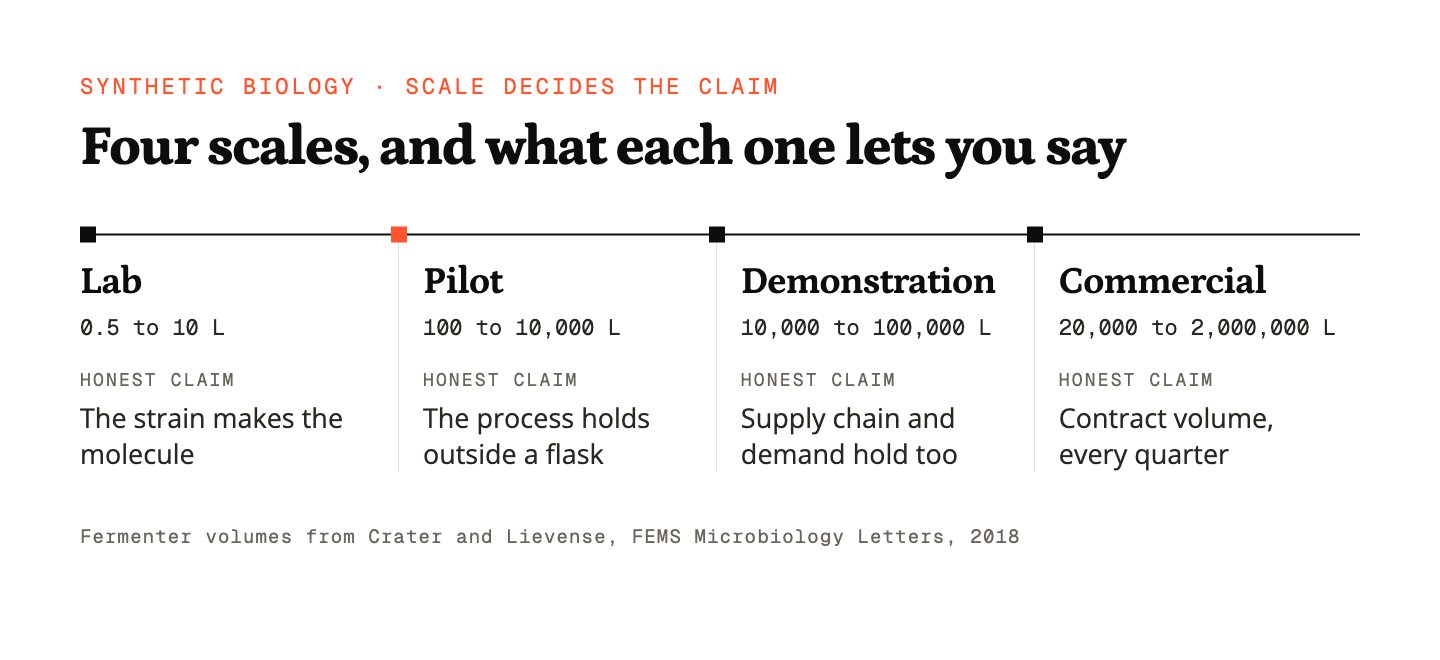
The stages carry different claims:
- Lab, 0.5 to 10 litres: the strain makes the molecule.
- Pilot, 100 to 10,000 litres: the process holds outside a flask.
- Demonstration, 10,000 to 100,000 litres: the supply chain and demand hold too.
- Commercial: contract volume, every quarter.
Partners check through diligence and through people who know the industry. An honest "we are at pilot scale, here is our route to demonstration" costs far less than a corrected overstatement. Our synthetic biology branding work treats naming the stage as a condition of the engagement.
Shared pilot capacity is now part of that route. BioMADE describes itself as closing the gap in pilot and demonstration-scale bioindustrial manufacturing through a pilot plant network. A company using that route can say so plainly.
How does cost per kilogram belong in the story?
Cost per kilogram belongs on the page as a stated number or a credible route to one. The incumbent's price is well understood in the category. Silence about your own cost lets the buyer assume the worst.
The strongest version states three things:
- The current cost.
- What has to be true for it to fall.
- When that is expected.
Few companies publish this. That scarcity is why publishing it is an advantage.
What regulatory path question has to be answered up front?
Answer whichever path applies to the molecule, stated plainly and early. A partner reads silence here as a sign the company has not checked.
The common paths differ by application:
- A US food ingredient may rely on a GRAS conclusion, which the FDA's page defines as general recognition of safety among qualified experts.
- An EU food made by new methods may be a novel food, assessed by EFSA before the Commission decides.
- An engineered microorganism in industrial use can fall under the EPA's biotechnology rules under TSCA and FIFRA.
Naming the path also sets a partner's expectations on timeline. A regulatory step that surprises a partner late in a deal is one of the fastest ways to lose it. The same discipline applies in our biotech guide, where the regulator decides.
What about biosafety and dual use?
A synthetic biology brand also has to answer biosafety and dual-use questions calmly. Large partners and some investors ask how the company governs its own research. The WHO's global guidance framework for the responsible use of the life sciences, published in 2022, sets out principles for mitigating biorisks and governing dual-use research.
A short, plain statement of the company's practice answers the question before it becomes a concern. Measurement matters here too. NIST develops measurement tools for nucleic acids, proteins, metabolites and cell systems, and a company that reports against recognised methods is easier to verify.
What can a company outside biology teach us about scale credibility?
A company outside biology shows that the fix is a narrative told straight. PolyEnergetics does not work in synthetic biology. It designs a molten salt micro modular reactor, which shares almost nothing physically with fermentation.
What it shares is the shape of the credibility problem. The technology is difficult and pre-commercial, and it has to be trusted by a technical partner and an investor at once.
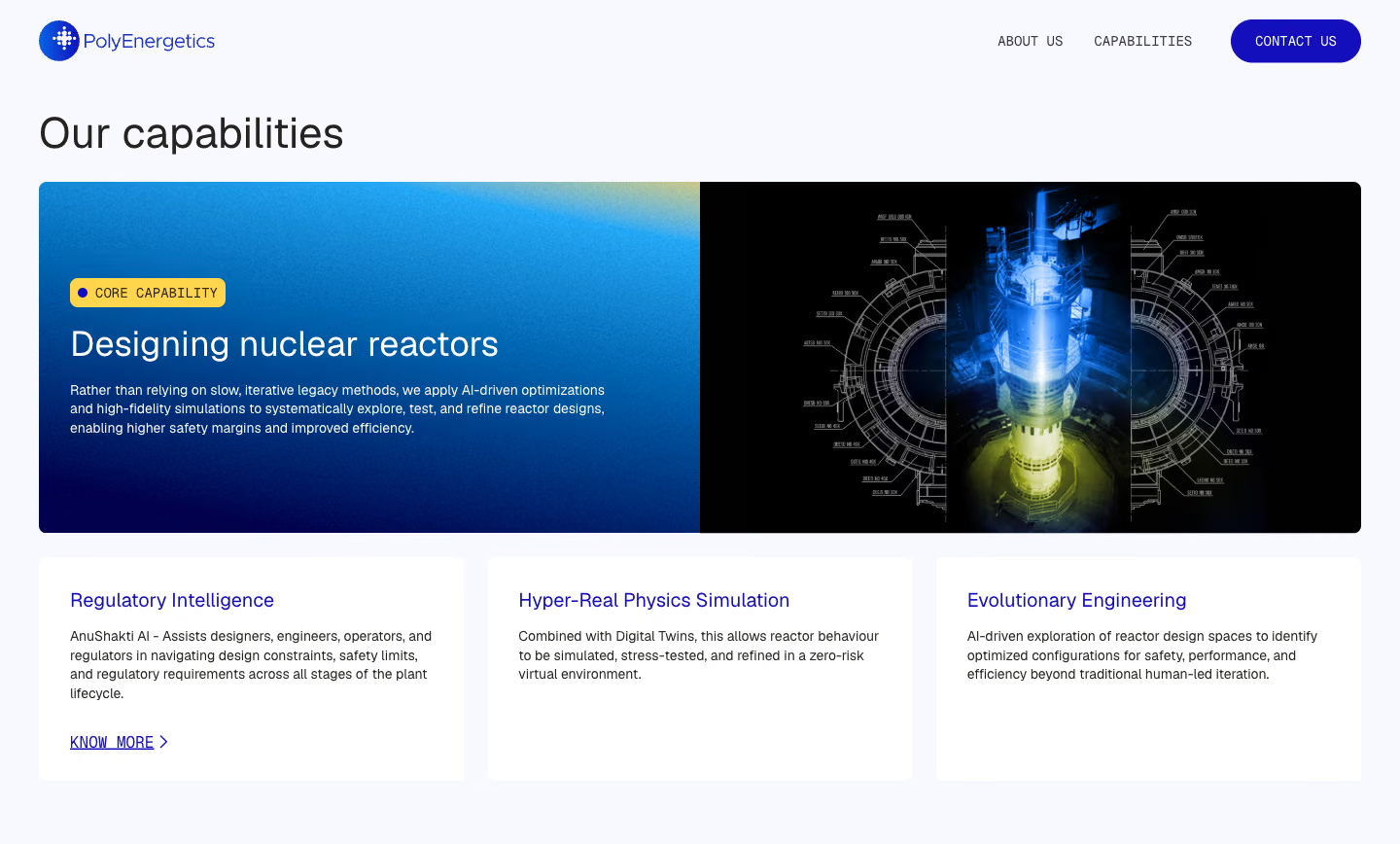
The site sets out the company's capabilities in reactor design, digital twins, simulation and operator training. Its co-founder and CEO, Pradeep, put the result this way: “Nuclear is the hardest category we could have asked someone to brand, and they made it read like a software platform without losing an ounce of gravity.”
The buyer's arithmetic does not transfer. A utility weighs a safety case and a licensing path, and a chemicals buyer weighs cost per kilogram and supply.
The discipline transfers: never say more than the current stage supports. Our cleantech guide covers the energy side in more depth.
What does naming need to hold across organism, product and the pivot?
Naming needs four layers: the company, the platform, the organism and the product. Build them as a system. Synthetic biology companies pivot feedstocks and molecules often, and a system with no room for that forces a rename at a bad moment.
Decide the architecture before naming the first product. Then the second and third molecule have somewhere logical to sit. Our naming work sets out that hierarchy first.
What does an engagement deliver, and how long does it take?
An engagement takes nine to sixteen weeks from kickoff to a finished brand system, at a fixed scope and one price. The price is quoted after a thirty-minute call, and the ranges are on our pricing page.
The work runs in this order:
- Category and positioning: product, ingredient, material or platform.
- Naming, narrative and messaging.
- An evidence architecture for titre, rate, yield and the cost curve.
- A visual identity that reads as an industrial supplier.
- A brand book that records all of it.
The team is nineteen people, ten of them engineers by degree, across strategy, 3D, delivery and build. We sign an NDA before reviewing unpublished strain data or process details. That is our normal starting point, and branding under NDA explains how it works.
When is this not a fit?
This is not a fit while the company is tempted to imply a scale it has not reached. Address that first. A brand engagement will surface the temptation immediately.
If the science and process team cannot take part in naming and evidence decisions, delay the work. They hold the titre, rate, yield and cost data the narrative is built on. If only the site needs work, our synthetic biology website service is the narrower option.
This suits a company willing to publish its actual stage, cost trajectory and regulatory path. A company that wants a more exciting version of an unsupported scale claim should look elsewhere.
FAQ
How is this different from your biotech pages?
Biotech is trials, endpoints and reimbursement, where a regulator makes the decision. Synthetic biology here is an industrial supply decision: scale, cost per kilogram and security of supply. A company with both a therapeutic and a manufacturing arm usually needs the two pages read together.
We are pre-commercial. Is it too early for this?
No, but the brand has to say so plainly. The expensive mistake is implying a scale the company does not have. Partners check, and one corrected overstatement costs more than the honest version ever would.
Should the cost curve be public?
A directional version, yes. The partners furthest along in a decision are the ones who leave when the number sits behind a form.
Can you model our process without disclosing the strain?
Yes. The pathway and the downstream train can be shown at a level that explains the route without exposing what is proprietary. Deciding exactly where that line sits is part of the engagement.
When should a synthetic biology company hire someone else?
When the temptation is to imply a scale not yet reached, or when the science and process team cannot take part in naming and evidence decisions.
Written by Mejo Kuriachan. More in the blog, the glossary and the FAQ.