
Strategic branding for IoT companies (after the pilot)
IoT brand strategy for buyers burned by stalled pilots: deployment evidence, a straight answer for IT and security, and the exit question answered early.

- A successful pilot proves a device works once, in front of an engaged sponsor. It does not prove the deployment survives ten thousand units and a sponsor who has moved on.
- Most buyers have a drawer of pilots that went nowhere. Leading with pilot results leads with the thing that already disappointed them.
- We have not built a brand for an IoT company. Turno, Cloudphysician and Cuzor, in neighbouring sectors, show the same method on the same deployment problem.
- Support period, protocols and data export are now regulated questions in the UK and EU. Answer them on the site before a buyer asks.
Strategic branding for an IoT or connected systems company is the work of deciding what the brand claims once the pilot has already succeeded and gone nowhere. A successful pilot proves the device works once, for a sponsor who was paying close attention. It does not prove the deployment still works at ten thousand units, three years later, after that sponsor has changed jobs.
Why does a successful pilot fail to prove a deployment?
A pilot fails to prove a deployment because it runs under conditions a deployment never gets. The sponsor is engaged, the unit count is small, and your own team is watching closely. None of that survives to year three.
The purchase turns on a different question. What happens at ten thousand units in the field, once the person who championed the project has moved on?
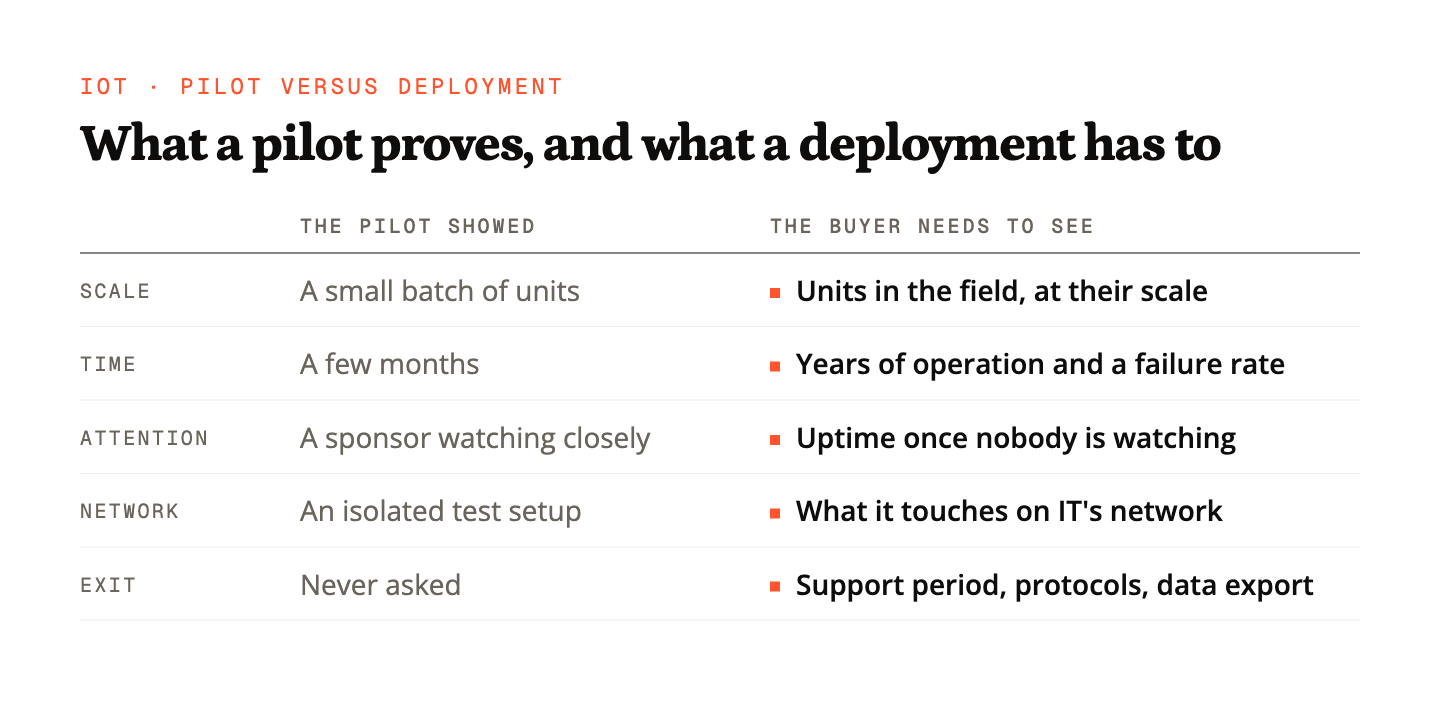
Our IoT branding work starts from that gap. A pilot answers whether the technology works. A deployment answers whether the company can support it when nobody is watching.
Why does leading with pilot results cost you credibility?
Leading with pilot results costs credibility because most buyers have run a pilot that never scaled. In a 2017 Cisco survey of 1,845 IT and business decision-makers, 60% of IoT initiatives stalled at the proof of concept stage. Only 26% of companies had an IoT initiative they considered a complete success.
Your pilot result reminds that buyer of their own stalled project. They already hold plenty of similar evidence.
The stronger opening is longevity:
- Units currently in the field.
- How long they have been running.
- The failure rate once the first attention has worn off.
Almost nobody in the category publishes these. A buyer who has been burned before wants exactly this.
What proof works in this category, and why does almost nobody publish it?
Operational numbers from a live deployment work, because they answer the scepticism a pilot cannot. Most IoT brands avoid them. The numbers may still be thin, or nobody has asked for them directly.
A brand that states these figures honestly, including where they are early, reads as more credible than one that says nothing. In a category this sceptical, silence on scale reads as something to hide.
Cloudphysician, a critical care software company, puts its numbers on the home page. The film we made for it held the same line on accuracy. Ayesha, Chief of Care Center and Model Factory, put it plainly: “If the heart rate was 120, it had to be 120, not 100.”

Whether to say "IoT" at all belongs to the same decision. The term carries a decade of unmet promises. Used without qualification, it invites the buyer to apply that history before reading a single number.
Who are the two buyers on the customer side, operations and IT?
Operations wants the device to keep working without anyone watching it. IT and security want it to stay off their list of network risks. A brand that speaks to only one of them loses the argument inside the customer.
Each side evaluates different things:
- Operations checks uptime, ease of install, and what a field failure involves.
- IT checks what the device speaks, how it authenticates, and what it can reach on the network.
- Security checks how updates are delivered and how vulnerabilities are reported.
Most IoT sites are written for operations, because operations runs the pilot. IT arrives later, often at the security review that can stall the deal. We cover that review from the vendor side in strategic branding for cybersecurity companies.
Published baselines make the IT answer easier to write.
ETSI EN 303 645 bans universal default passwords and requires a public vulnerability disclosure policy. NIST IR 8259A sets out a core baseline of device security capabilities. A site that maps its device to those documents answers IT before IT asks.
What is the lock-in question nobody says out loud, and how do you answer it?
The lock-in question is what happens to the devices and the data if you are acquired or the company folds. Every buyer planning a multi-year deployment is asking it internally. An unsupported device becomes the buyer's problem.
Regulation has now put the question in writing. The UK's product security regime, in force since 29 April 2024, requires manufacturers of consumer connectable products to publish a minimum security update period with an end date. The EU's Cyber Resilience Act entered into force on 10 December 2024, with reporting obligations from 11 September 2026 and main obligations from 11 December 2027.
State the exit position plainly on the site:
- The support period, with an end date.
- The protocols the device speaks, such as MQTT or Matter.
- The formats the data exports to.
- What the customer keeps access to if the relationship ends.
Answering this before it is asked builds trust. Most other moves in this category only avoid losing it.
What has Everything Deep Tech done in IoT, and what hasn't it?
We have not branded an IoT or connected systems company. Three engagements in neighbouring sectors carry close versions of the same problem. The comparison is worth stating precisely.
Turno provides diagnostics, state-of-health and second-life decisioning for commercial EV fleets. It sells on reliable operation across a fleet, where the operator weighs the numbers at scale and over time.
Prashant, Turno's Brand Lead, described the brief: “Turno's product is dense: battery state-of-health, second-life decisioning, fleet diagnostics. They translated all of it into a homepage that actually feels warm.”

Cloudphysician runs a tele-ICU platform across many hospital beds. Clinical operations wants it to work unwatched, and hospital IT has to clear data security before a bed goes live.
Cuzor makes gallium-nitride chargers and router UPS hardware for consumers. Its product page argues durability with a test rig, where most hardware pages use an adjective.
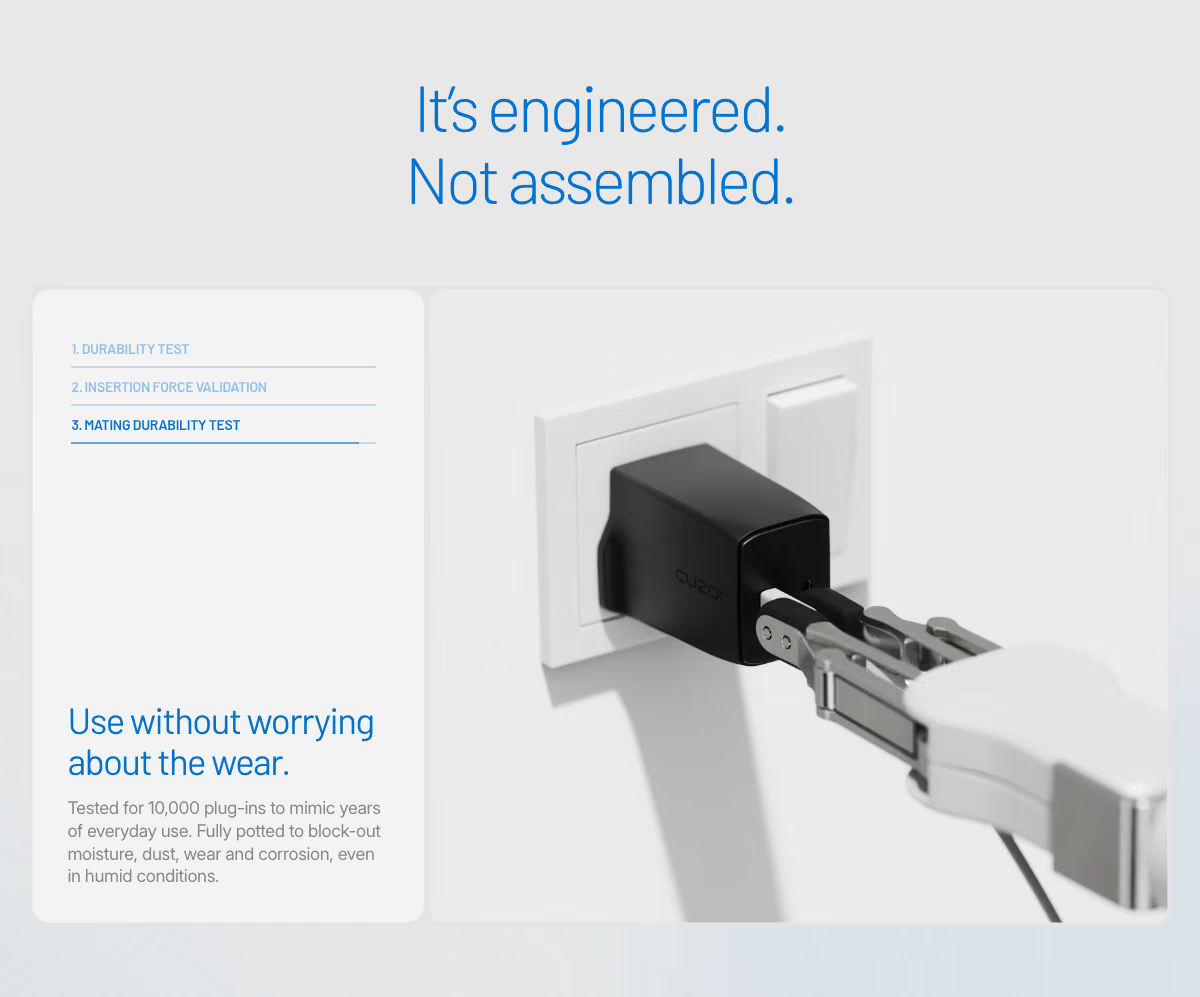
None of these companies sells a connected sensor or gateway. The interoperability and exit questions that decide many IoT deals were not the exact questions they faced. We would say so plainly on a first call.
What does naming need to survive a second hardware generation?
Naming survives a second hardware generation when the company, the device family and the platform are named as separate layers. Any one of the three can change on its own. A name built around the first device reads as a limit once the second one ships.
A device named for its first use case misleads as soon as a customer finds a second use. A platform with no identity of its own gets mistaken for a feature of the device. Our naming work sets those layers early, before purchase orders and integration documents carry the wrong structure.
What does an engagement deliver, and how long does it take?
An IoT brand engagement takes nine to sixteen weeks from kickoff to a finished brand system, at a fixed scope and one price. The price is quoted after a thirty-minute call, and the ranges are on our pricing page.
The work runs in this order:
- Category and positioning, against the platforms, the connectivity providers and the customer's own build option.
- Naming, where the layers need it.
- Narrative and identity.
- Messaging for operations, IT and security, and the budget owner in finance.
- A brand book that records all of it.
The team is nineteen people, ten of them engineers by degree, across strategy, 3D, delivery and build. That includes modelling the device in its real install context, as in our 3D industrial animation work.
We sign an NDA before reviewing unpublished technology, as our normal starting point. Deployment data and device architecture are often the most sensitive material a connected systems company holds. More in branding under NDA.
When is this not a fit?
A fast logo refresh or a single product page is not a fit. A freelance designer or a production studio will do that for less, because it needs no position against the platforms you are compared with. If only the site needs rebuilding, our IoT website work is the narrower option.
If operations and IT cannot both take part, wait. Operations holds the uptime and install evidence. IT holds the security and exit answers that stall deals late.
This suits a company ready to publish real deployment numbers and answer the exit question early. A company that wants a newer glowing globe while the evidence stays unpublished should look elsewhere.
FAQ
How long does an IoT branding engagement take?
Nine to sixteen weeks for positioning, narrative, identity and a brand book, at a fixed scope and one price agreed after an initial call.
Have you branded an IoT or connected systems company before?
No. Turno, Cloudphysician and Cuzor are the closest engagements: fleet battery diagnostics, a tele-ICU platform and consumer charging hardware. None is IoT, and we would tell you exactly where the comparison holds on the first call.
Should we still say IoT?
That is a positioning decision. The term buys instant recognition and carries a decade of stalled pilots with it. The right trade depends on who you are selling to.
What deployment evidence should be public?
Units in the field, years of operation, the support period with an end date, and what happens to devices and data if the relationship ends. The last one is the question most buyers ask internally and few IoT sites answer.
When should an IoT company hire someone else?
When the need is a quick visual refresh or a single page, or when operations and IT cannot both take part in the positioning and evidence decisions.
Written by Mejo Kuriachan. More in the blog, the glossary and the FAQ.