
Strategic branding for deep tech companies (decide before design)
Deep tech brand strategy as four decisions made before design: category, buyer, claim and evidence, in the order that stops a rebrand a year later.

- Deep tech brand strategy is the set of decisions made before design starts: which category you are read into, which buyer the page is written for, and what you claim that a competitor cannot.
- The common deep tech failure is a brand that describes its category accurately and the company not at all.
- Positioning has to be argued from the engineering out. Argued from the market in, the differentiator is the first thing lost.
- Naming and identity come out of these decisions. Choosing a look before the position is choosing the answer before the question.
Strategic branding is everything decided before anyone opens a design tool: which category you are read into, which buyer the page is written for, what you claim, and what evidence makes the claim survive contact with someone qualified to check it. For a deep tech company that last part is the whole job, because your buyer usually is qualified to check it.
What does deep tech brand strategy actually decide?
Deep tech brand strategy decides four things, in this order:
- The category a stranger files you under in the first four seconds. You cannot opt out of this, only influence it.
- The buyer the page is written for. Deep tech almost always has two or three people in the room, and they want opposite things.
- The claim: one sentence a competitor cannot honestly copy.
- The evidence that makes the claim believable to someone who could disprove it.
Everything downstream is an expression of those four: the name, the identity, the site and the film. When a brand feels arbitrary, one of them was usually never settled, and the design was asked to cover the gap.
For what the category looks like right now, and why so many brands in it read the same, see the state of deep tech branding.
Why does generic brand strategy fail on deep tech?
Generic brand strategy fails on deep tech because the brief degrades before it reaches the work. A studio that has not read your documentation writes to the part of the briefing call it understood. That is usually the market framing, and the mechanism gets left out.
What comes back is competent and describes your category correctly. It does not describe your company. Every competitor could run the same page with their logo on it, and several of them effectively do.
The tell is the first line of the homepage. If it could be true of four other companies, the position was never decided.
What has to be settled before anyone designs anything?
The claim and the evidence for it have to be settled first. Design cannot rescue an undecided position; it can only make it look more confident.
In practice, someone has to sit with your engineers and come out with a defensible sentence. "The leading platform for X" does not qualify. The sentence names the specific thing your architecture does that the alternatives cannot, stated so a specialist reads it and agrees.

That sentence is the brand. The rest is how consistently you can hold it. Our positioning work starts there, and a positioning alignment check shows whether your own team agrees on it yet.
How do you position when the category word stopped working?
When the category word stops working, you compete on the mechanism. "AI", "quantum", "sustainable" and "platform" have all been used flat.
Regulators have noticed the same thing about some of them. The UK's Green Claims Code says terms like "green", "sustainable" or "eco-friendly", used without explanation, are likely to be read as a claim about the whole business. A word that broad has to be proven in full, or it carries no information.
So the differentiator has to sit one level down: what your system does that the category implies and does not deliver. That is harder to write and much harder to copy. Two moves work:
- Name the failure mode you remove. Buyers recognise their own pain faster than your advantage.
- Be specific enough to be wrong. A claim that cannot be checked cannot be believed either.

Turno shows the first move on its own site: the result with Turno and without it, side by side.
How does the strategy change from one sector to the next?
The four decisions stay the same across sectors, and the evidence that carries them changes. Each sector guide covers where it sits:
- Cybersecurity buyers discount fear, so cybersecurity brand strategy runs on efficacy numbers with test conditions.
- In AI and ML, the model version loses value at the next release. The AI and ML guide covers what keeps it.
- Aerospace and defence treat every word as a contractual expectation, which is why that guide states readiness exactly.
- A quantum brand has to keep demonstrated results apart from the roadmap, as the quantum guide sets out.
- Biotech claims face a clinician, a regulator and an investor at once. The biotech guide covers claims that hold for all three.
- Energy buyers weigh delivery risk first, so energy infrastructure positioning leads on lead time and installed base.
- Cleantech buyers have read a decade of decarbonisation copy. The cleantech guide builds the brand on measured evidence.
- Telecom vendors are scored on a matrix. The telecom guide covers what the matrix cannot score.
- Component makers win on design-in, which is where the electronics and photonics guide starts.
- Manufacturers are qualified before they are chosen, so the advanced manufacturing guide leads with evidence at volume.
The remaining guides cover robotics, semiconductors, advanced materials, IoT, synthetic biology, XR and Web3 infrastructure.
What does naming have to do in deep tech?
A deep tech name has to be sayable in a procurement meeting, clear a trademark search in your actual markets, and outlast the first product. It does not have to explain the technology. Almost none of the good ones do.
The trademark part is where names fail late. The USPTO says likelihood of confusion is the most common reason it refuses a registration. Before a name is presented, it should be searched in the markets you sell into:
- the WIPO Global Brand Database, which covers international and many national collections
- EUIPO eSearch for the European Union
- the USPTO for the United States, and the national register for every other market on the plan
If you will file abroad, WIPO's Madrid System takes a single international application covering up to 133 countries.
What a name must not do is claim a category position the company has not earned, because the name is the one asset other people repeat for you. Our naming work runs trademark-shaped checks and screening before anyone commits. The formal clearance stays with your counsel.
Who does naming and identity for deep tech companies in India?
We do: Everything Deep Tech is the deep tech vertical of Everything Design, a Bengaluru studio. The work covers naming, identity and the narrative behind them:
- Lumora Security, a cybersecurity company, where naming was in scope alongside the brand, website and film.
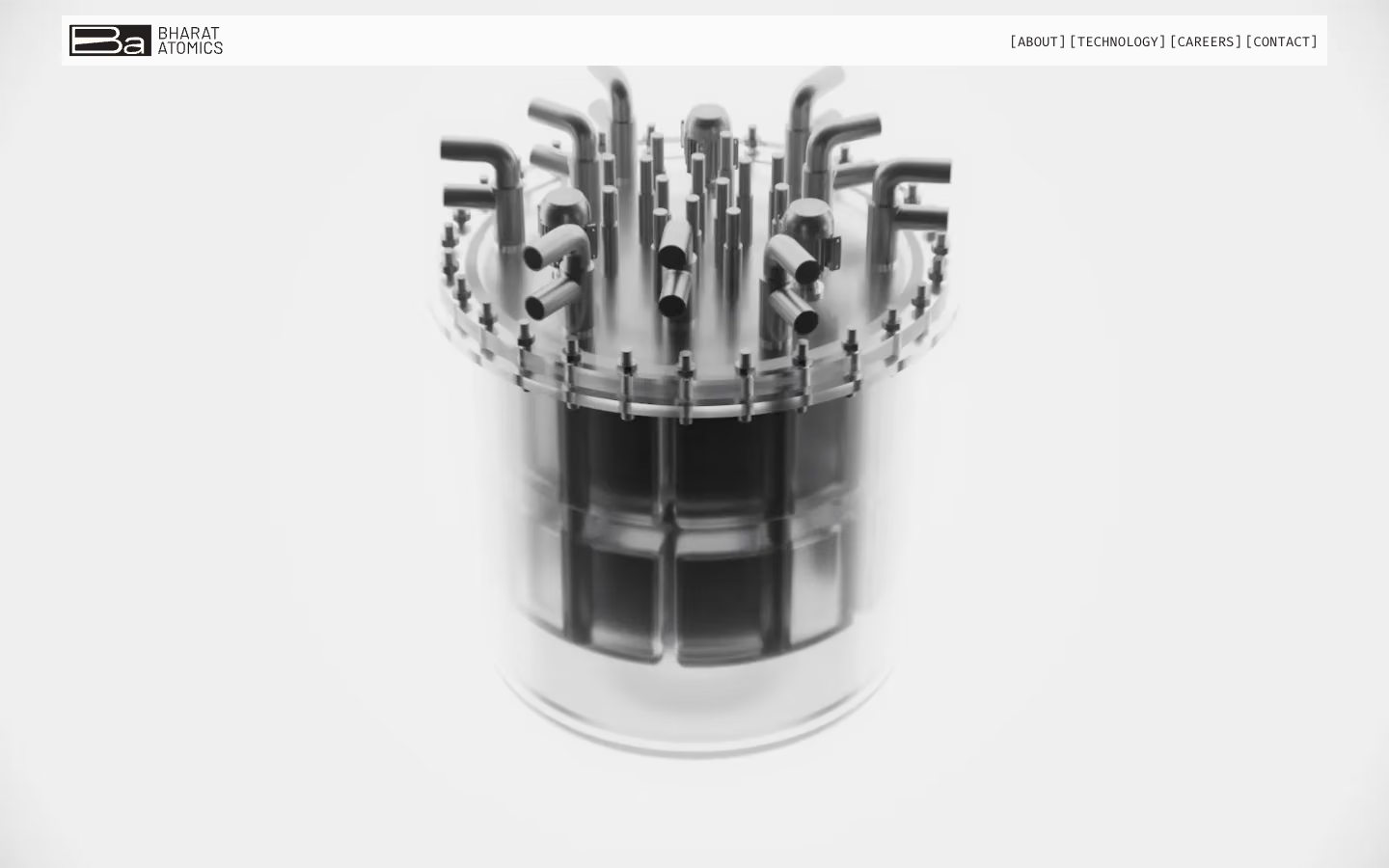
- Bharat Atomics, a nuclear energy company, where we did the branding, logo, brand narrative, website, pitch deck and 3D.
- Transitry, climate measurement, where we did the identity, narrative and website.
- Scimplify, an advanced materials manufacturer, where the visual language is in progress.
The full list is on our customers page. If you are comparing studios, choosing a deep tech branding agency sets out the questions worth asking any of them, us included.
How much evidence belongs in the brand itself?
A deep tech brand needs more evidence than a consumer brand and less than a paper. Your buyers are checking.
The brand's job is to make the evidence findable and legible. That means the number that matters, framed so a non-specialist sees its significance and a specialist recognises it as honest.

The rules point the same way. The FTC's advertising substantiation policy has required a reasonable basis for claims before they are published since 1984. The UK's advertising code carries its own substantiation rules.
Overclaiming here is a sales risk. The engineer who catches one wrong number stops reading the other twelve. Kandou AI shows the alternative: the mechanism drawn as a signal diagram an engineer can check.

When is the right time to do this?
The right time is when the technology is real and the explanation is the bottleneck.
NASA's scale runs through nine technology readiness levels, from research beginning at TRL 1 to flight proven at TRL 9. Brand work at the bottom of that scale is premature, because you will rewrite it when the product finds its shape. Deep tech branding by stage covers what each stage can carry.
After the third enterprise conversation where a qualified buyer misunderstood what you do, it is overdue. The signal is the gap between how good the engineering is and how quickly someone understands it.
If nobody has heard of you, brand strategy is not the first purchase. If people find you, read the page, and still cannot tell what you do or why it is hard, this is exactly what it is for.
What should you expect it to take?
A full deep tech brand system takes nine to sixteen weeks, and most of the risk sits in the first two. The ranges are on our pricing page.
The first two weeks settle the category, buyer, claim and evidence, while changes are still cheap. Once identity and site are in production, revisiting the position costs the production. That order is the difference between a brand that holds and one that gets quietly rewritten a year later. Our rebrand and website timeline breaks the weeks down.
Written by Mejo Kuriachan. More in the blog, the glossary and the FAQ.